Oklahoma City bombing
The fuse was five minutes long. Timothy McVeigh lit it first, then three minutes later -- still a block from the Alfred P. Murrah Federal Building -- lit the two-minute backup. He parked the Ryder truck in a drop-off zone beneath the building's second-floor day care center, locked the door, and walked away. At 9:02 a.m. on April 19, 1995, over 4,800 pounds of ammonium nitrate fertilizer, nitromethane, and diesel fuel detonated on N.W. 5th Street in downtown Oklahoma City. One-third of the nine-story building collapsed. The blast shattered glass in 258 nearby buildings, destroyed or damaged 324 structures within a four-block radius, and registered 3.0 on the Richter scale at seismometers twenty miles away. When the dust settled, 168 people were dead, including 19 children.
Roots of Rage
Timothy McVeigh and Terry Nichols met in 1988 at Fort Benning during Army basic training. McVeigh, a Gulf War veteran, became radicalized by anti-government and white supremacist propaganda, his fury sharpened by two events: the 1992 FBI standoff at Ruby Ridge and the 1993 siege in Waco, Texas, where a botched ATF raid escalated into a fifty-one-day confrontation ending in the deaths of David Koresh and eighty-one Branch Davidian members. McVeigh visited Waco during the standoff and returned after it ended. He decided that bombing a federal building would strike at what he considered the government's command centers. He timed the attack to coincide with the second anniversary of the Waco siege's fiery conclusion -- and, as he noted, with the anniversary of the Battles of Lexington and Concord, the first engagements of the American Revolution.
Building a Bomb in Plain Sight
McVeigh and Nichols bought or stole their materials over months, storing them in rented sheds across Kansas. Nichols purchased forty fifty-pound bags of ammonium nitrate fertilizer from a cooperative in McPherson, Kansas. McVeigh obtained nitromethane -- a racing fuel -- by posing as a motorcycle racer at a drag racing event in Ennis, Texas. They stole blasting caps, shock tube, and high-grade explosives from a quarry near Marion, Kansas. McVeigh arranged the explosive barrels inside a rented Ryder truck in a backward J-shape, reasoning that distributing the weight evenly would prevent the overloaded vehicle from drawing attention. He rigged a dual-fuse ignition system accessible from the cab, threading green cannon fuses through drilled holes and painting the plastic conduit yellow to match the truck's livery. The bomb cost roughly $5,000 to construct. On April 15, 1995, McVeigh rented the truck under the alias Robert D. Kling -- a name he chose partly because it reminded him of Star Trek's Klingon warriors.
Ninety Minutes to Arrest
Within ninety minutes of the explosion, Oklahoma State Trooper Charlie Hanger pulled over a yellow 1977 Mercury Marquis traveling north on Interstate 35 near Perry for having no license plate. The driver was Timothy McVeigh. He was arrested for carrying a concealed weapon. During booking, Hanger searched his patrol car and found a business card McVeigh had concealed after being handcuffed. On the back were the words: "TNT at $5 a stick. Need more." Meanwhile, FBI agents traced the Ryder truck through a vehicle identification number on a surviving axle to a rental agency in Junction City, Kansas. The investigation, codenamed OKBOMB, became the largest criminal case in American history: 28,000 interviews, 7,100 pounds of evidence, nearly one billion pieces of information. McVeigh was convicted and executed by lethal injection on June 11, 2001 -- the first federal execution in thirty-eight years. Nichols received life without parole.
A City Responds, A Nation Changes
By 9:03 a.m., the first of over 1,800 emergency calls flooded the system. Within the hour, 465 members of the Oklahoma National Guard arrived to provide security. FEMA activated eleven Urban Search and Rescue Task Forces, deploying 665 rescue workers. Over 12,000 people participated in relief operations in the days that followed. A photograph of firefighter Chris Fields carrying infant Baylee Almon from the rubble became an enduring symbol of the tragedy, winning the 1996 Pulitzer Prize. The bombing transformed federal security nationwide: Congress passed the Antiterrorism and Effective Death Penalty Act of 1996, the government spent over $600 million upgrading protection at federal buildings, and all new federal construction was required to incorporate blast-resistant design and setback distances. In 2010, Governor Brad Henry signed legislation requiring the bombing to be taught in Oklahoma schools, ensuring that a generation with no memory of the event would learn what happened at 9:02 on a spring morning in Oklahoma City.
From the Air
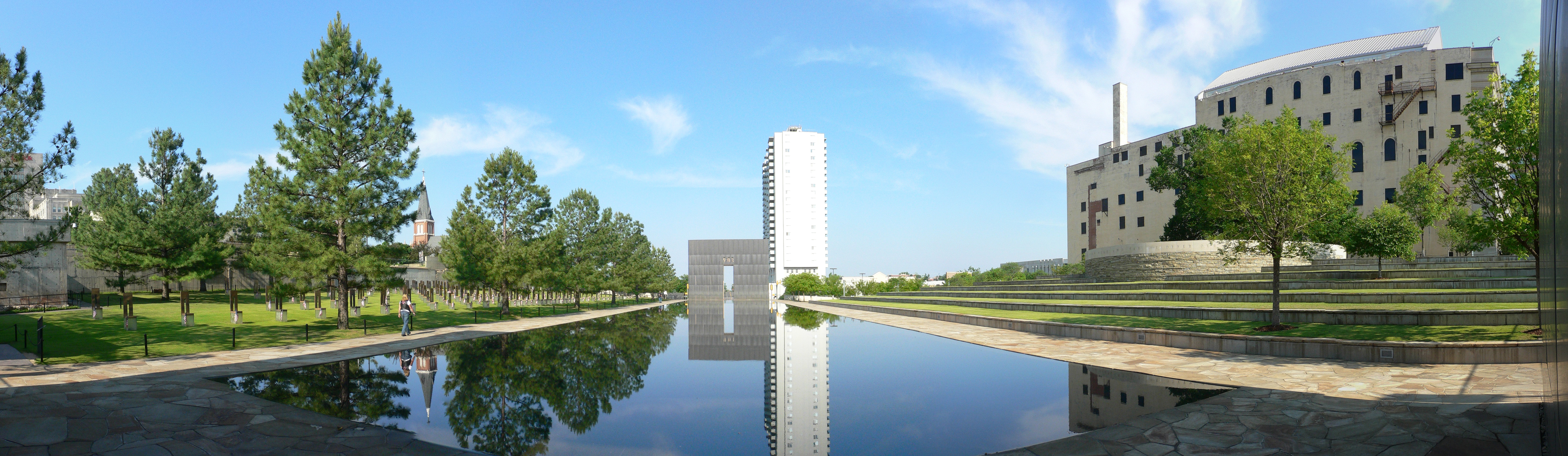
The Oklahoma City National Memorial marking the bombing site sits at 35.47N, 97.52W in downtown Oklahoma City. The memorial's reflecting pool, flanked by two large gates inscribed 9:01 and 9:03, is oriented east-west. The Survivor Tree, a large American elm, stands at the southeast corner. Nearest airports: Wiley Post Airport (KPWA) about 8 miles northwest, Will Rogers World Airport (KOKC) about 10 miles southwest. Downtown Oklahoma City's grid layout is clearly visible from 3,000-5,000 feet AGL. The Oklahoma State Capitol complex with its distinctive oil rigs is visible about a mile to the northeast.