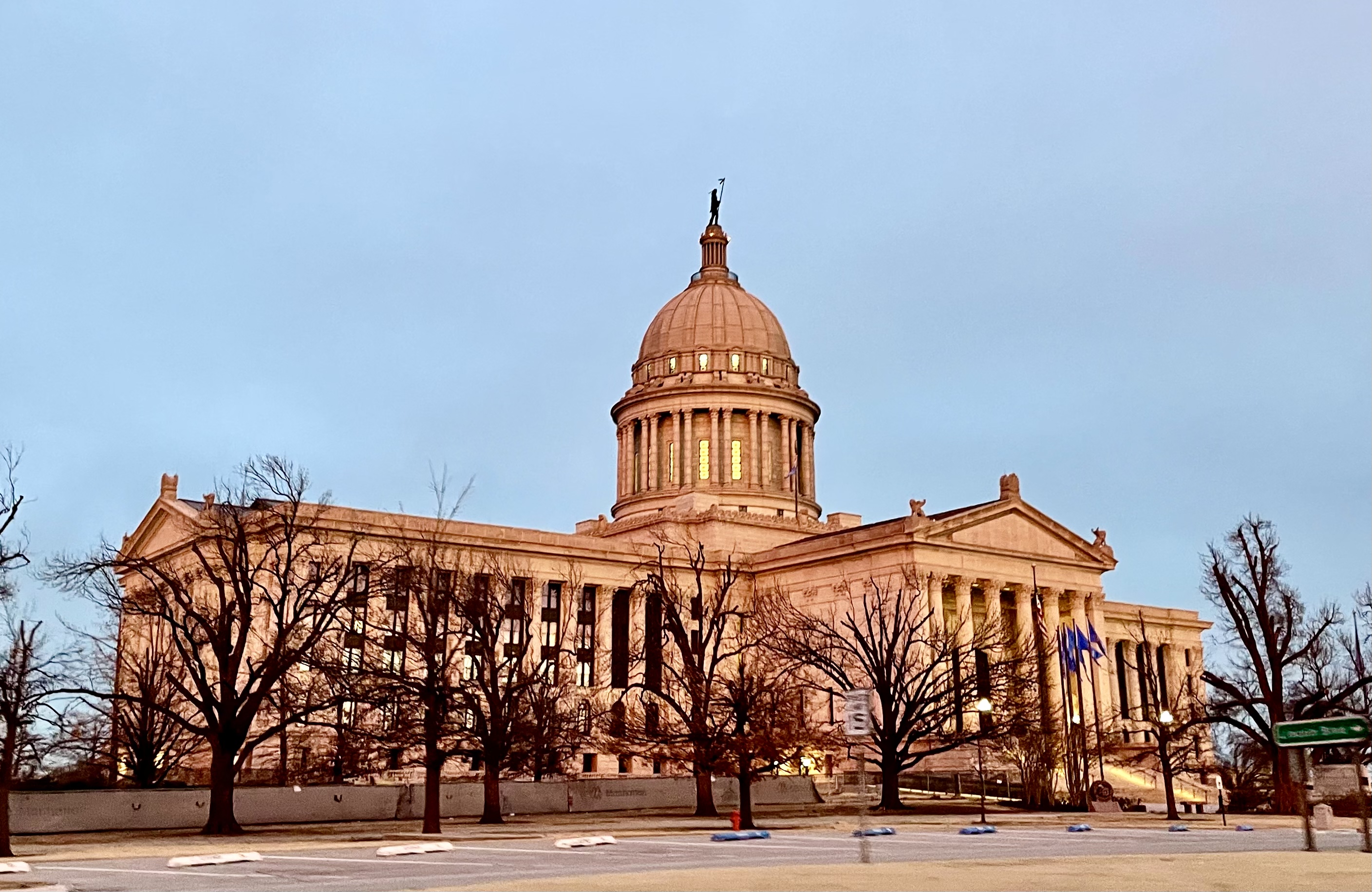
Oklahoma State Capitol
Oil derricks pump on the lawn of the Oklahoma State Capitol. It is the only state capitol complex in the United States with active oil rigs on its grounds, and the building itself sits directly atop the Oklahoma City Oil Field. This improbable pairing -- the machinery of democracy beside the machinery of petroleum extraction -- captures Oklahoma's identity more precisely than any motto or seal. The building at 2300 North Lincoln Boulevard opened in 1917 without its planned dome, a casualty of cost overruns that would not be corrected for eighty-five years.
From Land Run to Limestone
Oklahoma's first capital was Guthrie, settled at noon on April 22, 1889, when cannons sounded the start of the Oklahoma land run. The town served as territorial capital beginning in 1890, but the seat of government moved to Oklahoma City in 1910. Construction on the State Capitol began after a groundbreaking ceremony on July 20, 1914, with architects Soloman Andrew Layton and S. Wemyss-Smith receiving $75,000 to develop the plans. James Stewart & Company won the construction contract. The exterior rises in Indiana limestone over a base of Oklahoma pink granite, while Oklahoma black granite forms the center grand staircase. The interior features marble and fixtures from sources across the country. The building was completed on June 30, 1917, housing all three branches of state government for decades until the high courts moved most operations to the Oklahoma Judicial Center in 2011.
The Dome That Took a Century
The original design called for a dome, but the $1.5 million appropriated by the Oklahoma Legislature proved insufficient by the second year of construction, and the dome was cut. The architects, however, had built foundations strong enough to support one -- a remarkably forward-thinking decision that paid off over a century later. In 1998, state legislators created the Oklahoma Centennial Act, forming a commission to plan upgrades to the capitol complex. The dome was finally completed in 2002, made of steel-reinforced concrete and reinforced plaster casts. Its base is decorated in six-inch gold letters with the names of donors who contributed at least one million dollars to its construction -- a controversial "ring of honor" that drew comparisons to professional football stadiums. Donors named include Halliburton, Hobby Lobby, General Motors, and "the People of Oklahoma." In 2011, state representative Eric Proctor attempted to pass legislation replacing the corporate names with those of Oklahomans who had received the Congressional Medal of Honor.
Art Beneath the Dome
The capitol rotunda displays Chickasaw artist Mike Larsen's mural Flight of Spirit, honoring the Five Moons -- five notable twentieth-century Native American ballerinas from Oklahoma. Several large paintings by Wayne Cooper depicting the state's early heritage and oil history hang throughout the building. Seminole artist Enoch Kelly Haney's painting The Earth and I are One greets visitors on the first floor. The Senate lobby features a large oil-on-canvas painting of the Ceremonial Transfer of the Louisiana Purchase in New Orleans in 1803 by Mike Wimmer. Inside, the west wing houses the Oklahoma House of Representatives, the east wing the Oklahoma Senate, and the governor's ceremonial office occupies the second floor. The building also contains a museum, a cafeteria, and, in a touch of old-fashioned government practicality, a barbershop.
A Capitol Campus
The capitol building anchors a broader complex of government buildings, museums, and tree-lined boulevards. The Oklahoma History Center, opened in 2005 and operated by the Oklahoma Historical Society, preserves the state's story from prehistoric Native American tribes to the present. The Oklahoma Governor's Mansion features a limestone exterior designed to complement the capitol. The Oklahoma Judicial Center, housed in the former Oklahoma Historical Society building, took over most court operations in 2011. The complex sits along a stretch of Lincoln Boulevard that runs through the neighborhood, surrounded by restaurants and bars that give the government district an unexpectedly lively character. And through it all, the oil rigs keep pumping -- a working reminder that in Oklahoma, the wealth beneath the surface has always shaped what is built above it.
From the Air
The Oklahoma State Capitol sits at 35.49N, 97.50W along Lincoln Boulevard in Oklahoma City. The distinctive dome completed in 2002 is the most visible feature, and the oil rigs on the capitol grounds are unique among American state capitols. The Capitol complex includes surrounding government buildings and the Oklahoma History Center. Nearest airports: Wiley Post Airport (KPWA) about 7 miles northwest, Will Rogers World Airport (KOKC) about 12 miles southwest. Best viewed at 2,000-4,000 feet AGL. The capitol grounds are clearly visible in the grid pattern of northeast Oklahoma City.