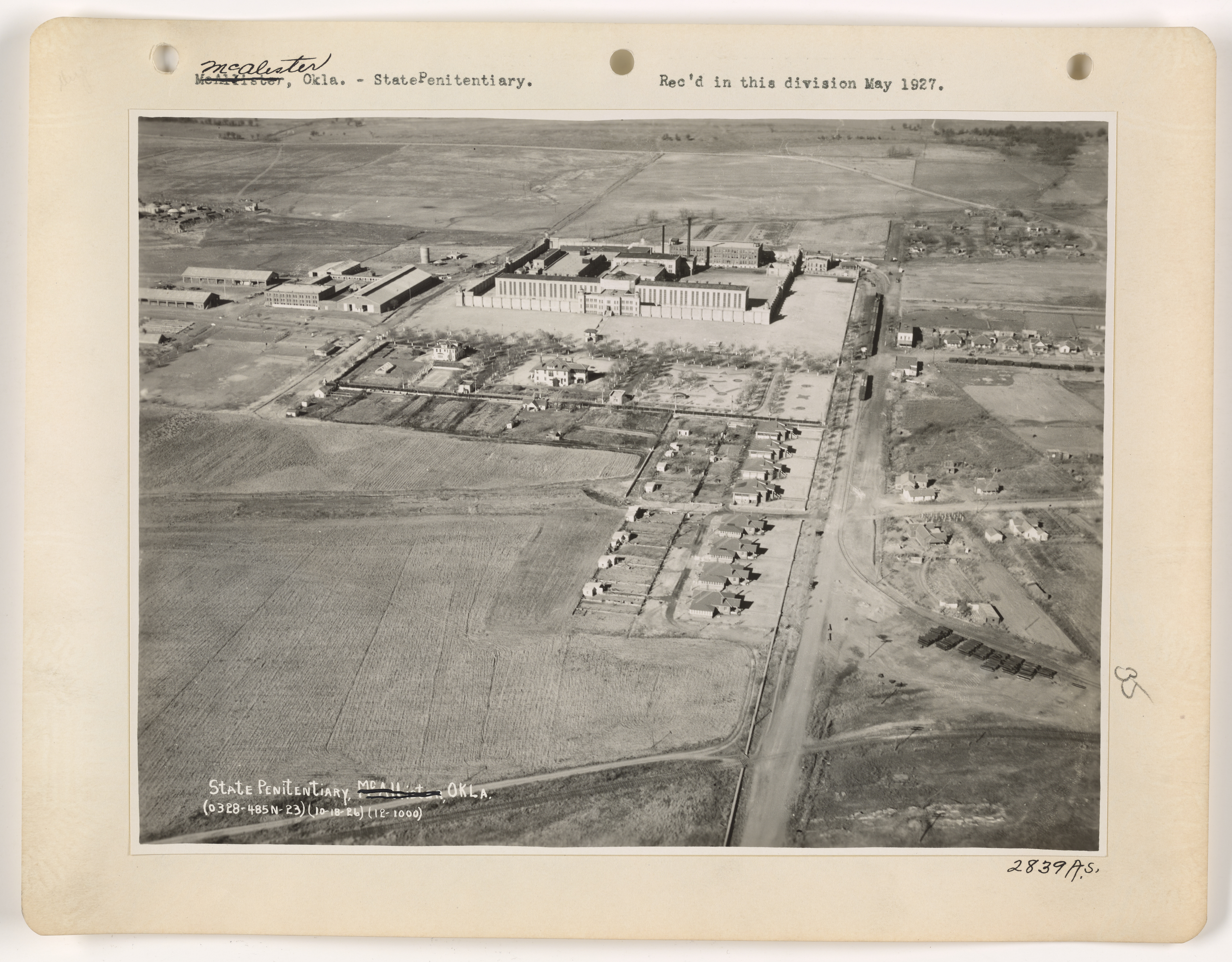
Oklahoma State Penitentiary
Everyone in McAlester, Oklahoma, called it Big Mac. For decades, the nickname carried a double edge -- part grudging local landmark, part dark joke about the maximum-security prison that had dominated the town since 1908. The Oklahoma State Penitentiary arrived that year when a reformer named Kate Barnard visited the Kansas state prison at Lansing, where Oklahoma's inmates had been sent during territorial days, and was horrified to find them forced to work in the mines. Within two months of her report, Governor Charles N. Haskell sent two trainloads of fifty prisoners each to McAlester. Big Mac was born.
From Territorial Lockup to Stone Walls
The prison grew quickly from its makeshift beginnings. The F Cellhouse went up in 1935, and the New Cellhouse followed. A shoe manufacturing plant and tailor shop replaced the mine labor Barnard had banned, giving inmates work that at least produced something beyond broken backs. Female prisoners, also returned from Kansas, initially occupied a ward near the East Gate on the fourth floor of the West Cellhouse. By 1926, the growing female population of twenty-six warranted a separate building west of the main institution. Across the street from the prison walls, the Warden's House still stands as an artifact of the early days, now listed on the National Register of Historic Places. Later additions brought the Talawanda Heights Minimum Security Unit in 1989, a mental health special care unit in 1992, and the notorious H Unit, which houses both death row and Oklahoma's lethal injection chamber.
Three Days of Fire
By 1970, Big Mac had become a pressure cooker. Experts described Oklahoma's prison system as one of the most inefficient, archaic, and corrupt in the country. The State Penitentiary was at 219 percent capacity. Raw sewage backed up into cells. Facilities remained racially segregated. Staff had cut deals with convict bosses, granting them privileges in exchange for managing other prisoners; these bosses sold job assignments, and Black inmates could purchase only menial positions. Between 1970 and July 1973, the facility recorded nineteen violent deaths, forty stabbings, and forty-four serious beatings. A three-day hunger strike in January 1973 drew little attention. Six months later, the prison erupted. The 1973 McAlester Prison Riot led to the landmark case Battle v. Anderson, in which Judge Luther Bohanon found conditions unconstitutional and placed the Department of Corrections under federal control. The last issue in the case, medical care for inmates, was not settled until 2001 -- twenty-seven years after the riot.
Old Sparky and the Long Walk
Between 1915 and 2014, Oklahoma executed 192 men and 3 women at Big Mac. The state employed three methods over that span: hanging, electrocution, and lethal injection. The electric chair, known as Old Sparky, performed eighty-two executions before its last use in 1966. Lethal injection replaced it on September 10, 1990, when Charles Coleman became the first person executed in Oklahoma in twenty-four years. The execution of Clayton Lockett in 2014 drew international attention when a series of complications prompted the governor to order a review of the entire execution process. H Unit, the death row facility, has remained one of the most closely watched prison units in the country, housing inmates whose cases have shaped national debates about capital punishment, wrongful conviction, and clemency.
The Prison Rodeo
For nearly seven decades, Big Mac hosted something no other prison in America could match. Starting in 1940, the Oklahoma State Penitentiary staged a prison rodeo -- a two-day event each August that became a joint venture between the city of McAlester and the Department of Corrections. Cowboys behind bars competed in traditional rodeo events while thousands of spectators packed the arena. The rodeo paused during World War II and again during the 1970s uprising but always returned, becoming as much a McAlester tradition as the prison itself. John Steinbeck immortalized Big Mac in The Grapes of Wrath, and Woody Guthrie sang about it in The Ballad of Tom Joad. The rodeo finally went dark in 2009 due to state budget shortfalls, and despite support from both the warden and the governor, the cost of restoring the deteriorating arena has kept the gates closed ever since.
From the Air
Oklahoma State Penitentiary sits at 34.95N, 95.78W in McAlester, Oklahoma. The prison complex is visible from altitude as a large walled compound on the south side of town. Look for the distinctive rectangular cell blocks and open yard areas. Nearest airport: McAlester Regional Airport (KMLC), about 3 miles south. Best viewed at 3,000-4,000 feet AGL. The surrounding terrain is hilly eastern Oklahoma woodland.