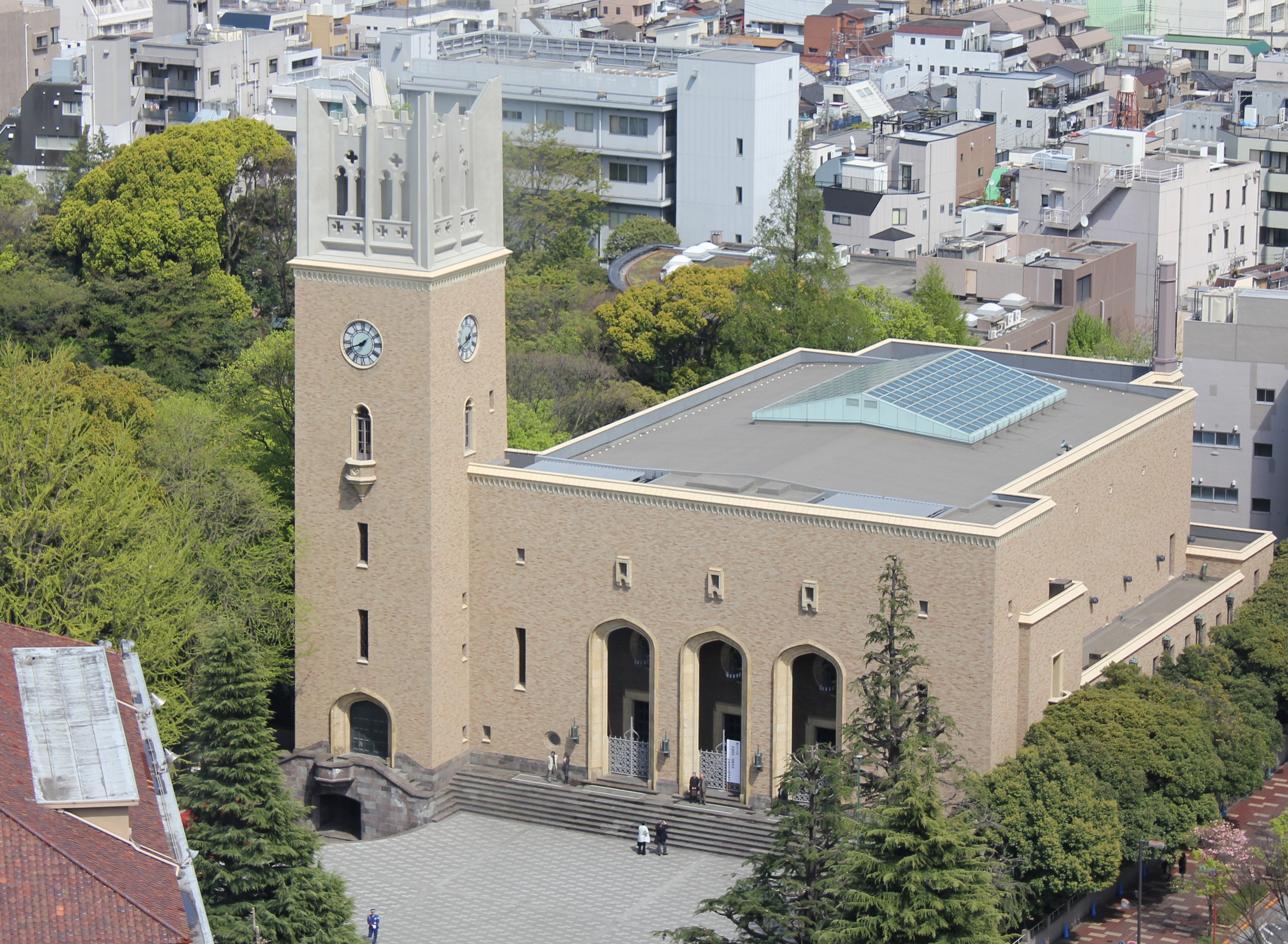
Okuma Auditorium: The Bells That Ring Like Westminster
Six times a day, four bronze bells ring out across the Shinjuku rooftops in a harmony that belongs to London. The bells atop the clock tower of Okuma Auditorium at Waseda University were cast by the MacLean Company in Baltimore, shipped across the Panama Canal to Tokyo, and tuned to produce the same chime sequence heard at the Palace of Westminster. They were the first set of four bells ever used in Japan. When they sound at noon, students crossing the campus below hear Big Ben's melody transposed to a neighborhood in northwest Tokyo, echoing off concrete and tile in a city thirteen time zones from the Thames.
A Memorial Interrupted by Earthquake
On January 10, 1922, Okuma Shigenobu died. He had been Prime Minister of Japan twice and had founded Waseda University in 1882. The university resolved immediately to build a memorial auditorium in his honor -- prior to its construction, ceremonies were held in tents in Waseda's courtyard. In April 1923, the university solicited design proposals and began raising funds toward a target of two million yen. A design was chosen. Then, on September 1, 1923, the Great Kanto earthquake struck, devastating Tokyo and Yokohama. The earthquake's costs, combined with the expense of rebuilding the Waseda University Library, consumed the predicted funds entirely. The memorial was suspended. It would not resume until 1925, when university president Sanae Takada commissioned three architects from Waseda's own Department of Architecture -- Koichi Sato, Takeo Sato, and the renowned structural engineer Tachu Naito -- to create a Gothic design. Construction began on February 11, 1926, carried out by the TODA Corporation, and the auditorium opened on October 20, 1927.
A Tower Measured in Lifetimes
The seven-story clock tower that rises to the left of the auditorium stands exactly 125 shaku tall -- approximately 38 meters. The measurement is not arbitrary. Okuma Shigenobu famously advocated a theory of human longevity he called 'life of 125 years,' arguing that with proper health and discipline, the human body could endure for more than a century. The tower's height encodes that conviction in stone and mortar. The auditorium itself seats 1,123 people across three floors, with a smaller hall of 301 seats in the basement. The Tudor Gothic design draws from international influences: Ragnar Ostberg's Stockholm City Hall, completed in 1923, is considered a primary inspiration. Observers have also noted resemblances to Kronborg Castle in Denmark, Carfax Tower in Oxford, and Magdalen Tower at Magdalen College. And the oval-shaped transom windows on the roof represent the Sun, Moon, and nine traditional planets of the Solar System -- symbolizing what the designers called 'the harmony of the universe.'
Where Presidents Have Spoken
The auditorium's stage has hosted figures that reflect Japan's place in the world across the decades. In 1946, a retirement ceremony was held for Katsuichi Kasagiyama, a Waseda graduate and sekiwake-ranked sumo wrestler -- a distinctly Japanese occasion. Then the world leaders arrived. United States President Bill Clinton spoke here on July 7, 1993. Chinese General Secretary Jiang Zemin addressed the hall on November 28, 1998. Japanese Prime Minister Junichiro Koizumi took the podium on April 15, 2002, and Chinese General Secretary Hu Jintao followed on May 8, 2008. Each year, Waseda's undergraduate and graduate schools fill the auditorium for entrance and graduation ceremonies. On days when the university is not using the space, student clubs stage plays, lectures, and events. The auditorium remains what it was built to be: a gathering place.
Designation and Restoration
In April 1999, the auditorium became the first building designated under the Tokyo Metropolitan Landscape Regulations as a Tokyo Metropolitan Historic Building -- a recognition of its significance to the city's architectural heritage. Between 2006 and 2007, the entire structure was renovated to celebrate Waseda's 125th anniversary, a number that echoed Okuma's longevity theory once more. The restoration was completed on October 2, 2007, and two months later, on December 4, the Japanese Agency for Cultural Affairs designated the auditorium as an Important Cultural Property of the Showa period. Today the building stands as it did in 1927 -- Tudor Gothic stonework, Westminster chimes, a clock tower whose height argues that human life should be longer than it is, and transom windows shaped like the orbits of planets.
From the Air
Located at 35.709°N, 139.722°E on the Waseda University campus in Shinjuku, Tokyo. The seven-story clock tower (approximately 38 meters) is the most identifiable feature from the air, rising above the surrounding low-rise campus buildings. Best viewed at 2,000-3,000 feet AGL. The campus sits along the Kanda River in northwest Shinjuku. Tokyo Haneda Airport (RJTT) is approximately 12 nautical miles to the south-southeast. The clock tower is not easily distinguished from surrounding Shinjuku high-rises at higher altitudes but becomes prominent below 3,000 feet.