Okunoin: Japan's Largest Cemetery and a Monk Who Never Died
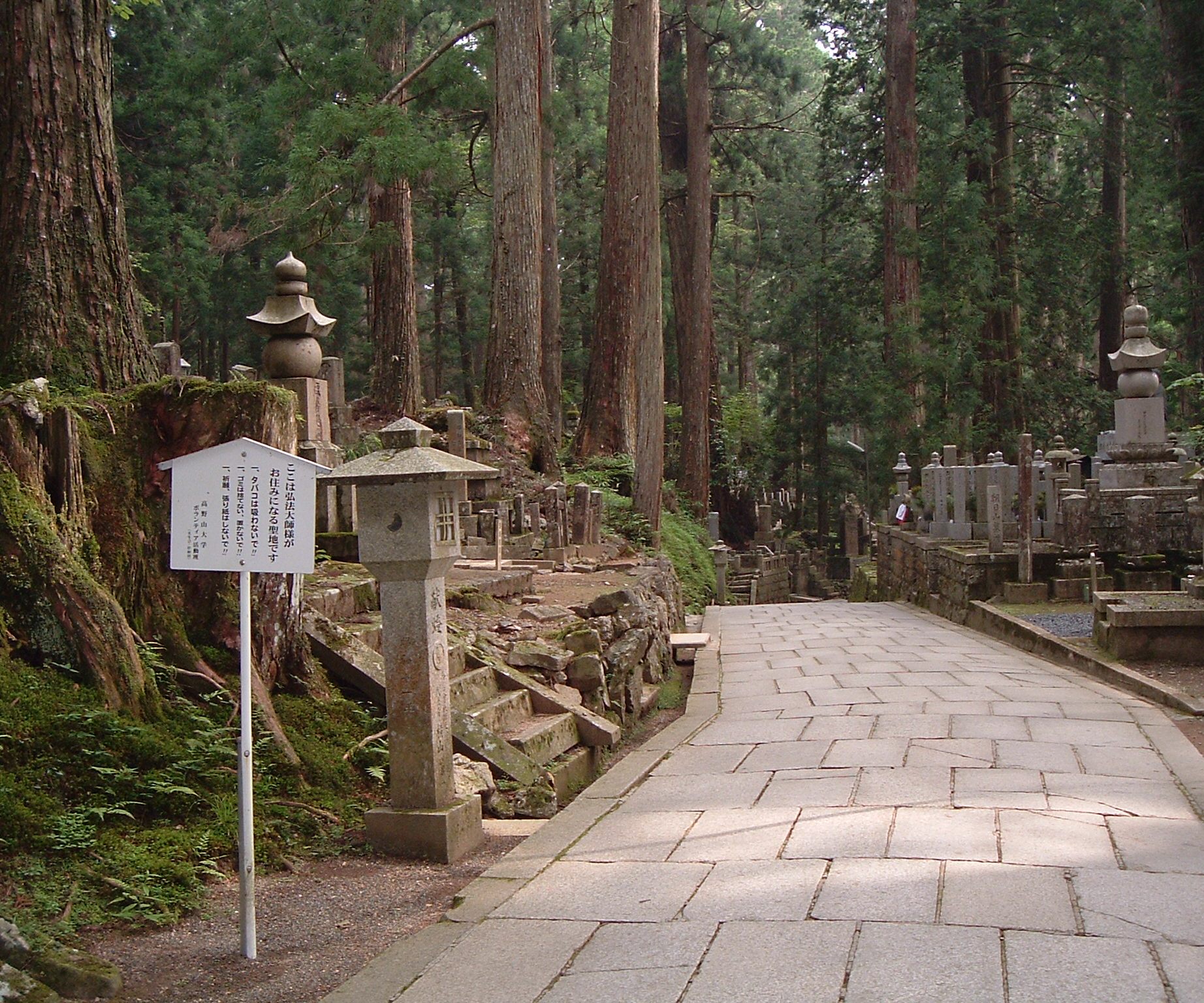
Two meals a day, every day, since the year 835. That is the obligation Buddhist monks on Mount Koya have maintained at the Gobyō, the mausoleum where Kukai -- founder of Shingon Buddhism -- is believed to rest not in death but in eternal samadhi, a meditative trance from which he will emerge only when Maitreya, the future Buddha, appears. The path to his resting place passes through Okunoin, the largest cemetery in Japan: more than 200,000 graves spread over two kilometers of forest, shaded by cryptomeria and cypress trees whose earliest planting records date to 1012 AD. Feudal lords and anonymous pilgrims, corporate memorials and children's statues, all stand together in a landscape where the distinction between the living, the dead, and the still-meditating has been blurred for nearly twelve centuries.
A Forest Older Than Memory
The cemetery occupies the outskirts of the temple town of Koya, stretching through a forest of towering conifers that belong predominantly to the genera Cryptomeria and Chamaecyparis. These are not ornamental plantings. Many of these trees are ancient -- documentary records of planting at Okunoin go back to 1012 AD, and the forest that surrounds Kukai's mausoleum was originally left in its natural wild state. Much of that primeval growth was cut during the Meiji era in the late 19th century, but the remaining old-growth stands create a cathedral-like atmosphere: massive trunks rise straight into a canopy that filters sunlight into pale green shafts, and moss blankets every horizontal surface -- gravestones, pathways, and the hundreds of stone Jizo statues that stand draped in hand-sewn red bibs, guardians of children and travelers.
Samurai, Corporations, and Termites
Okunoin is democratic in its acceptance of the dead. Walk the main sandō path and you pass graves of the Shimazu clan warlords, memorials to fallen samurai, and tombs of pilgrims who traveled across Japan to be buried near Kukai. But the cemetery is not frozen in the feudal past. Japanese corporations began erecting memorial stones here in the modern era -- a practice documented by the New York Times as far back as 1993 under the headline "For Japan Inc., Company Rosters That Never Die." Among the more unusual monuments: the aerospace manufacturer ShinMaywa placed a grave marker featuring an Apollo 11 rocket, and the Japan Termite Control Association erected a memorial to the termites destroyed in the course of their work. The juxtaposition is surreal -- thousand-year-old moss-covered tombs standing beside polished corporate granite -- but at Okunoin, all of it belongs.
The Hall That Never Goes Dark
The sandō path ends at the Tōrō-dō, the Hall of Lamps, the main hall of worship built directly before Kukai's Gobyō mausoleum. Inside, over ten thousand lanterns donated by pilgrims and worshippers burn in perpetuity. Two of these flames are legendary: they are said to have been kept alight without interruption for more than 900 years. The sheer density of flickering light inside the hall creates an effect that photographs cannot capture -- a warm, shifting glow that fills the space with something between reverence and wonder. Before reaching the Tōrō-dō, visitors cross a bridge that marks the entrance to the inner sanctum, where they pour water over bronze statues to pray for the souls of their ancestors. Beyond the hall, Kukai's mausoleum stands closed to visitors. Photography is forbidden in the inner precinct. The silence is absolute.
The Path After Dark
Okunoin transforms at night. The main path through the cemetery is illuminated, and the experience of walking beneath towering cryptomeria in the dark, passing thousands of graves lit only by stone lanterns and low electric lights, is unlike anything else in Japan. The Jizo statues take on a different character in the half-light -- their red bibs glow faintly, their stone faces seem watchful rather than serene. Night visits are not a special event but a common practice: the cemetery is open around the clock, and many visitors specifically choose to walk Okunoin after sunset. The darkness amplifies the forest sounds -- wind through branches, distant temple bells -- and strips away the visual distractions of daytime tourism. What remains is the path, the trees, the dead, and the quiet certainty that at the end of the walk, monks have already prepared tomorrow's meal for a man they will never stop serving.
From the Air
Located at 34.22N, 135.61E on the eastern edge of the Mount Koya plateau in the Kii Mountains, Wakayama Prefecture. From altitude, Okunoin is not easily distinguished as a cemetery -- it reads as dense forest cover on the mountain slope, distinct from the temple rooftops of the Koya town center to the west. The two-kilometer path runs roughly east through the forest canopy. Best viewed at 3,000-4,000 feet AGL as part of the broader Mount Koya complex. Kansai International Airport (RJBB) lies approximately 40 nm northwest. Osaka Itami Airport (RJOO) is roughly 45 nm north. Nanki-Shirahama Airport (RJBD) sits about 35 nm south. Morning fog is common in the mountain valleys.