Old Aker Church
Beneath the limestone floor of Old Aker Church lies an ancient silver mine. The Akerberg mines were active since the early Viking Age, mentioned in the 1170 Historia Norvegiae, and the wealth they once yielded spawned centuries of local legend about hidden treasure and even dragons lurking in the tunnels below. Above those mines, around 1080, King Olav Kyrre raised a Romanesque basilica that still stands today as the oldest building in Oslo. Nearly a thousand years of fire, war, and quiet devotion have passed through its doors, but the church on Telthusbakken hill endures, its thick stone walls a rebuke to everything that has tried to bring it down.
A Church Built on Silver and Legends
Olav Kyrre chose this hilltop in the St. Hanshaugen borough for reasons both spiritual and practical. The site had likely served as a regional thing, a Viking-era assembly ground where disputes were settled and laws proclaimed. Building a Christian church on pagan ground was a deliberate act of conversion, and the king intended his three-naved basilica to serve all of Vingulmark, the historic region surrounding what would become Oslo. The limestone walls rose thick and plain in the Romanesque style, built to last centuries rather than to impress with ornamentation. They have done exactly that. The surrounding churchyard dates to the 12th century, and the graves of astronomers, statesmen, architects, and industrialists have accumulated in the soil around the church ever since.
Trial by Fire and Lightning
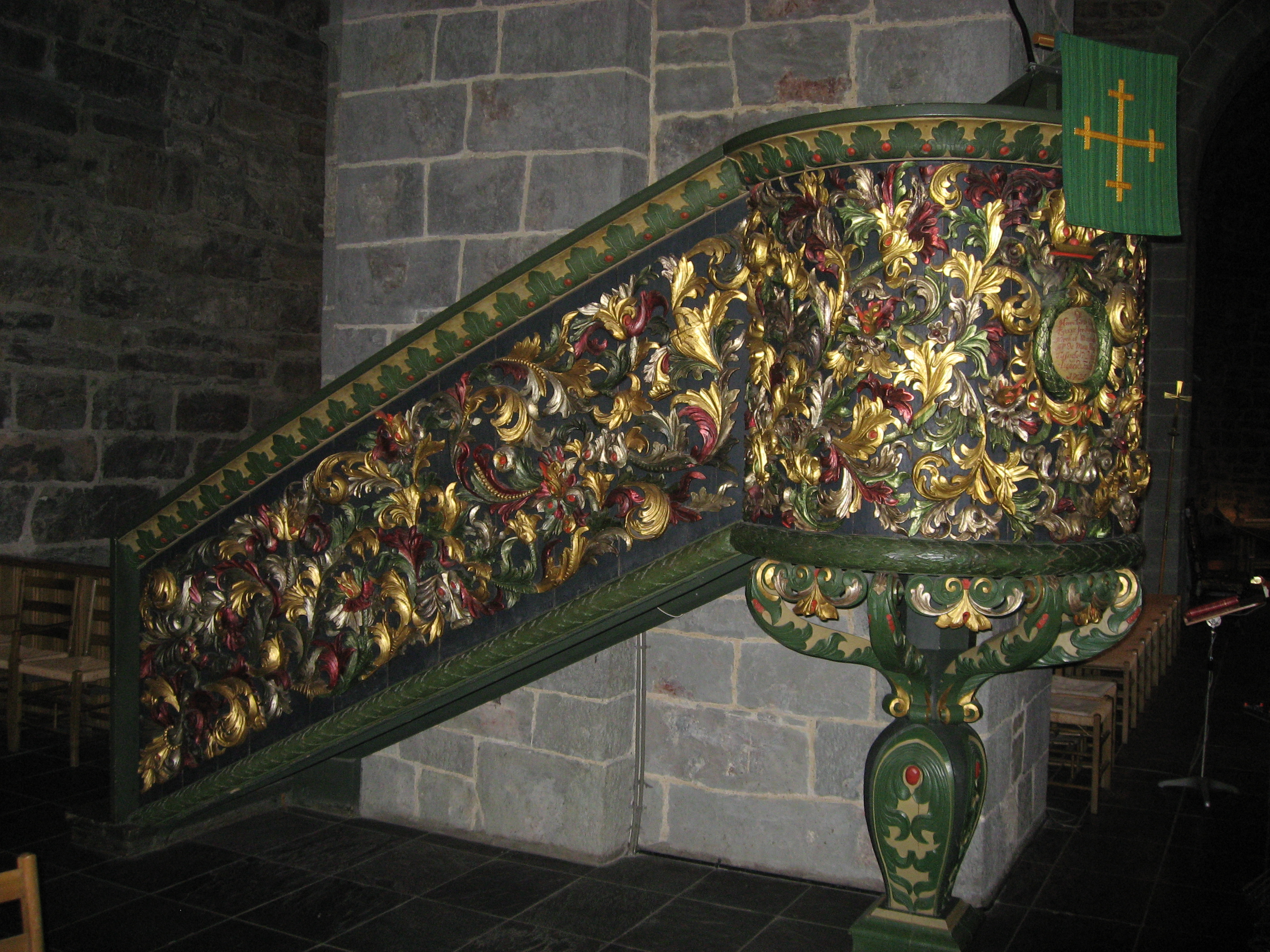
Old Aker Church has survived what would have destroyed lesser structures. It was pillaged and damaged by fire multiple times over the centuries, but the worst blow came in 1703, when a lightning strike ignited a fire that destroyed the tower, the church bells, and the entire interior inventory. For more than 150 years, the church carried the scars. In 1861, architects Heinrich Ernst Schirmer and Wilhelm von Hanno restored the exterior and added a new tower, the one that still defines the church's silhouette against the Oslo skyline. A century later, between 1950 and 1955, restorers stripped away accumulated plaster to reveal the original brick walls beneath, and the Baroque pulpit and baptismal font from 1715 were carefully returned to their intended prominence. Each restoration peeled back a layer of improvisation to find something older and more honest underneath.
The Queen in the Crypt
The most remarkable chapter in the church's long history unfolded in secret. When Nazi Germany invaded Norway in April 1940, King Haakon VII and his family fled to England aboard a British cruiser, uncertain whether they would ever return. Left behind in Oslo was the coffin of the king's wife, Queen Maud, who had died unexpectedly in London in 1938. On April 19, 1940, Bishop Eivind Berggrav and Hofmarschall Peter Broch orchestrated a clandestine operation: they moved the queen's coffin to Old Aker Church and concealed it in a hidden tomb within the crypt. There it remained, undiscovered by the German occupiers, for nine years. Only in 1949, four years after liberation, were Queen Maud's remains finally retrieved and interred in the Royal Mausoleum at Akershus Castle. The church that had guarded silver in the Viking Age had guarded a queen in the modern one.
The Living Churchyard
Old Aker Cemetery wraps around the church like a stone garden, its headstones tracing the intellectual and commercial history of Norway. Christopher Hansteen, the astronomer who mapped Earth's magnetic field, lies here alongside Hans Nielsen Hauge, the lay preacher whose revival movement reshaped Norwegian Christianity in the early 19th century. Henriette Wegner, a co-owner of Hamburg's Berenberg Bank, shares the ground with statesmen and architects. Adjacent to the medieval burial ground stands the newer Cemetery of Our Saviour, established in 1808, extending the community of the dead outward from the church that first gathered them. The parish remains active, its congregation assembling each week in the same nave where worshippers have gathered since the age of Viking assemblies and silver mines.
From the Air
Located at 59.92N, 10.75E in central Oslo's St. Hanshaugen borough, atop Telthusbakken hill. The church's stone tower is visible from lower altitudes amid surrounding 1880s-era buildings. Nearest major airport is Oslo Gardermoen (ENGM), approximately 40 km northeast. Oslo Fornebu (former airport, now redeveloped) was the historical nearest field. Best viewed at 2,000-3,000 ft AGL on approach from the Oslofjord.