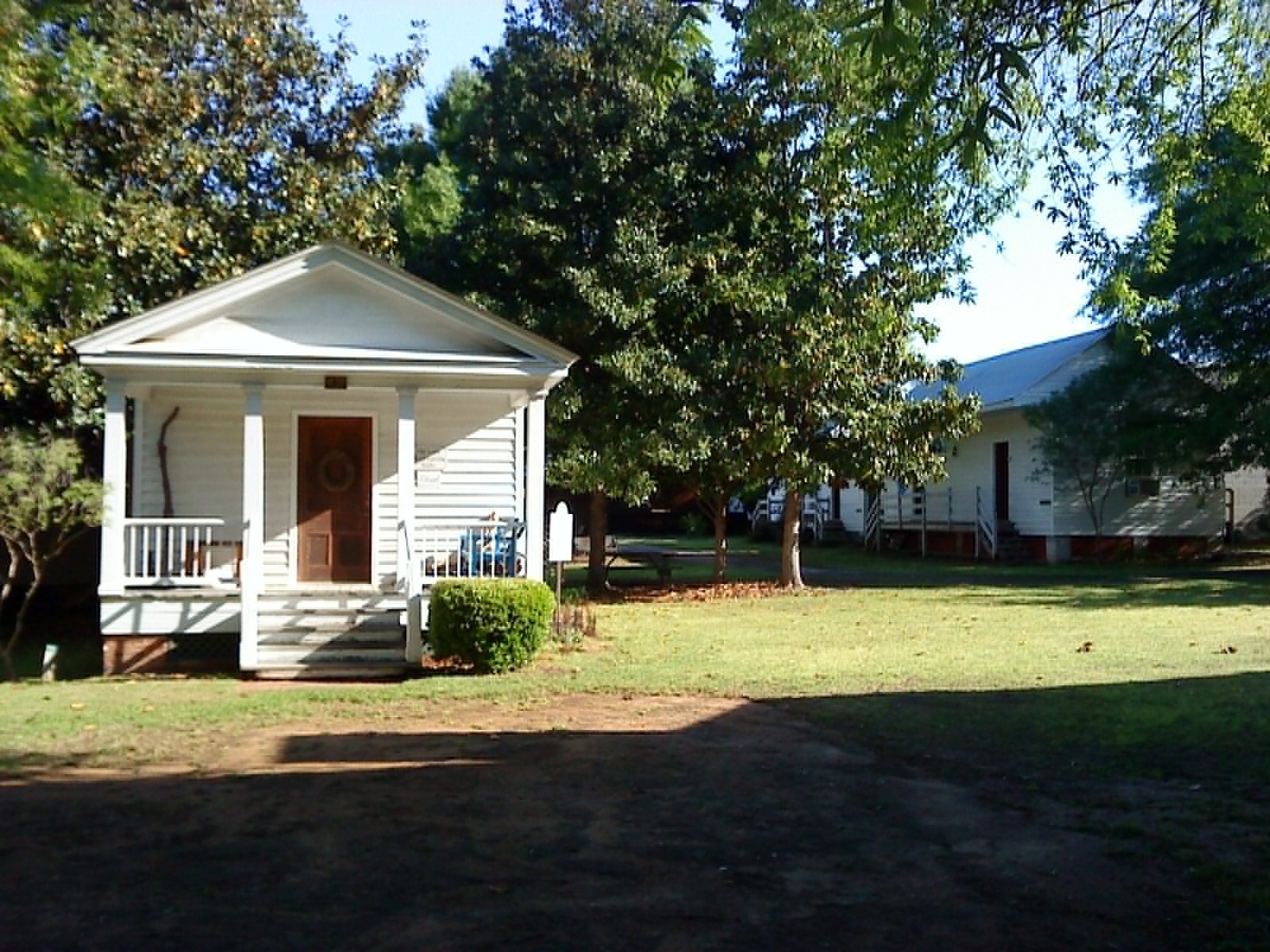
Old Alabama Town
In 1825, the Marquis de Lafayette -- aging hero of the American Revolution on a farewell tour of the nation he helped create -- spent the night at Lucas Tavern on the Federal Road through Creek territory. Nearly two centuries later, that same tavern serves as the visitors' center for Old Alabama Town in downtown Montgomery, the oldest surviving building in Montgomery County. It arrived here in 1978, relocated from the settlement of Waugh along Line Creek, joining a growing collection of structures that the Landmarks Foundation of Montgomery had been rescuing from demolition since 1967. Today more than fifty restored buildings line six blocks of North Hull Street, each one a chapter from central Alabama's past that somebody refused to let disappear.
A Townhouse with Fourteen-Foot Ceilings
The anchor of Old Alabama Town is the Ordeman-Shaw House at 230 North Hull Street, an Italianate townhouse built on its original site by architect Charles Ordeman in 1852-1853. Its bracketed overhanging roof cornice and asymmetric door placement marked it as fashionable for the era. Inside, fourteen-foot ceilings on the top two floors combine with tall windows to create natural air circulation -- nineteenth-century Alabama's answer to the brutal Southern summer. The Landmarks Foundation purchased the house and its dependencies in 1968, and the three-year restoration that followed became the cornerstone of everything Old Alabama Town would become. It opened for public tours in 1971, the first building in what would grow into an entire neighborhood of rescued architecture.
The Working Block and the Living Block
Old Alabama Town divides into distinct sections that reconstruct different facets of daily life. The Working Block, entered through the 1840s Rose-Morris House, recreates nineteenth-century workplaces: a cotton gin, a blacksmith's shop, a print shop, and a grist mill. These are not reproductions but original buildings, most relocated from sites across central Alabama where they faced destruction. The Living Block, introduced by Lucas Tavern, gathers the institutions of community life: a schoolhouse, a doctor's office, a church, and a carriage house. Together they paint a picture of a world where commerce and community operated at arm's length, where the sounds of the gin and the anvil drifted toward the church steeple and the schoolyard.
North Hull Street's Architectural Parade
The residential buildings lining North Hull Street display architectural styles spanning decades of Alabama history, from modest pioneer dwellings to the grandeur of the Thompson Mansion, an 1850 Greek Revival house originally built in Tuskegee and relocated to Old Alabama Town by 1990. The Foundation has acquired and restored more than fifty structures over its decades of work. Most were moved from endangered sites around central Alabama; a few, like the Ordeman-Shaw House, stand on their original ground. The variety is the point: an elegant townhouse shares the same street with a rural cabin, a grocery store faces a church. The buildings represent not one version of Alabama's past but the full cross-section -- the people who built, worked, worshipped, and traded in a state whose history defies simple summary.
Preservation as Civic Memory
When the Montgomery City Commission established the Landmarks Foundation as a nonprofit in 1967, Alabama's historic structures were vanishing under the pressure of urban renewal and neglect. The Foundation's approach was practical: buy endangered buildings, move them if necessary, restore them with period accuracy, and open them to the public. More than half a century later, the result is a walkable neighborhood where every structure is authentic and every restoration tells a story of something almost lost. Old Alabama Town sits in the heart of a city already dense with history -- the State Capitol where Jefferson Davis took his oath, the church where Martin Luther King Jr. preached, the corner where Rosa Parks refused to stand. Among these landmarks of national drama, Old Alabama Town preserves the quieter history: the daily life of ordinary people in a place that shaped America.
From the Air
Located at 32.38N, 86.30W in the heart of downtown Montgomery, Alabama along North Hull Street. The six-block historic district sits just north of the Alabama State Capitol and is within walking distance of other major Montgomery landmarks. Montgomery Regional Airport (KMGM) is approximately 7 miles southwest. From altitude, the North Hull Street corridor is visible in downtown Montgomery's grid, near the bend of the Alabama River. The low-rise historic structures contrast with surrounding modern development.
Sources
- Old Alabama Town - Wikipedia
- Old Alabama Town - Encyclopedia of Alabama
- Lucas Tavern Historical Marker
- Tour Old Alabama Town - Ordeman-Shaw House
- Old Alabama Town - Encyclopedia of Alabama
- Lafayette's Visit to Alabama - Encyclopedia of Alabama
- Thompson Mansion - Tour Old Alabama Town
- Lucas Tavern Historical Marker - HMDB