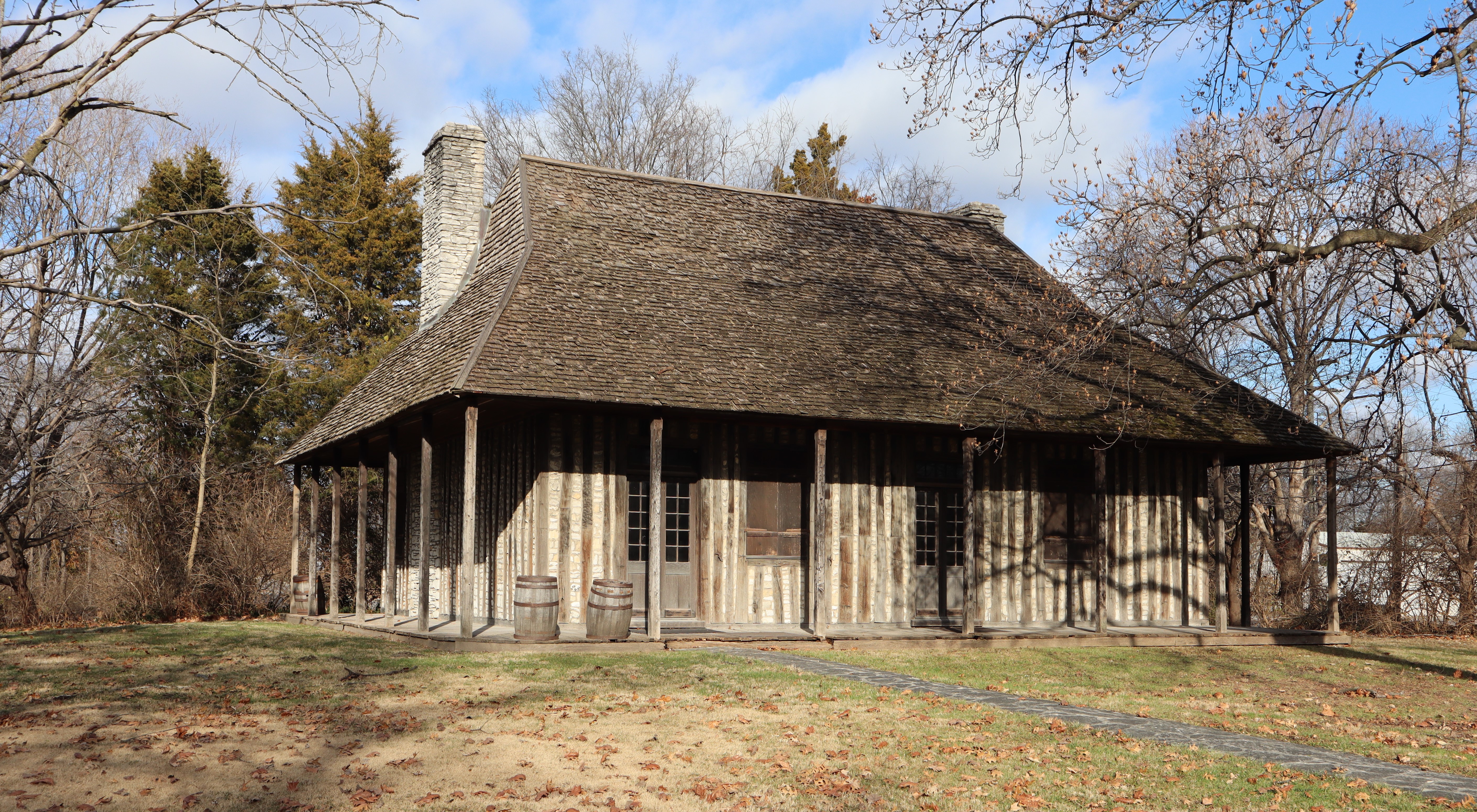
Old Cahokia Courthouse
How many times can you take a building apart and put it back together before it becomes a different building? The Cahokia Courthouse has been dismantled and reconstructed three times since 1904. First it was carried across the Mississippi to St. Louis for the World's Fair. Then it was shipped to Chicago's Jackson Park. Finally, Cahokia residents -- furious that their oldest building had been moved to the opposite end of the state -- lobbied to bring it home. By the time it returned in the 1920s, very little of the original 1740 timber remained. The state of Illinois says the rebuilt courthouse 'contains some pieces' of the original structure. It is the most honest kind of historic preservation: a building that admits it is mostly a replica while insisting that the story it tells is entirely real.
Logs Standing Upright
The building traces its ancestry to a French-Canadian log cabin built around 1740, in a region the French had claimed following the explorations of Marquette, Jolliet, and La Salle in the 1670s. The Mississippi Valley south of the Missouri River offered exceptionally fertile alluvial soil, and the local Illiniwek people were friendly to the newcomers. French-speaking immigrants, mostly from Canada, settled villages like Kaskaskia, Prairie du Rocher, and Cahokia, often naming their communities after the Native American tribes who lived nearby. The unknown builder of the courthouse used a distinctly French colonial technique: logs raised vertically rather than laid horizontally as English-speaking frontiersmen did farther east. This construction style is called poteaux-sur-sol -- posts on sill -- with upright timbers grounded in a foundation sill to retard rot.
Frontier Justice in Four Rooms
After the American Revolution and the 1783 Treaty of Paris transferred the east bank of the Mississippi from Great Britain to the United States, frontiersmen organized St. Clair County on April 27, 1790 -- the first county in the Illinois region of the Northwest Territory. They needed a courthouse, and the 1740 cabin, an unusually well-built structure, was promoted to the job. Territorial law books describe what happened inside: land titles and transfers were registered, licenses for taverns and ferryboats were issued, criminal cases were heard, and votes were counted. The four-room building served as the legal and administrative heart of the entire county until population growth made it obsolete. The federal government opened its first Illinois land office in Kaskaskia in 1804, and settlers poured in faster than the tiny courthouse could serve them.
Three Lives of One Building
By 1904, the courthouse had become one of the oldest surviving buildings in Illinois, and promoters for the St. Louis World's Fair bought it, dismantled it, and hauled the surviving posts across the river as a fair attraction. When the fair ended, the cabin was dismantled again and rebuilt in Jackson Park in Chicago in 1906. Each round of disassembly and reconstruction replaced more of the original wood with new timbers. Cahokia residents, watching their heritage languish 300 miles away, successfully lobbied in the 1920s for a third reconstruction on the original site. The state acknowledged that the rebuilt structure was mostly new material. It is a genuine Ship of Theseus -- a philosophical puzzle made physical, standing on its original plot of land.
Standing Still at Last
Since 1985, the reconstructed Cahokia Courthouse has been managed by the Illinois Historic Preservation Agency. It is interpreted to resemble its appearance around 1800, when it served as a frontier courthouse of the Northwest Territory. Exhibits focus on the legal cases that once filled these rooms and the remarkable physical journey the building has taken over three centuries. A visitor center features displays about the French colonial occupation of the American Bottom in the 18th century and the nearby Nicholas Jarrot Mansion. The courthouse was listed on the National Register of Historic Places in 1972. It sits quietly now in Cahokia Heights, Illinois, on the same ground where French settlers first raised its logs vertically nearly three hundred years ago -- a building that has traveled more than most people and is finally, permanently, home.
From the Air
Located at 38.571°N, 90.192°W in Cahokia Heights, Illinois, on the east bank of the Mississippi River directly across from downtown St. Louis. The site is modest from altitude -- a small reconstructed log structure in a residential area. Best identified by proximity to the Gateway Arch (5 nm NW) and KCPS (St. Louis Downtown Airport, 2 nm south). The American Bottom floodplain is visible below as flat agricultural land along the river. Nearest airports: KCPS (2 nm S), KSTL (St. Louis Lambert International, 15 nm NW).