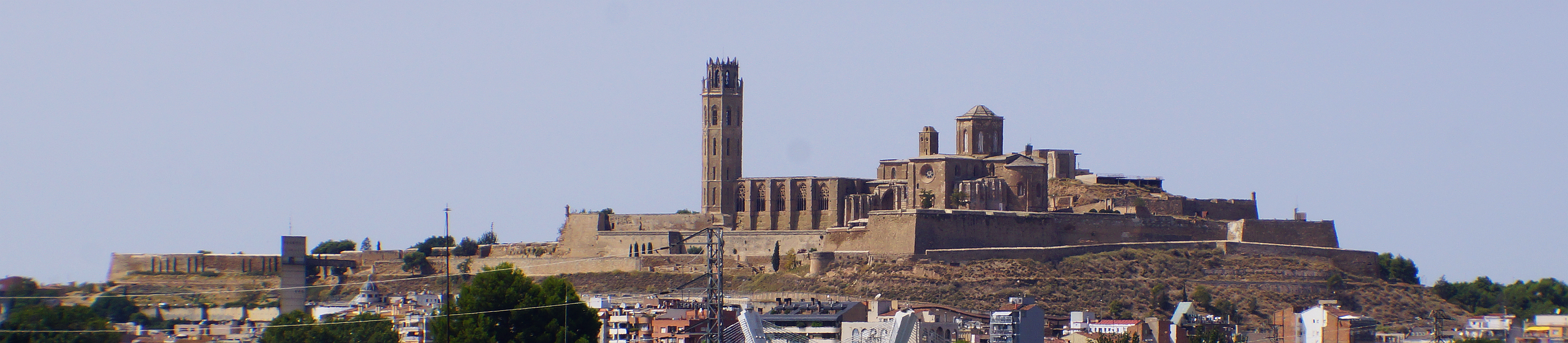
Old Cathedral of Lleida
Philip V ordered it destroyed. His troops had taken Lleida during the War of the Spanish Succession, and the hilltop cathedral of La Seu Vella had been instrumental in the city's defense - its commanding position made it a natural fortress. The king wanted it gone. But destruction proved inconvenient, and so the order was softened to conversion: in 1707, the Cathedral of St. Mary of la Seu Vella became a military citadel, its nave filled with soldiers where monks had once chanted, its chapels repurposed as barracks. It would remain a garrison for two centuries, its religious function transferred downhill to a new cathedral consecrated in 1781. And yet La Seu Vella remains the defining monument of Lleida - the symbol visible from every corner of the city, even though it lost its original purpose over three hundred years ago.
Layers Deeper Than Stone
The hilltop had been sacred ground long before the current structure rose. A Palaeo-Christian and Visigothic cathedral occupied the site first, replaced after the Islamic conquest by a mosque rebuilt in 832. When Ramon Berenguer IV of Barcelona and Ermengol VI of Urgell conquered the city in 1149, the mosque was reconsecrated as Santa Maria Antiqua and entrusted to canons regular. But the existing structure was not grand enough for 12th-century ambitions. In 1193, the cathedral chapter commissioned master Pere de Coma to design a new building in Romanesque style. King Peter II of Aragon laid the first stone in 1203, and construction continued throughout the reign of James I of Aragon before the cathedral was consecrated to the Virgin Mary on 31 October 1278. The cloisters were not completed until the 14th century; the bell tower, begun in that same century, was finished in 1431.
The Tower That Tells Time
The octagonal bell tower rises 60 meters above the hilltop, tapering from a base diameter of 12.65 meters to 9.62 meters at its summit. Inside, 238 steps spiral upward past walls that have absorbed seven centuries of footfalls. Two bells mark the passage of time: Monica announces the quarter-hours, and Silvestra strikes the hours - names that give personality to the mechanical rhythms of a city that has listened to them for generations. The bells themselves are in the International Gothic style of the 15th century, their forms reflecting the same artistic sensibility that shaped the cathedral's later additions. From the top, the view extends across the Segre River valley and the plains of western Catalonia, the landscape that made Lleida a strategic prize worth fighting over and, ultimately, worth a cathedral.
A Cloister Open to the World
Most cloisters turn inward, enclosing their gardens behind solid walls. La Seu Vella's cloister does the opposite. Placed unusually in front of the main entrance rather than beside or behind the church, it features an open gallery that offers panoramic views across the city and the valley below. The cloister is considered one of the largest in Europe, and its 17 ornate Gothic windows are each unique in design. Among them is the Muslim window of the palmtrees, a remnant of the Islamic architectural tradition that once governed this site, and a central window in the westernmost wing that bears both a Star of David and a Christian cross in its stone tracery - a meeting of three faiths frozen in carved stone. The capitals of the cloister columns depict religious scenes: Abraham's angelic visitors, the story of Cain and Abel, episodes from the New Testament.
From Barracks Back to Monument
The cathedral endured its military life with the stoic patience of stone. Much of the interior's painted murals and sculpture survived, though the War of the Spanish Succession stripped away a significant portion of the decoration. The building was declared a national monument in 1918 - a formal acknowledgment that what Philip V had tried to erase was, in fact, irreplaceable. Restoration work began in 1950 and has continued in phases since. Today La Seu Vella stands as a museum and monument rather than a working church, its nave empty of pews but full of spatial power. The transitional Romanesque-Gothic design - a basilica on a Latin cross plan with five apses and almost no Islamic architectural influence, unusual for a building on the site of a former mosque - reads clearly in the proportions. Visitors climb the 238 steps of the bell tower and look out over the same plains, the same river, the same city that has been looking up at this building since the 13th century.
From the Air
Located at 41.62N, 0.63E on the prominent hilltop above Lleida, Catalonia, Spain. La Seu Vella is the most visually distinctive feature of Lleida from the air - its large cathedral structure and octagonal 60-meter bell tower crown the highest point in the city. The unusually placed cloister in front of the main entrance is identifiable from moderate altitudes. The New Cathedral (La Seu Nova) sits approximately 500 meters downhill in the city center. Nearest airport: Lleida-Alguaire Airport (LEDA) approximately 15 km northeast. Barcelona-El Prat (LEBL) is about 160 km east. The Segre River curves through the city below the hilltop.