Old Cathedral of Salamanca
When Salamanca decided it needed a bigger cathedral in the 16th century, the original plan was to tear the old one down. Cooler heads prevailed. The Old Cathedral, begun in the first third of the 12th century under Bishop Jerome of Perigord and completed at the end of the 14th, was kept open for worship while the New Cathedral rose alongside it over 220 years. By the time the newer building was finished, demolishing the older one seemed wasteful, even foolish. So both survived, joined at the hip: the south wall of the New Cathedral rests on the reinforced north wall of the Old. It is an accidental gift. The Old Cathedral of Santa Maria is now one of the finest Romanesque-Gothic buildings in Castile, and its main altarpiece is among the most extraordinary medieval paintings in Spain.
Where Romanesque Met Gothic
Bishop Jerome of Perigord, a French cleric who had arrived in Iberia during the Reconquista, initiated construction after King Alfonso VI of Leon restored the Diocese of Salamanca and his son-in-law Raymond of Burgundy repopulated the city. The cathedral was built during a transitional moment in architectural history, when Romanesque was yielding to Gothic, and the building preserves the tension between the two styles. The pillars were designed to support barrel vaults in the Romanesque tradition, but the cathedral was completed in 1236 with ribbed Gothic vaults instead. There is no constructive continuity between the lower supports and the ceiling above them, a visible seam where one era met another. Bishop Alfonso Barasaque provided the final push to complete the project. The building is dedicated to Saint Mary of the See, Santa Maria de la Sede.
Fifty-Three Panels by Three Brothers
The main altarpiece, installed between 1430 and 1450, is a towering work of fifty-three painted panels depicting scenes from the life of the Virgin and of Christ. Three artists created it, and all three were brothers. The Italian painter Dello Delli executed the first twelve panels, which are widely considered the finest in quality. His brother Sanson Delli painted panels in the central section, assisted by local artists working under Dello's direction. The third brother, Nicolo Delli, better known as Niccolo Fiorentino, completed additional sections. Above the altarpiece panels, Niccolo Fiorentino also painted a fresco of the Last Judgment in the half-dome of the apse. The result is a unified composition that tells its story from bottom to top, each tier rising toward the final reckoning overhead.
Chapels, Cloisters, and Examinations
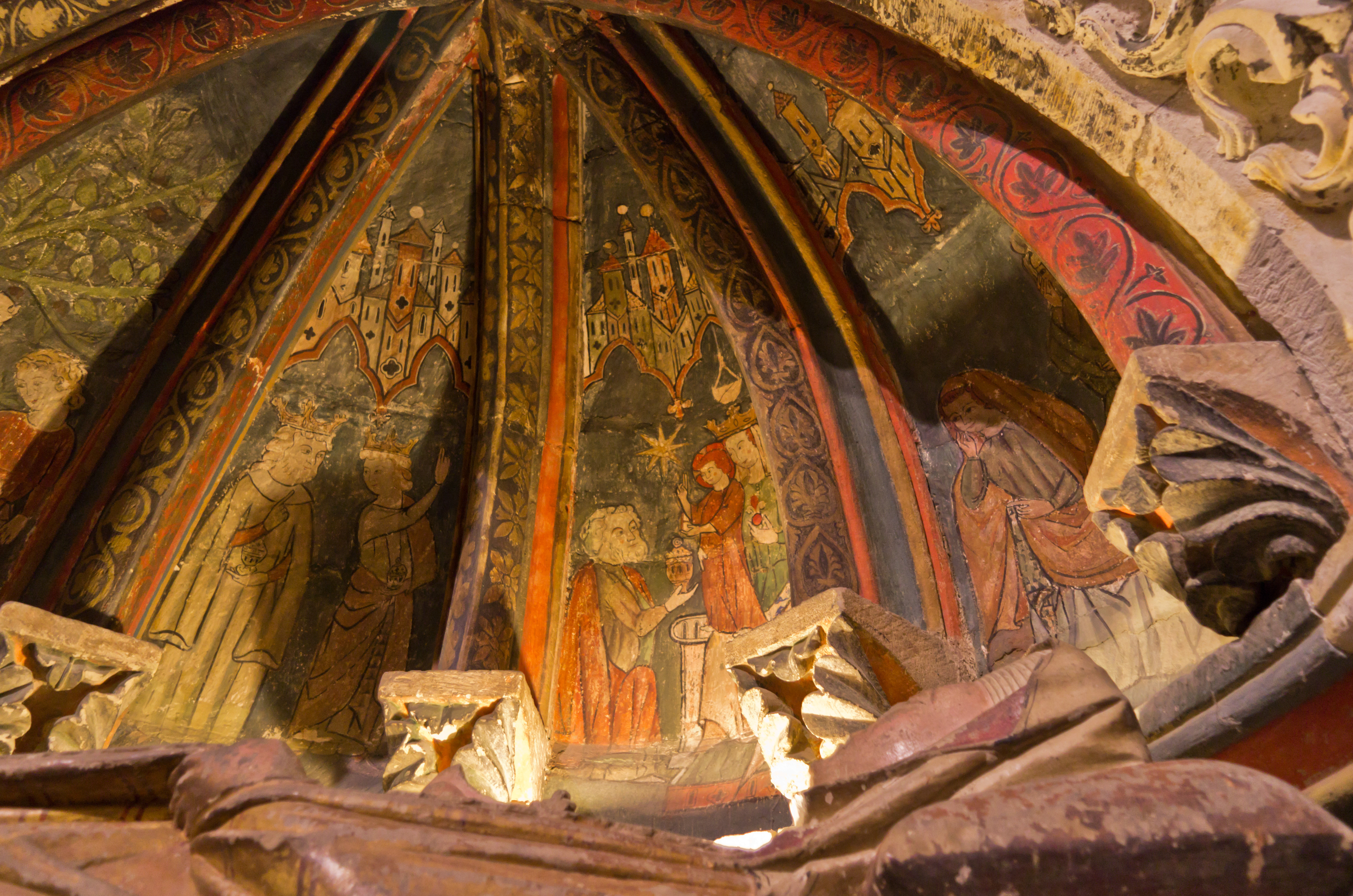
The Old Cathedral's cloister chapels served purposes that went well beyond worship. The Chapel of Santa Catalina, also known as the Capilla del Canto, was founded by Bishop Vidal in the 12th century and later enlarged in the 15th century to house the chapter library. It became the largest chapel in the cloister and served as the examination hall where students of the University of Salamanca were tested for their bachelor's degrees. It also hosted medieval compostelan synods and served as a singing chapel where music was taught in one of the main chairs of the Spanish university system. Under the bell tower, the Chapel of San Martin preserves frescoes and a connection to the earliest days of the building. The name Saint Martin could not be given to the cathedral itself, which was dedicated to the Virgin, so the French saint was honored in this smaller space.
Alabaster, Grillwork, and the Anaya Legacy
The Chapel of San Bartolome, also known as the Chapel of the Anaya family, contains one of the cathedral's most striking monuments. At its center rests the alabaster tomb of Diego de Anaya, bishop of Salamanca and archbishop of Seville, who founded the Colegio Mayor de San Bartolome, the oldest college in Salamanca. The tomb, possibly by a German master, is surrounded by an elaborate 16th-century grille dense with decoration and allusions to death, its ironwork partially obscuring the sepulcher in a way that feels both protective and theatrical. Other members of the Anaya family are buried in the same chapel, and two notable tombs on the east wall depict their occupants reading, a fitting pose for a family whose patriarch created one of Spain's foundational academic institutions.
From the Air
Located at 40.96N, 5.67W in Salamanca, Castile and Leon, Spain, immediately adjacent to the New Cathedral. The Old Cathedral is partially hidden by the larger New Cathedral from most aerial perspectives but its distinctive Torre del Gallo (Rooster Tower) dome is a useful identifier. Both cathedrals sit on the southern edge of the old town above the Tormes River. Nearest airport is LESA (Salamanca) approximately 15 km east. Best viewed from 2,000-3,000 ft AGL. The golden sandstone of Salamanca's historic center is distinctive from the air.