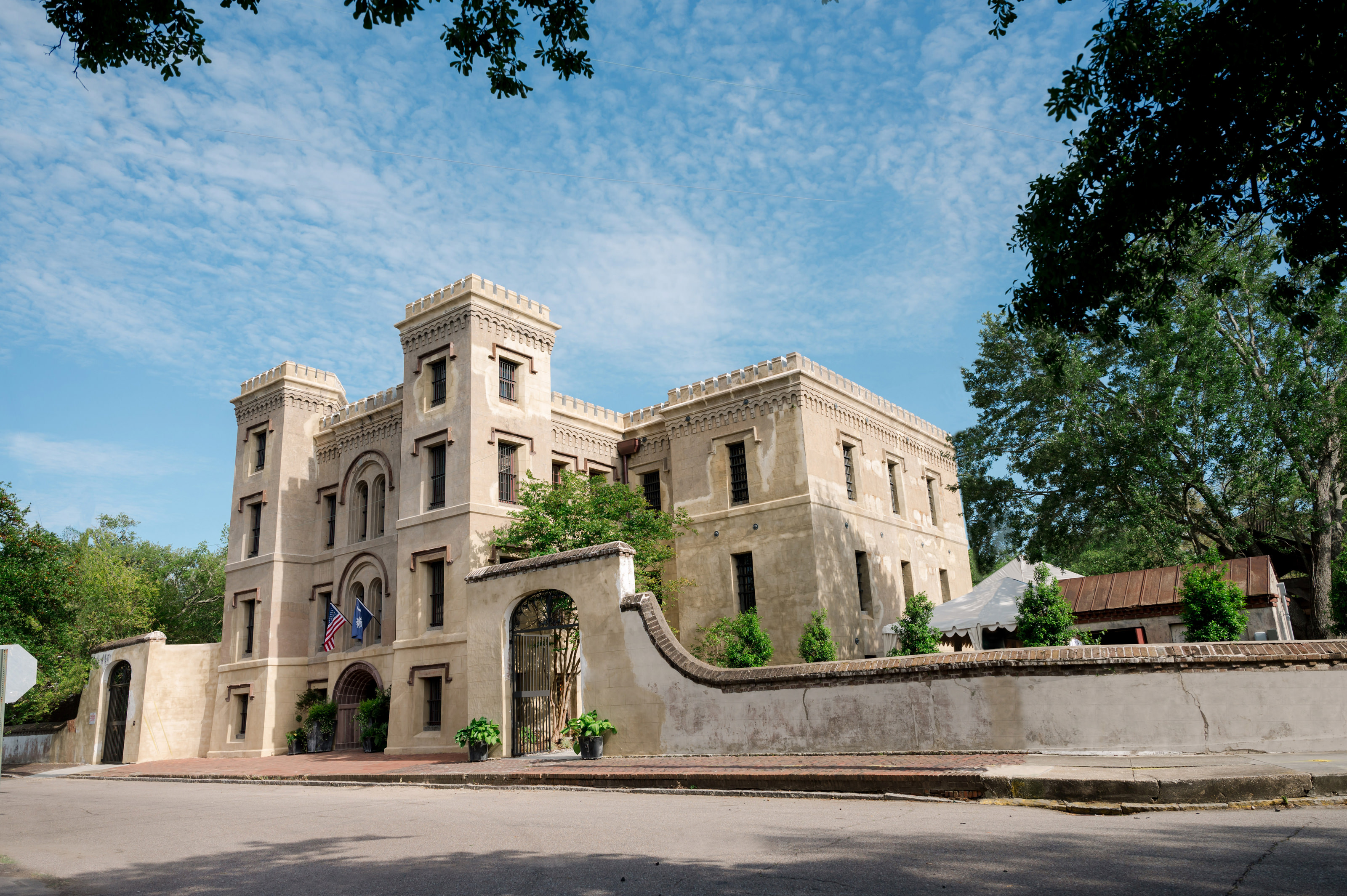
Old Charleston Jail
Lavinia Fisher reportedly told the crowd gathered for her execution in 1820: "If anyone has a message for the devil, tell me and I'll deliver it myself." Whether the quote is legend or fact, it captures the spirit of the Old Charleston Jail, a building that held the city's most dangerous, desperate, and defiant inhabitants for 137 years. Convicted of highway robbery along the Charleston Neck, Fisher and her husband John became the jail's most infamous early residents. She was not the last. Denmark Vesey spent his final days in the octagonal tower before his hanging in 1822. Pirates awaited the gallows within its walls. Civil War prisoners of both sides paced its corridors. The four-story structure at 21 Magazine Street accumulated human suffering the way old stone absorbs moisture, and it never fully dried out.
Built for the Dispossessed
The land beneath the jail was set aside for public use in 1680, at the very founding of Charleston, designated for institutions serving the poor, the sick, and the dispossessed. Hospitals, burial grounds, and jails occupied the four-acre parcel over the next century. The jail that stands today was constructed in 1802, a four-story building topped with a distinctive two-story octagonal tower. In 1822, the renowned architect Robert Mills designed a fireproof wing, though it was later demolished. Architects Barbot and Seyle redesigned the building in 1855, adding a rear octagonal wing and Romanesque Revival elements that gave the jail its castellated, fortress-like appearance. The 1886 Charleston earthquake severely damaged the tower and upper story, which were subsequently demolished, leaving the building in roughly the form visible today.
Vesey's Last Stand
In the summer of 1822, authorities discovered what would have been one of the largest slave revolts in American history. Denmark Vesey, a formerly enslaved man who had purchased his freedom after winning a lottery, had spent years organizing an armed uprising in Charleston. When the plot was betrayed before it could be carried out, Vesey and several hundred free Black people and enslaved people were arrested. Sixty-seven were convicted. Thirty-five were hanged, including Vesey, who spent his last days confined in the jail's octagonal tower. Four white men were also convicted for supporting the conspiracy. The aftermath extended far beyond the jail walls: authorities imposed severe new restrictions on both free and enslaved African Americans in Charleston, including a law requiring all Black sailors arriving in port to be detained in the jail for the duration of their ship's stay.
Pirates, Outlaws, and the Fisher Legend
Before Vesey, the jail held John and Lavinia Fisher, convicted of highway robbery in the Charleston Neck area and imprisoned from 1819 to 1820. Over time, Lavinia Fisher's story grew into legend, and she became known in popular lore as America's first female serial killer, though her actual conviction was for robbery rather than murder. The tales surrounding her, involving poisoned tea and trapdoors at the couple's inn, have never been verified, but they attached themselves to the jail's reputation permanently. In 1822, the same year as the Vesey conspiracy, some of the last high-seas pirates to operate along the American coast were held in the jail while awaiting execution. The building's population was always a cross-section of Charleston's underside: common criminals alongside political prisoners, the desperate alongside the defiant.
A Civil War Prison
During the Civil War, the Old Charleston Jail held prisoners from both sides of the conflict. Union officers and soldiers of the United States Colored Troops were incarcerated within its walls, alongside Confederate prisoners held for various offenses. The jail became one of many detention facilities in a city under siege, as Union forces bombarded Charleston from Morris Island and blockaded its harbor. The conditions inside deteriorated as the war dragged on and the city's resources dwindled. The jail continued operating as the Charleston County Jail long after the war ended, housing inmates until 1939, when operations finally moved to a newer facility. By the time it closed, an estimated thousands of people had passed through its cells over the course of nearly a century and a half.
From Cells to Corridors
After closing in 1939, the Old Charleston Jail sat in varying states of disuse and decay. The American College of the Building Arts acquired the building in 2000 and used it as a campus, but the structure's preservation needs were immense. Ghost tours began operating out of the jail in 2003, capitalizing on its grim history and attracting television crews from the Travel Channel and Food Network. A major renovation beginning in 2016 transformed the building into an event venue and museum at 21 Magazine Street. The prisoner graffiti still visible on some cell walls remains the most direct connection to the building's past, handwritten marks left by people whose names are mostly lost. The jail stands today as a reminder that Charleston's elegance was always paired with harshness, its grand houses casting long shadows over places like this.
From the Air
Located at 32.78°N, 79.94°W on Magazine Street in Charleston's historic district, just north of Broad Street on the peninsula between the Ashley and Cooper Rivers. The jail is part of a cluster of institutional buildings in the upper portion of the historic district. From the air, look for the distinctive four-story structure near the intersection of Magazine and Franklin Streets. Charleston Executive Airport (KJZI) is approximately 7nm west; Charleston AFB/International (KCHS) is about 10nm north-northwest. The Arthur Ravenel Jr. Bridge crossing the Cooper River provides a prominent visual reference. Best viewed at lower altitudes in clear conditions.