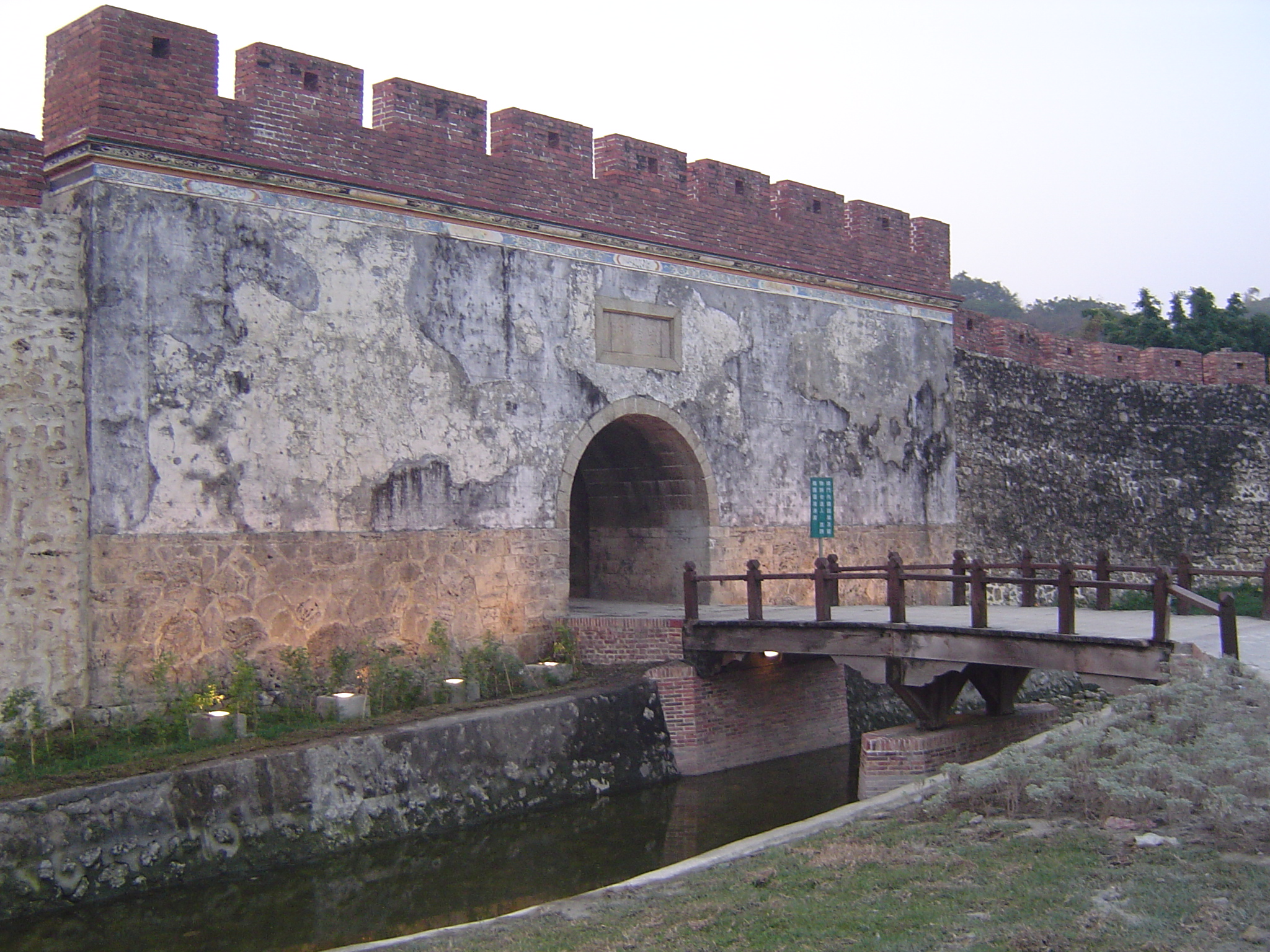
Old City of Zuoying
The Qing dynasty banned defensive walls in Taiwan. The policy was straightforward: walls enable rebellion, and the empire had just annexed the island in 1684. Then in 1721, a man named Zhu Yigui led a revolt in southern Taiwan, captured the unprotected Fengshan County seat at Zuoying, and destroyed its government buildings. The ban was lifted immediately. By 1722, the first wall went up -- built of mud, with a moat, around a settlement flanked by Turtle Mountain and Snake Mountain. It was the beginning of a three-century argument, conducted in stone and blood, over whether the Old City of Zuoying was worth defending or too cursed to inhabit.
The City Nobody Wanted
The mud wall did not hold long. In 1787, the Lin Shuangwen Rebellion broke through it, and the rebels destroyed the fortifications. Local officials, concluding the site was simply unlucky, moved the county seat to Pitouchieh, present-day Fengshan District. But moving did not stop the attacks. In 1805, a pirate who styled himself the Sea-calming Majestic King broke into the walled city anyway. Plans to move back to Zuoying stalled for lack of funds until 1824, when yet another rebellion panicked residents into action. The government collected 140,000 silver yuan -- three-quarters of it from civilians -- and between 1825 and 1826 built a new stone wall of concrete and granite, with four gates facing the cardinal directions. It was one of the most advanced fortifications in Taiwan. Then the governor died, reportedly of disease, and residents refused to move in. They considered his death an omen. The new walled city sat empty until 1853, when the Qing government finally ordered the county seat relocated.
Four Gates, Four Fates
Each of the four gates met a different end. The East Gate, called Fongyi Gate, survived best. A portion of its connecting wall still stands, though years of neglect during military occupation allowed vines to swallow the stonework in a slow green siege. The North Gate, or Gongchen Gate, bears two inscribed boards and sculptures of the door gods Shenshu and Yulu. Nearby, the Gongchen Well served residents for two centuries before the post-war government decided to seal it with an iron lid -- a lid that now, with unintentional comedy, bears zebra crossing marks from the road painted over it. The South Gate, Ciwun Gate, lost its connecting walls entirely and now sits marooned in the center of a traffic circle, reinforced with concrete in 1961. The West Gate, Dianhai Gate, simply vanished during the Japanese occupation. Its existence was not even confirmed until a Japanese military map surfaced decades later. A monument was unveiled at the site in 2004.
Military Ground
The Japanese transformed Zuoying in ways the Qing never intended. As imperial military strategy evolved, the colonial government converted Zuoying Port into a naval base and designated the walled city a military district. Over fifty households were forced to relocate. After World War II, the Kuomintang government maintained the North and East Gates as military zones and established three villages within the old walls. The city's identity shifted from administrative center to garrison -- its ancient fortifications no longer defending against rebellion but serving as the perimeter of a modern naval installation. It was not until 1985 that the Ministry of the Interior recognized what had survived. The North, South, and East Gates were designated First-class historic sites, and the remaining wall sections were renovated beginning in March 1991.
Stone Memory
Walking the Old City today is an exercise in reading layers. The granite blocks of the 1826 wall show tool marks from nearly two centuries ago. The East Gate's vine-scarred surface records decades of military neglect followed by careful restoration. The South Gate's concrete reinforcements speak to a mid-century pragmatism that valued traffic flow over preservation. And the West Gate's absence -- marked only by a monument erected in 2004 by then-mayor Frank Hsieh -- tells the story of colonial erasure. The old city contained temples to Mazu, Confucius, and Guan Yu, along with administrative offices whose functions are recorded only in documents: the record office, the defense office, the administration office. Zuoying's walls were built to keep people out, but what they ended up preserving was a compressed history of Taiwan itself -- Qing ambition, local superstition, Japanese militarism, and the slow, imperfect work of remembering.
From the Air
The Old City of Zuoying is located at 22.680N, 120.290E in Kaohsiung's Zuoying District. From the air, the surviving gate structures and wall fragments are embedded within the modern urban grid. The East Gate and its remaining wall section are the most visible landmarks. Zuoying Naval Base lies immediately to the west, and Lotus Pond is directly to the east. Nearest major airport is Kaohsiung International Airport (RCKH), approximately 10 km south. Best viewed at 1,500-2,500 feet to distinguish the historic gates from surrounding development.