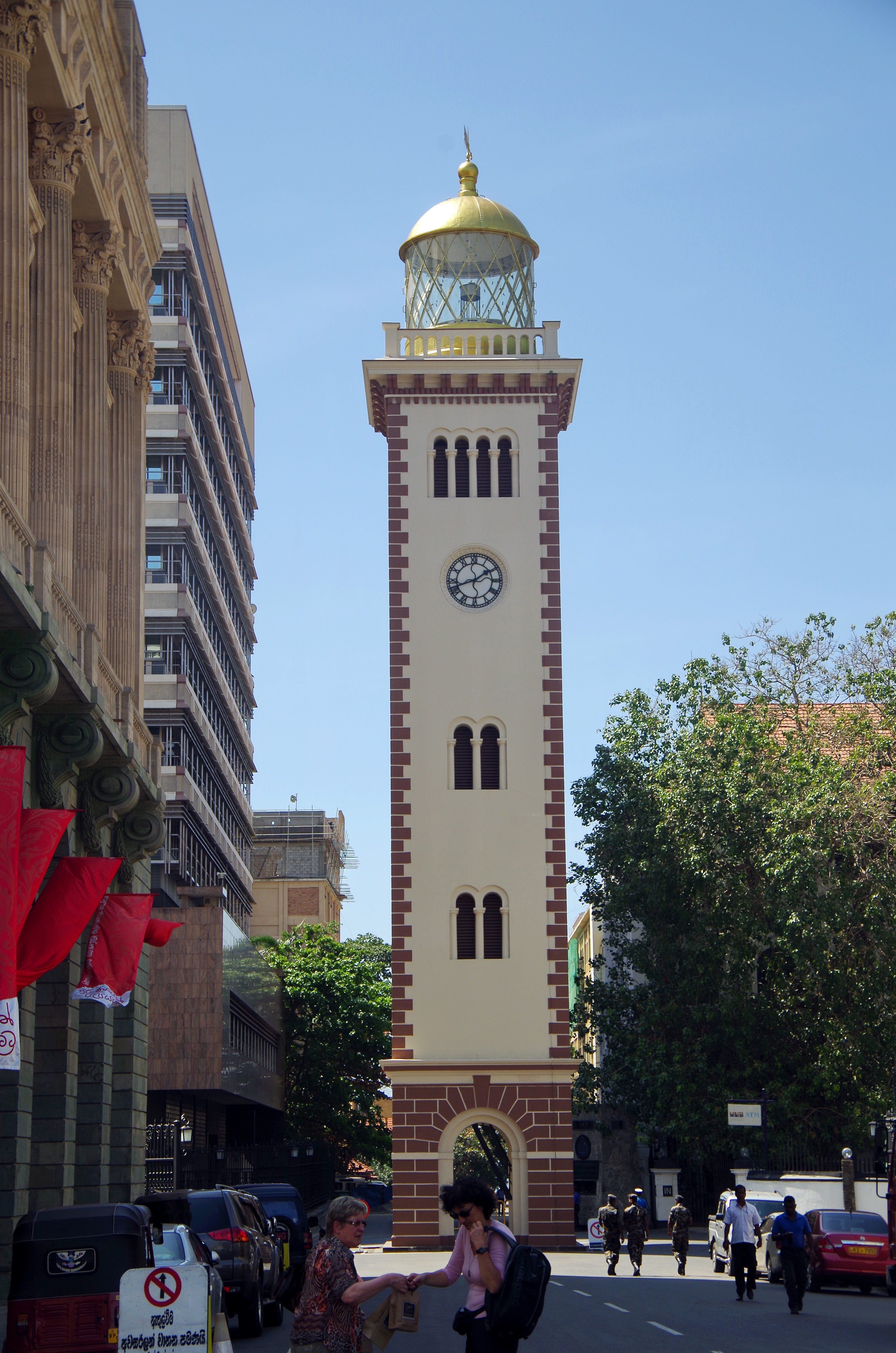
Old Colombo Lighthouse
The clock was ready 43 years before the tower was. In 1814, Governor Sir Robert Brownrigg commissioned a clock for Colombo at a cost of 1,200 pounds. Then, for reasons of economy, the colonial administration put it in a warehouse and left it there. For four decades, Colombo's official timepiece sat in a crate while the city told time by the sun and the harbor bells. It was not until 1857 that the clock finally found a home - a 29-meter tower at the junction of Chatham Street and Queens Road (now Janadhipathi Mawatha), designed not by a government architect but by Emily Elizabeth Ward, the wife of Governor Sir Henry George Ward. The tower she designed would become the tallest structure in Colombo, a lighthouse that guided ships for 85 years, and a clock tower whose mechanism came from the same workshop that built Big Ben.
A Governor's Wife and a Clockmaker's Masterpiece
Emily Elizabeth Ward's tower was completed on 25 February 1857 and formally commissioned the following month. The Public Works Department built it under the supervision of John Flemming Churchill, Director General of Public Works, but the design belonged to Ward - an unusual credit for a woman in British colonial Ceylon. The clock mechanism itself was constructed by Dent, the English clockmaking firm that had been commissioned to build the Great Clock of Westminster (whose bell is popularly known as Big Ben) just five years earlier, in 1852 -- though that clock would not be installed and running until 1859. The bells of the Colombo tower consisted of a main bell weighing approximately 250 kilograms and two auxiliary bells of 152 kilograms each. When the tower was completed, it was the tallest structure in Colombo, its chimes audible across the fort district and out over the harbor.
When the Tower Became a Lighthouse
In 1867, a navigational light was installed in the tower, transforming the clock tower into a dual-purpose structure - timekeeper and harbor guide in one. The revolving dioptric light, built by Chance Brothers of Birmingham, sat at a focal plane 140 meters above sea level and was visible from 27 kilometers away in clear weather. It produced a distinctive triple flash at 30-second intervals: three one-second bursts separated by 18 seconds of darkness. Approaching ships could identify Colombo's harbor by that rhythm alone. The light evolved with the technology of its age. It burned kerosene oil from 1867, was converted to gas in 1907, and finally electrified in 1933 with a 1,500-candlepower lamp. For decades, the Old Colombo Lighthouse was both the city's clock and its coastal beacon - keeping time and keeping ships safe with the same Victorian precision.
Blinded by Its Own Success
The harbor that the lighthouse served brought prosperity, and prosperity brought buildings, and buildings blocked the light. By the mid-20th century, the structures rising around the port had grown tall enough to obscure the lighthouse beam from approaching vessels. The navigational light was decommissioned on 12 July 1952, replaced by the new Colombo Lighthouse at Galbokka Point, which had a clearer sightline to the sea. The tower's career as a lighthouse was over after 85 years. But the clock kept running. In October 1913, the original 1814 mechanism - nearly a century old by then - was replaced with a new clock featuring a six-foot dial glazed with opal glass for nighttime illumination. The tower was re-inaugurated on 4 April 1914. That clock still marks the hours at the junction of Chatham Street and Janadhipathi Mawatha, outlasting the light it was paired with and the fort ramparts that once surrounded it.
The Clock That Outlived the Fort
The fort ramparts that once enclosed this corner of Colombo were demolished between 1869 and 1871, part of the British decision to clear the obsolete defenses for military barracks and modern development. The lighthouse erected in 1829 on the ramparts was demolished along with them. But the clock tower survived - it stood on its own foundation, independent of the walls. It has now stood through the end of Dutch architecture, the demolition of the fort, the construction of British barracks, the decommissioning of its own light, and the transformation of the Fort district from administrative capital to financial center. At the junction where it rises, the streets still carry their colonial names alongside their Sinhala replacements. Queens Road became Janadhipathi Mawatha. The tower remained the tower. Whatever Colombo becomes next, the clock Emily Ward designed will likely still be chiming above it, keeping time for a city that has changed its government, its name, and its skyline but never bothered to silence its oldest working clock.
From the Air
Located at 6.935°N, 79.843°E at the junction of Chatham Street and Janadhipathi Mawatha in Colombo's Fort district. The clock tower is a distinctive vertical landmark amid the lower colonial-era buildings of the Fort. From the air, it is just inland from the harbor and south of the Port of Colombo. The newer Colombo Lighthouse at Galbokka Point is visible approximately 200 meters to the northwest. Bandaranaike International Airport (VCBI) lies 30 km north. Ratmalana Airport (VCCC) is 12 km south. Best viewed at 1,000-3,000 ft in clear conditions. Tropical weather year-round with monsoon seasons.