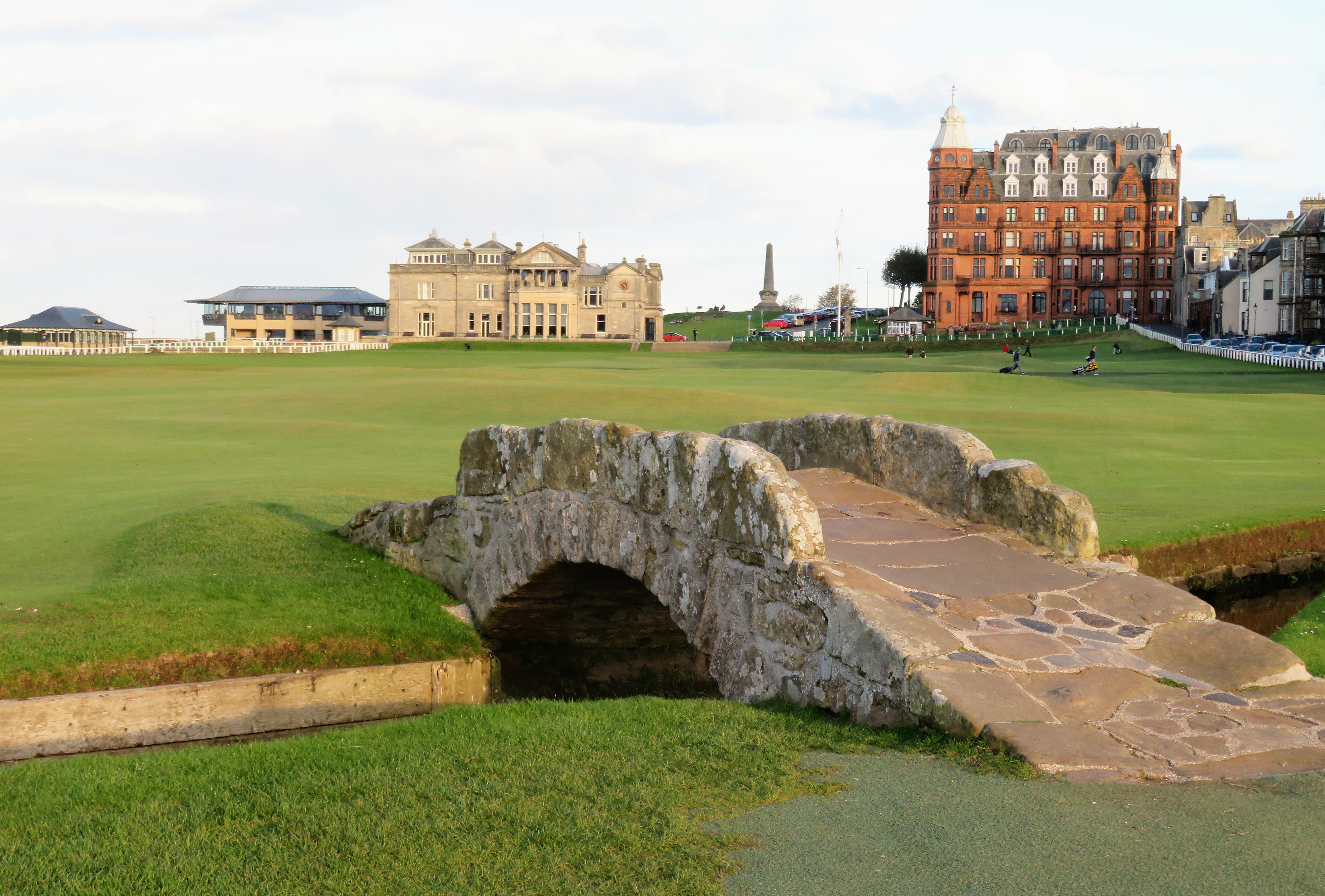
Old Course at St Andrews
In 1457, King James II of Scotland banned golf. Young men, he complained, were playing too much of it and neglecting their archery practice -- archery being rather more useful for national defence. The ban held through the reigns of James III and James IV, until James IV became a golfer himself in 1502 and quietly dropped the prohibition. The links at St Andrews, where the game had been played since the early fifteenth century, carried on regardless. Five and a half centuries later, the Old Course remains what it has always been: public land over common ground, open to anyone, shaped by wind and weather and the accumulated decisions of generations, and regarded by golfers worldwide as the place where their sport began.
How Eighteen Became the Number
The Old Course did not start with eighteen holes. It started with twenty-two, played out and back along a narrow strip of linksland between the town and the sea. Golfers played the same fairways in both directions, which meant groups heading out would meet groups coming in, playing toward the same hole from opposite ends. In the 1760s, the Society of St Andrews Golfers -- the precursor to The Royal and Ancient Golf Club -- decided that the first four and last four holes were too short and should be combined, reducing twenty-two holes to eighteen. The decision was pragmatic, not philosophical, but it established the standard that every golf course in the world would eventually follow. Around 1863, the greenkeeper Old Tom Morris separated the 1st green from the 17th, producing the current layout with seven double greens and four single greens -- an arrangement unique to the Old Course and a constant source of confusion for first-time visitors.
Bobby Jones and the Key to the City
Bobby Jones first played St Andrews in the 1921 Open Championship. It did not go well. On the 11th hole in the third round, he hit his ball into a bunker, took four unsuccessful swings to escape, lost his temper, and tore up his scorecard -- disqualifying himself. He was nineteen years old and had not yet learned the patience the Old Course demands. Six years later, he returned and won the Open, becoming the first amateur to win back-to-back Open Championships, finishing six strokes clear of the field. In 1930, he won the British Amateur at St Andrews, beating Roger Wethered 7 and 6 in the final, on his way to completing the Grand Slam -- all four major championships in a single year, a feat never repeated. Jones fell in love with the course that had once humiliated him. In 1958, the town awarded him the Freedom of the City, only the second American so honoured after Benjamin Franklin in 1759. His acceptance speech has become one of golf's most quoted passages: 'I could take out of my life everything but my experiences here in St Andrews and I would still have had a rich and full life.'
One Hundred and Twelve Bunkers
ESPN once observed that no other golf course has as many famous landmarks as St Andrews, and the observation is precise. The Old Course's 112 bunkers are not mere hazards -- they are named, storied, and in some cases notorious. The Road Hole Bunker on the 17th, a deep pot guarding the green, has been called the most feared hazard in golf. The Swilcan Burn crosses the 1st and 18th fairways, a modest watercourse that has swallowed more golf balls than any stream in history. The Swilcan Bridge, a small stone footbridge at least 700 years old, was originally built to help shepherds move livestock across the burn. It is now the most photographed structure in golf, the spot where retiring champions traditionally pause for a final wave. The Beardies on the 14th are four small bunkers said to be difficult to mow, hence the name. The Admiral's Bunker on the 11th reportedly got its name from an admiral who fell into it while distracted by a young woman. Each bunker carries its own history, its own casualties, its own small mythology.
Common Ground
The Old Course is closed on Sundays. Not for religious observance -- though that was once the reason -- but to let the course rest. Dog walkers, families, and joggers reclaim the fairways, a weekly reminder that the Old Course is not a private club's manicured preserve but common land held in trust under an act of Parliament. In 1552, Archbishop John Hamilton confirmed the townspeople's right to play on the links, and that right has never been revoked. The R&A clubhouse sits adjacent to the first tee, but The Royal and Ancient is only one of several clubs with playing privileges. The general public can book tee times through a daily ballot -- a system that ensures St Andrews remains, as it has been since the fifteenth century, a course where anyone can play. The Open Championship has been held here thirty times since 1873, more than at any other venue, and currently returns every five years. But the Old Course's deepest claim is not as a championship venue. It is as the place where golf became golf -- where the number of holes was standardised, where the rules were codified, and where the game's essential character as a contest between player and landscape was first established on the windswept links of Fife.
From the Air
The Old Course at St Andrews is at approximately 56.35N, 2.82W, stretching along the coast of St Andrews Bay in northeast Fife. The links are clearly visible from the air as a distinctive coastal strip of green. The R&A clubhouse and the town of St Andrews are adjacent. Dundee Airport (EGPN) is approximately 10 nm west. Leuchars Station airfield is approximately 5 nm northwest. Best viewed at 1,500-2,500 ft AGL. The coastline and St Andrews Bay provide clear navigational context.