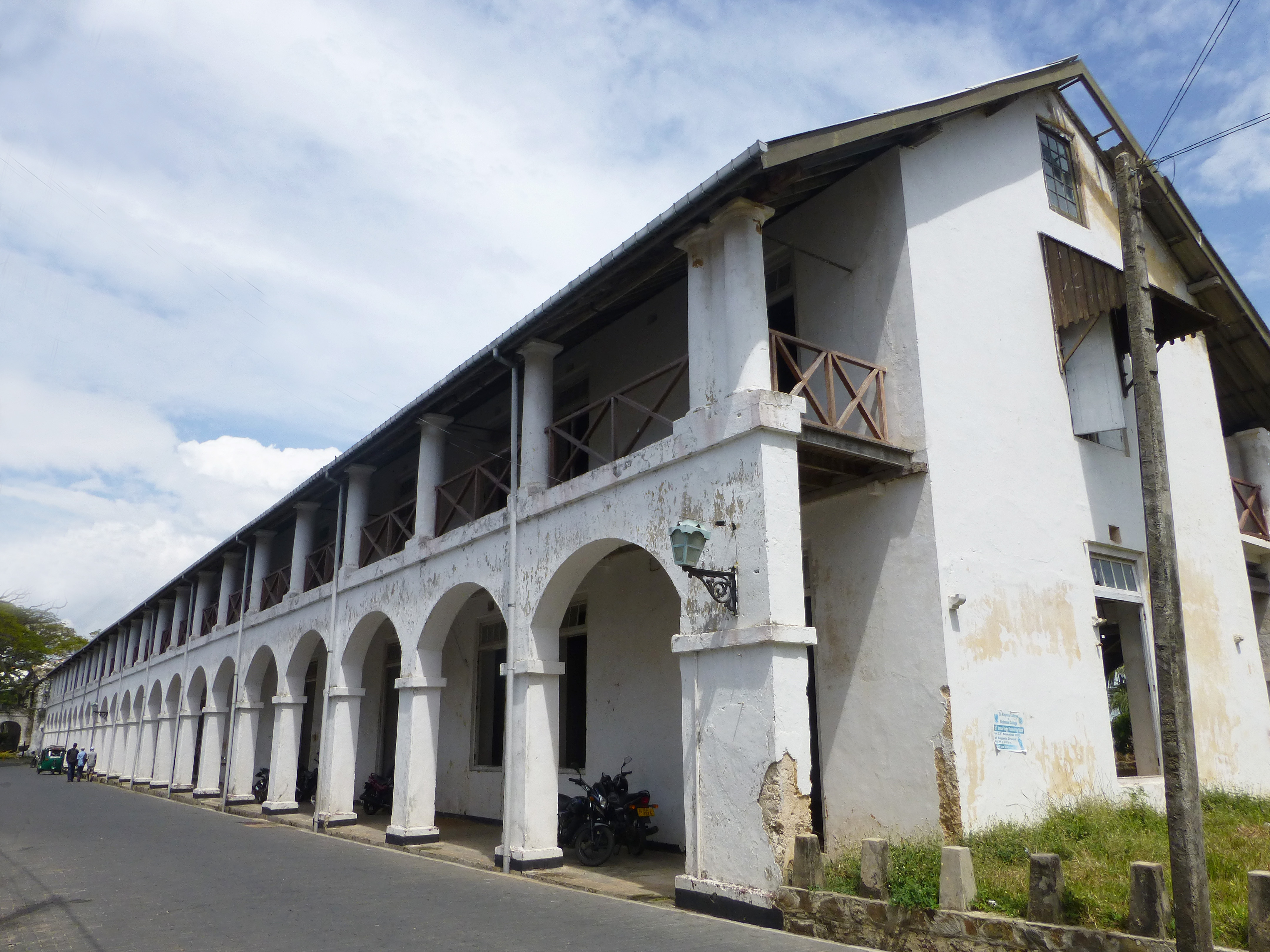
Old Dutch Hospital, Galle
The building has been a hospital, a barracks, a government office, a town hall, and a shopping precinct -- and it has outlasted every institution that occupied it. The Old Dutch Hospital in Galle Fort is one of the oldest surviving structures within the fortified city, built by the Dutch East India Company in the 17th century to treat the officers, administrators, and sailors who kept the spice trade running through Sri Lanka's southwest coast. Its placement was deliberate: close enough to the harbor that sick and injured seafarers could be carried to its doors without crossing the entire fort. What the VOC built for medical necessity, four centuries of subsequent owners have repurposed with varying degrees of ambition, until the building's history became more interesting than any single chapter of its use.
Coral Walls and Colonial Layers
The Dutch built the hospital on the site of the Portuguese mint, between the Black Fort and Aurora Bastion on the eastern side of the fortification. They used cabook -- coral stone cut from local reefs -- for the masonry, paved the floors with granite, and raised thick plinth walls designed to keep tropical heat and humidity at bay. Long colonnaded verandas ran along both sides of the two-story structure, creating shaded outdoor corridors that served as recovery wards in the sea breeze. The design was as much about ventilation as about architecture. When the British captured the fort in February 1796, they extended the building northward, following the Dutch ground plan but switching to brick and introducing glazed windows and fanlights. They also added a wing stretching toward the sea. Despite being constructed in different centuries with different materials, the extensions were designed to read as a single building -- a small feat of architectural diplomacy that mirrors the fort's larger story of successive occupiers building atop each other's foundations.
Five Lives in Four Centuries
The hospital's first reinvention came in 1850, when the British converted it into a barracks. The wards that had treated Dutch sailors now housed British soldiers. After the barracks, the building became the office of the Government Agent, the chief colonial administrator for the district, and it served that function until Sri Lanka's independence in 1948. The newly independent nation found another use: the old hospital became the Galle Town Hall. The first meeting of the Galle Municipal Council was held on 26 April 1967. Over time, the grand colonnaded verandas were partitioned into cramped municipal offices, and the building's architectural character slowly disappeared behind plywood and filing cabinets. By 2003, the offices had outgrown the space entirely and were relocated outside the fort, leaving the building empty and uncertain of its next purpose.
Collapse and Restoration
Emptiness proved nearly as destructive as overuse. In 2006, the International Council on Monuments and Sites began conservation work, funded by American Express and the World Monuments Fund. Workers repaired the roof, restored walls and windows, updated the sewage system, and addressed architectural details that had been neglected for decades. Then, in December 2009, water seepage caused a section of the two-story building and its colonnade to collapse. The restoration was not just cosmetic surgery -- it was emergency medicine on a patient that had survived centuries of use only to be threatened by neglect. Work resumed and was completed in March 2011. The massive teak beams that the Dutch had installed in the 17th century were found to be largely intact beneath the damage, a testament to both the quality of the original construction and the durability of tropical hardwood when properly sheltered.
The Precinct Within the Fort
In 2014, the Urban Development Authority, assisted by the 10th Engineering Regiment of the Sri Lankan Army, converted the restored building into a shopping and dining precinct. President Mahinda Rajapaksa formally opened the complex on 20 September 2014. The renovation preserved the historic architecture -- the thick cabook walls, the granite floors, the deep verandas -- while inserting restaurants, cafes, and shops into the colonial framework. The upper floor, reached by the original wooden staircase, retains its timber flooring. Long open verandas still run along each wing, as they did when recovering Dutch sailors watched ships enter the harbor from their beds. The building's success as a commercial space has been quiet rather than dramatic: it draws visitors without overwhelming the fort's residential character, and its restaurants offer views across the bay toward the same waters where the VOC ships once anchored. After five lifetimes of service, the Old Dutch Hospital has found a sixth -- and this one, for the first time, does not require anyone to be in charge of it.
From the Air
The Old Dutch Hospital is located at 6.027N, 80.219E within Galle Fort, on the eastern side of the fortified headland near the harbor. From the air, the building's long rectangular footprint and colonnaded structure are distinguishable within the fort's grid of streets, positioned between the Black Fort and Aurora Bastion. It faces the harbor, and its proximity to the water's edge makes it one of the first fort structures visible when approaching from the east. Nearest airports: Koggala Airport (VCCO) approximately 15 km southeast; Mattala Rajapaksa International (VCRI) roughly 150 km east-southeast; Colombo Bandaranaike International (VCBI) 150 km north. Recommended viewing altitude: 1,500-3,000 ft for building detail within the fort complex.