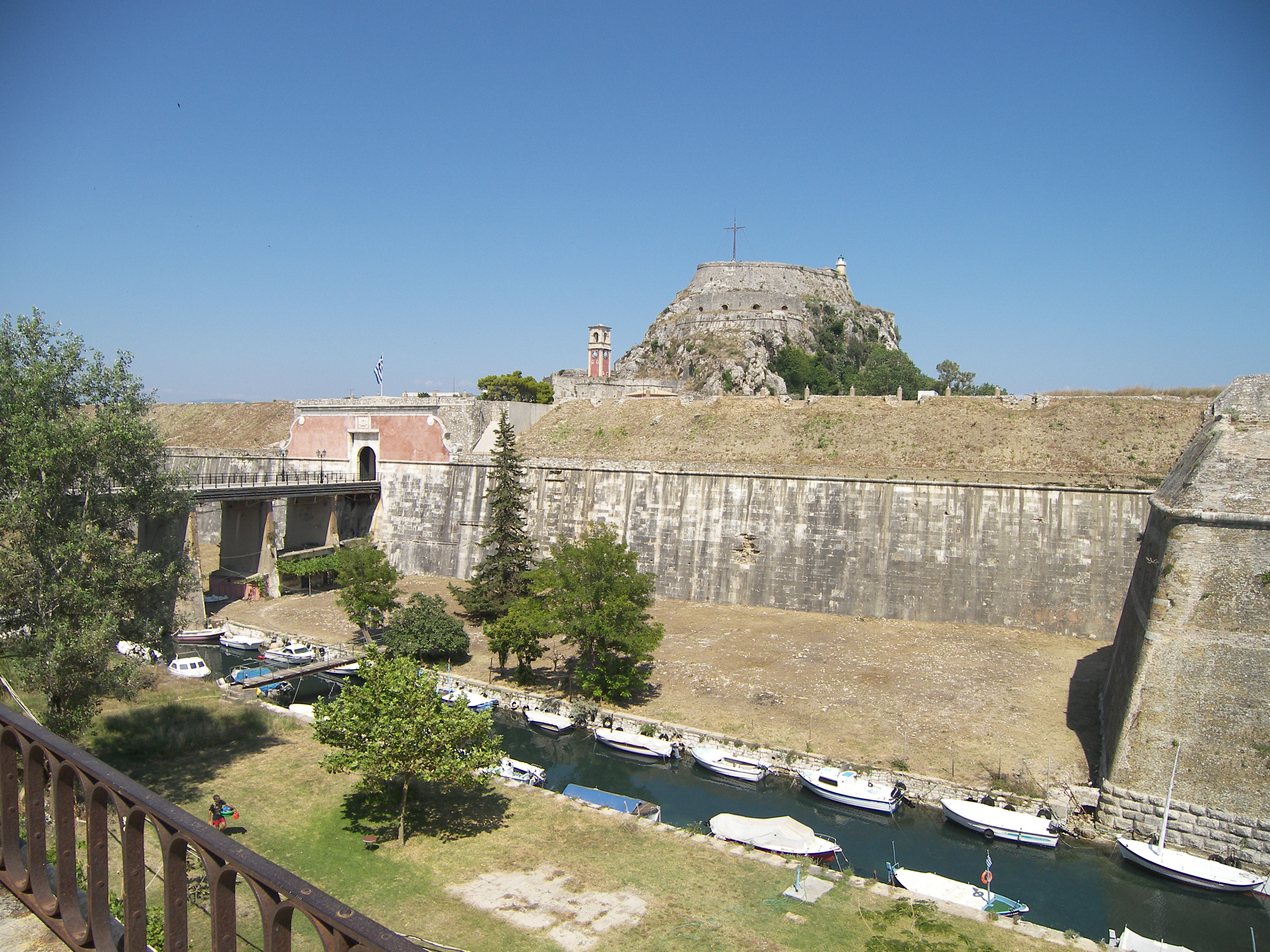
Old Fortress, Corfu
The city's name is a clue hidden in plain sight. "Corfu" descends from Korypho -- the Greek word for peak -- and refers to the twin summits of this fortress promontory jutting into the Ionian Sea. Before the old town spread westward, before the New Fortress rose, before the Esplanade became a cricket pitch under British rule, this rocky headland was Corfu. The Byzantine town huddled within its walls. The Venetians rebuilt those walls into something the Ottoman Empire threw its armies against three times and failed to take. The fortress endured. What happened inside its walls across the centuries is a story that runs from military triumph to unspeakable cruelty.
The Peaks That Named a City
The Old Fortress occupies a promontory separated from the town by the Contrafossa, an artificial moat that the Venetians carved to isolate the stronghold. A bridge spans this channel, connecting the civilian city to the military one. The twin peaks -- koryphes in Greek -- gave the town its Western identity, a name that stuck even as the fortress passed through half a dozen hands. During Byzantine times, the original town of Corfu grew within and around these heights. When the Venetians took control in 1386, they recognized the promontory's strategic genius: steep cliffs on three sides, deep water below, and a single approachable face that could be walled, moated, and bristling with cannon. They turned a natural stronghold into an engineered one, layering centuries of fortification onto bedrock that had been defensible since antiquity.
Three Sieges, Three Failures
The Ottomans tested this fortress repeatedly, and the fortress held. The great siege of 1537 brought Suleiman's forces against the walls, ravaging the undefended countryside -- the people of Corfu who could not fit within the fortress were killed or enslaved. The Venetians' triage was brutal: women, children, and the elderly were classified as inutili, the useless, and turned away from the gates to face the Ottoman army outside. The siege of 1571 followed a similar pattern. But it was the 1716 siege that became legendary. Venice appointed Count Johann Matthias von der Schulenburg to command the defense. For seven weeks, Schulenburg and the Corfiote garrison fought the Ottoman forces, who outnumbered them significantly. Captain Andrea Pisani, the Venetian fortress commander and brother of the Doge, was killed along with his staff. On 19 August 1716, the Ottomans abandoned the siege. Schulenburg rebuilt the fortress afterward, adding new fortifications on Avrami and Sarocco hills by 1721.
Bombardment and Occupation
The fortress survived the Ottomans only to face modern weaponry. In 1923, during the Corfu Incident, the Italian Air Force bombarded both the Old and New Fortresses -- an act of aggression by Mussolini's government over a diplomatic dispute. The damage was repaired, but worse was coming. When Nazi Germany occupied Corfu during World War II, the Old Fortress became a prison. On 8 June 1944, the Jewish community of Corfu -- families who had lived on the island for centuries -- received orders to report to the fort the following morning. Some escaped into the countryside, hidden by Christian neighbors. Most, fearing for their families, obeyed. Inside the fortress, the Nazis stripped them of jewelry, keys, and possessions, then held them for days in the old jail under conditions without basic amenities.
The Deportation That Emptied a Community
From the fortress, the Jewish prisoners were transported by stages -- first to Lefkada, then to Patras, Piraeus, and the Haidari detention camp near Athens. From there, approximately 1,800 Corfiot Jews were loaded onto trains bound for Birkenau. Of those who were forced to leave Corfu, only 120 returned. An entire community, woven into the island's fabric since at least the medieval period, was effectively erased in a matter of weeks. The fortress that had sheltered Corfiots from Ottoman armies became the instrument of their community's destruction under Nazi occupation. Today, the fortress grounds host art and culture exhibitions, and the Hellenic Music Research Lab of the Ionian University occupies part of the site. The transformation from prison to cultural space does not erase what happened -- it layers new meaning onto old stone, as Corfu has always done.
From Ramparts to Film Sets
The fortress found an unexpected second life in popular culture when the 1981 James Bond film For Your Eyes Only used it as a filming location -- the scene where Bond pushes the villain Emile Locque's Mercedes off a cliff was shot on its ramparts. The fortifications that Schulenburg added after 1716 were demolished when Corfu united with Greece in 1864, as required by the Treaty of London, but the core Venetian structure remains. Walking the fortress today, you cross the bridge over the Contrafossa, climb through Venetian gates, and reach the twin peaks where the view encompasses the town, the sea, and the Albanian mountains beyond. The stone holds all of it -- the Byzantine origins, the Venetian engineering, the Ottoman failures, the Nazi atrocity, and the slow work of turning a military site into something that serves peacetime.
From the Air
The Old Fortress sits at approximately 39.623N, 19.929E on a prominent promontory on the eastern edge of Corfu Town. From the air, it is clearly distinguishable as a rocky headland separated from the town by the Contrafossa channel. The twin peaks are visible from moderate altitude. Corfu International Airport (ICAO: LGKR) is approximately 3 km to the south. The fortress faces the Albanian coast across the narrow Corfu Channel. Look for the bridge connecting the fortress to the main town across the artificial moat.