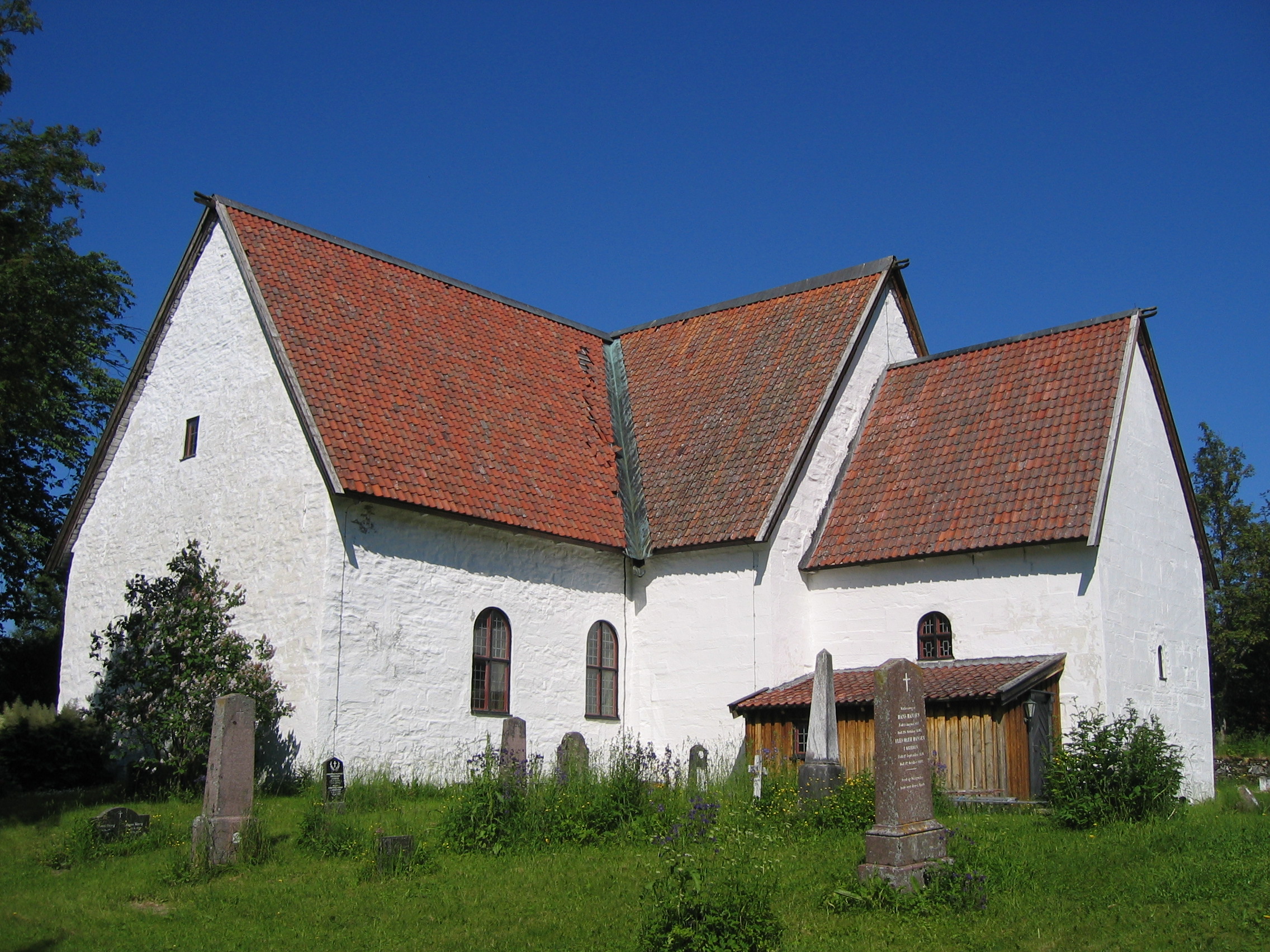
Old Gildeskål Church
In 1881, the parish of Gildeskål built a new church one hundred meters west of the old one. The new building seated 750 people, nearly three times the capacity of its predecessor, and met the legal requirement that all rural churches accommodate at least 30 percent of their parishioners. The old church was closed and turned into a museum. It was, by then, roughly 750 years old. It had been considered too small for the parish's needs. It had not been considered too old to stand.
A King's Church at the Edge of the Known World
The earliest historical records mentioning Old Gildeskål Church date to 1432, but the building itself is far older. Archaeological and architectural evidence points to a construction date around 1130, possibly commissioned by King Øystein Magnusson, who was known for building churches and public works across his kingdom. At that date, Gildeskål was near the northern limit of organized Christendom in Scandinavia. The white stone church was built in the long church style, with a rectangular nave and a narrower, almost square chancel set under a lower roofline. It was a modest building by European standards, but at 67 degrees north latitude, any stone church was a statement of permanence in a landscape that seemed designed to discourage it.
Fire and Reinvention
Around 1710, a major fire gutted the interior, destroying all the church's furniture and decoration. The walls survived, as stone walls do, and the parish rebuilt rather than replaced. An addition on the south side transformed the floor plan into a half-cruciform shape. The pulpit that stands in the church today was painted by Gottfried Ezekiel, an artist who received his commission as a painter in Bergen in 1744 and arrived in northern Norway around 1751. Ezekiel spent years working through the region's churches, painting altarpieces and pulpits with the vivid, somewhat naive style characteristic of provincial Scandinavian religious art. His altarpiece for the new Gildeskål Church, built a century and a half later, still hangs there today. The old church also retains its enclosed pew for the social elite and the simpler pews assigned to parishioners of lower rank, a tangible reminder that spiritual equality and social equality were not the same thing in 18th-century Norway.
Birthplace of Norwegian Democracy
In 1814, Old Gildeskål Church played a role far beyond its size. Together with more than 300 other parish churches across Norway, it served as a polling station for elections to the Norwegian Constituent Assembly, the body that would write the Constitution of Norway at Eidsvoll Manor. These were Norway's first national elections. Each church parish functioned as a constituency, electing delegates called "electors" who then gathered at the county level to choose the representatives who would travel to Eidsvoll. The system was improvised, the turnout uncertain, and the entire process unfolded against the backdrop of the Napoleonic Wars' end and the dissolution of the union between Denmark and Norway. That a stone church above the Arctic Circle participated in this foundational democratic moment speaks to the reach of the ambition behind it.
Too Small to Serve, Too Old to Lose
By the mid-19th century, the parish had outgrown its medieval church. A law passed in 1851 required rural churches to seat at least 30 percent of their parish members, and Old Gildeskål's 275-person capacity fell well short. Rather than demolish and rebuild, the parish chose to build anew on the same property, leaving the old church standing just a hundred meters away. The new Gildeskål Church, completed in 1881, took over all active parish functions. The old church, relieved of its duties, became a museum of itself. Its pipe organ, its votive ship hanging in the nave, its painted pulpit, its stratified pews - all remained in place, not as working furnishings but as artifacts of a community's nine centuries of worship. Today, visitors to the village of Inndyr in Nordland county can stand between the two churches and see nearly a millennium of Norwegian religious architecture in a single glance.
From the Air
Located at 67.06°N, 14.05°E just north of the village of Inndyr in Gildeskål Municipality, Nordland county, Norway. The white stone church is visible from the air adjacent to the larger 1881 Gildeskål Church on the same property. Best viewed at 2,000-3,000 feet altitude. The coastal setting along the Nordland fjord landscape provides scenic context. Nearest airport: Bodø Airport (ENBO) approximately 40 km north-northeast. Weather is typical of coastal Nordland with frequent clouds and precipitation.