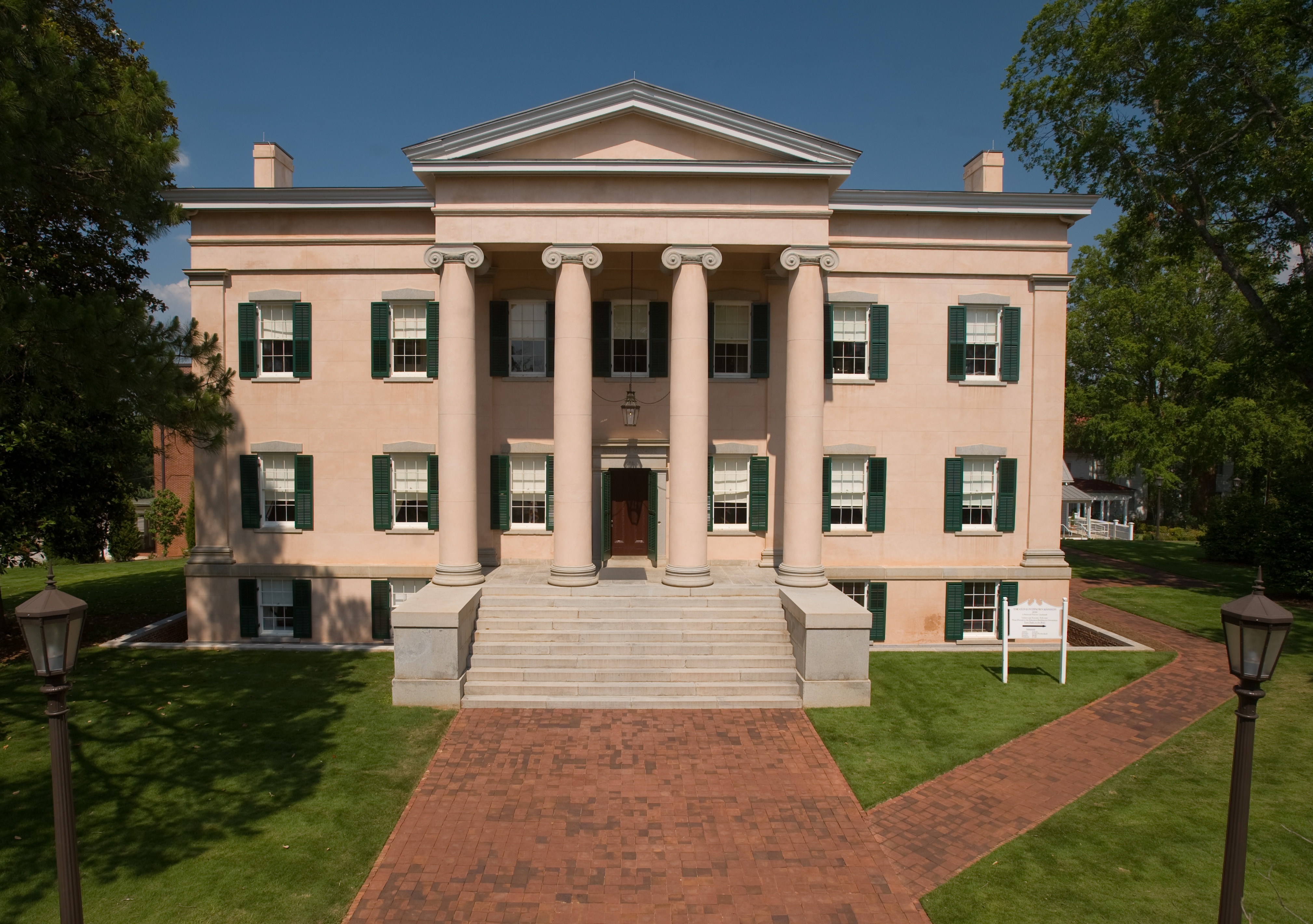
Old Governor's Mansion, Milledgeville
On the night of November 23, 1864, General William Tecumseh Sherman ate dinner in someone else's dining room. The someone was Governor Joseph E. Brown, who had already fled Milledgeville as Union troops poured into Georgia's capital. Sherman settled into the mansion's family dining room, its fine plaster walls and Ionic columns now framing a very different kind of state business. The building he commandeered -- a stuccoed-brick Greek Revival temple completed in 1839 -- had housed eight Georgia governors across a quarter-century of political ambition, cotton wealth, and the institution of slavery. Sherman claimed it as a prize. But the mansion outlasted the general, the war, and even the capital itself.
A Capital Built from Treaty Land
Milledgeville owes its existence to a land deal. The 1802 Treaty of Fort Wilkinson compelled the Muscogee Creek Nation to cede territory west of the Oconee River, and within two years Georgia had laid out a new capital on the freshly acquired ground, naming it for Governor John Milledge. The city's grid, modeled after Savannah and Washington, D.C., was designed to project authority. By the 1830s, Milledgeville needed an executive residence to match. The state legislature commissioned Irish-born architect Charles B. Cluskey, who delivered what many consider his finest work: a two-story, stuccoed-brick mansion crowned by a circular cupola, its west facade dominated by a four-columned Ionic portico with granite bases and capitals. Completed in 1839 for Georgia's chief executives, it became the first of the state's three official governor's mansions.
Governors, Power, and Enslaved Labor
Eight governors called the mansion home between 1839 and 1868, from Charles McDonald to Rufus Bullock. It was a stage for political theater and social display -- state dinners, legislative receptions, the performative grandeur of antebellum Southern power. Governors George Crawford and Howell Cobb entertained national dignitaries beneath the pedimented gable. But the mansion ran on the labor of enslaved people. Black carpenters and masons had built much of Milledgeville's grand architecture, and enslaved domestic workers maintained the governor's household, cooked the meals, tended the grounds. Today the museum's mission explicitly interprets the lives of both the free and the enslaved who occupied the building, confronting the institution that underwrote its elegance.
Sherman's Prize
When Sherman's forces reached Milledgeville in November 1864 during the March to the Sea, Georgia's capital was defenseless. Governor Brown had already evacuated. Union soldiers marched into the statehouse, held a mock legislative session repealing Georgia's ordinance of secession, and helped themselves to the contents of the state arsenal. Sherman himself chose the governor's mansion as his headquarters. The general spent one night there -- sleeping, according to local tradition, in the family dining room rather than the governor's bed. His army moved on the next morning, leaving the mansion intact. Unlike much of what lay in Sherman's path, the building survived the march without destruction, its columns and cupola standing as they had for twenty-five years.
From Dormitory to Museum
After the capital moved to Atlanta in 1868, the mansion's grandeur served humbler purposes. It became a boarding house, then passed to the newly organized Georgia Military and Agricultural College, and later to Georgia Normal and Industrial College -- now Georgia College and State University. For decades, students slept in rooms where governors once held court; the school's president kept an apartment on the second floor. The ground floor opened for tours in 1967, but the building's full transformation came between 2001 and 2005, when a $9.5 million restoration funded by the Georgia General Assembly and the Woodruff Foundation returned the mansion to its circa 1851 appearance under Governor Howell Cobb. The effort restored original paint colors, room layouts, and period furnishings down to the arched stone lintels and pilastered corners.
A Living Landmark
The Old Governor's Mansion was designated a National Historic Landmark in 1973 for its architectural significance. In 2015, it joined a select group as a Smithsonian Institution affiliate -- one of only six in Georgia. Today, it operates as an accredited museum of the American Alliance of Museums, open to the public six days a week. Tours move through the restored rooms on the hour, tracing the building's arc from seat of power to war prize to college dormitory to public museum. The mansion sits at the corner of Clarke and Greene Streets, its manicured grounds bordered by a brick retaining wall topped with a low white fence, the Ionic columns still catching afternoon light exactly as Cluskey intended nearly two centuries ago.
From the Air
Located at 33.079N, 83.231W in central Milledgeville, Georgia, on the campus of Georgia College and State University. The mansion's white-columned facade and cupola are visible at lower altitudes among the tree-lined campus. Milledgeville sits along the Oconee River in Baldwin County, central Georgia. Nearest airports: Baldwin County Airport (KMLJ) approximately 3nm southeast, Middle Georgia Regional Airport (KMCN) in Macon approximately 25nm southwest. The surrounding terrain is gently rolling piedmont with scattered hardwood forests.