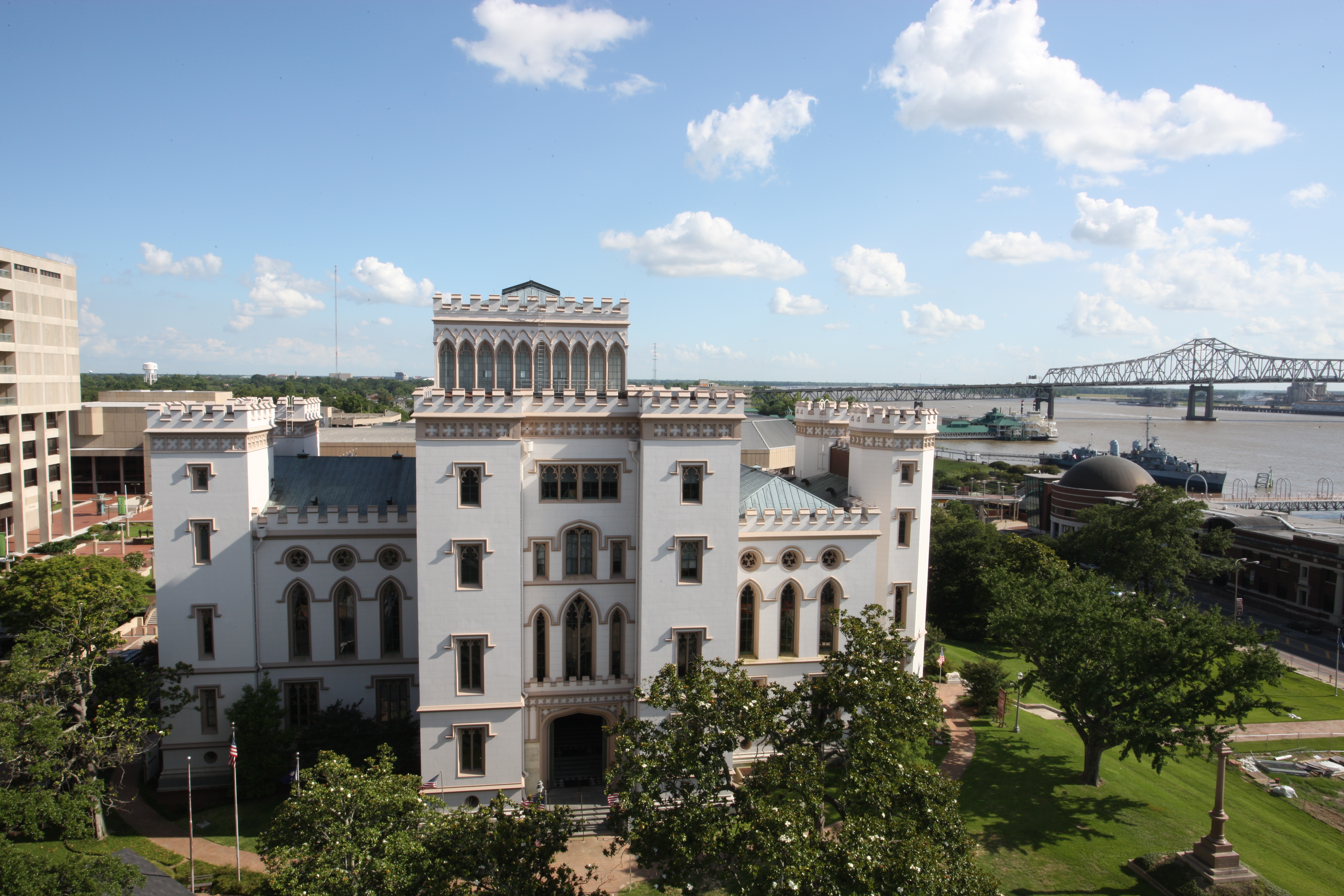
Old Louisiana State Capitol
Most state capitols aspire to classical grandeur: marble columns, polished domes, the usual geometry of democracy. Louisiana's original statehouse aimed for something stranger. Perched on a bluff above the Mississippi River in Baton Rouge, the Old Louisiana State Capitol looks like a medieval castle that wandered across the Atlantic and decided to stay. Its crenellated towers and Gothic arches were so theatrical that Mark Twain reportedly mocked the building as a monument to bad taste. But the castle has outlasted every critic, surviving Union occupation, two fires, decades of abandonment, and a complete gutting -- only to be rebuilt, each time, by Louisianans who refused to let it fall.
A Castle for a Legislature
When the building was completed in 1852, its design was a deliberate provocation. Gothic Revival architecture was an unusual choice for a government building in the American South, where neoclassical temples were the norm. But Louisiana has never been a normal state, and its capitol reflected that defiance. The building was constructed to both look like and function like a castle, earning it a constellation of local nicknames: the Louisiana Castle, the Castle of Baton Rouge, the Castle on the River. For nearly a decade, legislators debated the fate of the state beneath pointed arches and stone battlements, governing from a building that seemed designed for a different century entirely. The building was added to the National Register of Historic Places on January 12, 1973, and designated a National Historic Landmark on May 30, 1974.
Fire, Occupation, and Ruin
The Civil War nearly destroyed the castle. In 1862, Union Admiral David Farragut captured New Orleans, and Louisiana's seat of government fled from Baton Rouge. Federal troops moved into the statehouse, converting it first into a prison and then into a garrison for African-American soldiers under General Culver Grover. While serving as a garrison, the building caught fire twice, reducing Louisiana's proud capitol to a gutted, empty shell. The Union Army eventually abandoned the ruin. For twenty years, the old gray castle stood open to the sky, its walls blackened, its interior gone. It took until 1882 for architect William A. Freret to complete a total reconstruction, installing the spiral staircase and stained glass dome that remain the building's most breathtaking features today.
Abandoned Again
The rebuilt statehouse served Louisiana's legislature for another half century, but by the late 1920s the state had outgrown it. Governor Huey P. Long championed the construction of a new, towering Art Deco capitol nearby, and when that building opened in 1932, the old castle was abandoned once more. Over the following decades, it housed an unlikely parade of tenants: federally-chartered veterans organizations, offices of the Works Progress Administration, and various state agencies. The building endured, but without a clear purpose, it drifted toward neglect. That a structure this distinctive could sit largely forgotten for decades speaks to a peculiar American tendency to overlook what is right in front of us.
The Ghost Who Tells the Tale
Restored in the 1990s, the Old State Capitol reopened as the Museum of Political History, with free admission and a refreshed exterior now finished in shades of tan stucco rather than its former gray. The museum's signature experience is The Ghost of the Castle, a twelve-minute theatrical production in which visitors encounter the spirit of Sarah Morgan Dawson, a young Baton Rouge woman who loved the castle and documented its Civil War ordeal in her diary, later published as Sarah Morgan: The Civil War Diary of a Southern Woman. Through Sarah's ghost, the building's trials come alive -- fire, abandonment, resurrection. An interactive gallery lets visitors explore the colorful history of Louisiana's governors, including the towering and controversial Huey P. Long. Each year, an annual ball brings 18th- and 19th-century French traditions back into the castle's halls, with participants in period dress dancing beneath the stained glass dome.
The Bluff Above the River
The Old State Capitol sits within walking distance of some of Baton Rouge's most significant landmarks: the current Art Deco capitol tower, the Old Louisiana Governor's Mansion, the Louisiana Arts and Science Museum, St. Joseph Cathedral, and the Shaw Center for the Arts. Together, they form a compact cultural corridor along the Mississippi bluff. But the castle remains the most visually arresting of them all, its Gothic silhouette unmistakable against the flat Louisiana sky. From the air, the building's crenellated roofline and the green lawns of its riverfront setting stand out sharply against downtown Baton Rouge's modern grid -- a reminder that some of America's most fascinating architecture was born from its most eccentric impulses.
From the Air
Located at 30.447N, 91.189W on a Mississippi River bluff in downtown Baton Rouge. The Gothic castle-like structure with its crenellated roofline is visible at lower altitudes against the modern downtown grid. Best viewed from 2,000-3,000 ft AGL approaching from the river side. Nearby airports: KBTR (Baton Rouge Metropolitan, 7 nm north), KHZR (False River Regional, 20 nm northwest). The current tall Art Deco Louisiana State Capitol tower is a useful landmark nearby.