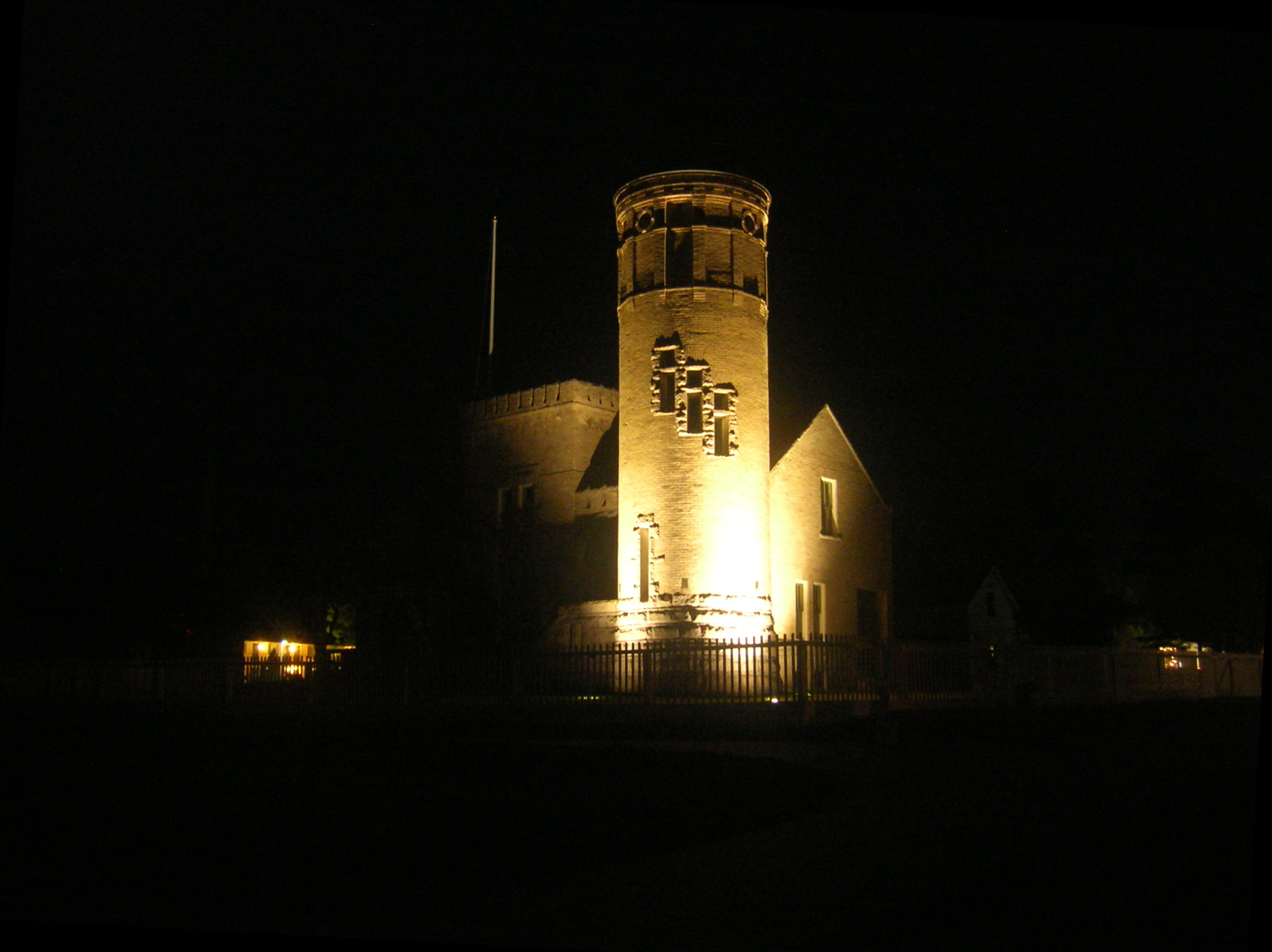
Old Mackinac Point Light
During one particularly humid two-week stretch, the fog signal crew at Old Mackinac Point burned 52 cords of stove wood to keep steam up for the foghorn. That is roughly 4,000 cubic feet of timber, consumed in a fortnight, to produce a sound that could cut through the dense gray blanket that regularly choked the Straits of Mackinac. The fog came first. The lighthouse grew out of it. And when the Mackinac Bridge opened on November 1, 1957, the light went dark the same day -- replaced not by another beacon, but by a bridge so massive that no mariner could miss the straits entrance again.
Before the Light, There Was Fire
Long before the Lighthouse Board debated where to place a beacon, the Ojibwa people who lived along the straits lit fires on shore to guide waterborne travelers through one of the most dangerous passages in the Great Lakes. European shipping brought larger vessels and greater risk. In 1829, the Bois Blanc Lighthouse was built to help mariners make the westerly turn into the straits and to warn of the shoals surrounding the island. Three years later, Congress placed a lightship on Waugoshance Shoal to mark the western entrance. By 1838, a naval lieutenant named James T. Homans reported the lightship "wholly inadequate" and recommended a permanent light on the point west of Mackinaw Harbor. His recommendation was ignored. In 1854, the Lighthouse Administration placed a light at McGulpin Point instead -- a decision local residents had argued against.
Cream City Brick and a Fresnel Lens
In 1889, the United States Lighthouse Board finally agreed that Mackinaw Point was the right location. Congress initially funded only a steam-powered fog signal, which was built in 1890 and proved so essential in the fog-choked straits that the case for a full lighthouse became irresistible. Congress authorized funding in March 1891, and the Board moved quickly. General contractor John Peter Schmitt of Detroit built the tower and attached keeper's dwelling in 1892 on a foundation of ashlar limestone. The walls were constructed of Cream City brick -- the distinctive pale yellow brick produced from the clay beds around Milwaukee -- trimmed with Indiana limestone. The double-walled cylindrical tower rose to its full height and was capped by a prefabricated octagonal iron lantern housing a fourth-order Fresnel lens. The design was unique in the Great Lakes: a castle-like structure with a picturesque silhouette that made it instantly recognizable.
Guiding the Car Ferries Home
Old Mackinac Point Light served a specific and critical role: guiding the railroad car ferries that linked Michigan's two peninsulas. The SS Chief Wawatam and the SS Sainte Marie operated between Mackinaw City and St. Ignace, carrying rail cars across the straits on runs that could become harrowing in fog and winter ice. The lighthouse beam was described as "particularly valuable" to these ferry crews, who relied on it as their primary visual reference when approaching the Mackinaw City docks. This was the same crossing that eventually demanded something more permanent than ferries. When the Mackinac Bridge opened in 1957, it rendered both the ferry service and the lighthouse obsolete in a single day. The light was deactivated, and the building sat empty.
Castle on the Point
The lighthouse stood neglected for decades before serious restoration began in 2000, with the goal of returning the complex to its appearance around 1910. In 2004, Mackinac State Historic Parks reopened the lightkeeper's quarters and tower to the public as part of the Fort Michilimackinac complex. The original Fresnel lens was placed on display. Beginning in 2018, National Restoration Inc. undertook major exterior and interior masonry work to preserve the distinctive Cream City brick and limestone trim. Today the first floor includes period furnishings, hands-on exhibits where visitors can test nighttime navigation skills and light a miniature Fresnel lens, and costumes that let them dress as a lighthouse keeper. Historic interpreters lead tours up the tower and into the lantern room. The lighthouse sits within Michilimackinac State Park, just a few hundred feet east of the Mackinac Bridge -- the very structure that made it unnecessary.
From the Air
Old Mackinac Point Light is located at approximately 45.788N, -84.729W at the very northern tip of Michigan's Lower Peninsula, immediately east of the Mackinac Bridge's southern anchorage. The castle-like structure with its distinctive Cream City brick is best spotted from 1,500-2,500 feet AGL. It sits within Fort Michilimackinac State Park and is extremely close to the bridge -- look for it just east of the bridge's south tower when approaching from the east. Pellston Regional Airport (KPLN) is approximately 14 nm south-southwest, and Mackinac Island Airport (KMCD) is about 8 nm east. The Mackinac Bridge itself is the dominant visual landmark. Fog is frequent in the straits, especially spring through early summer.