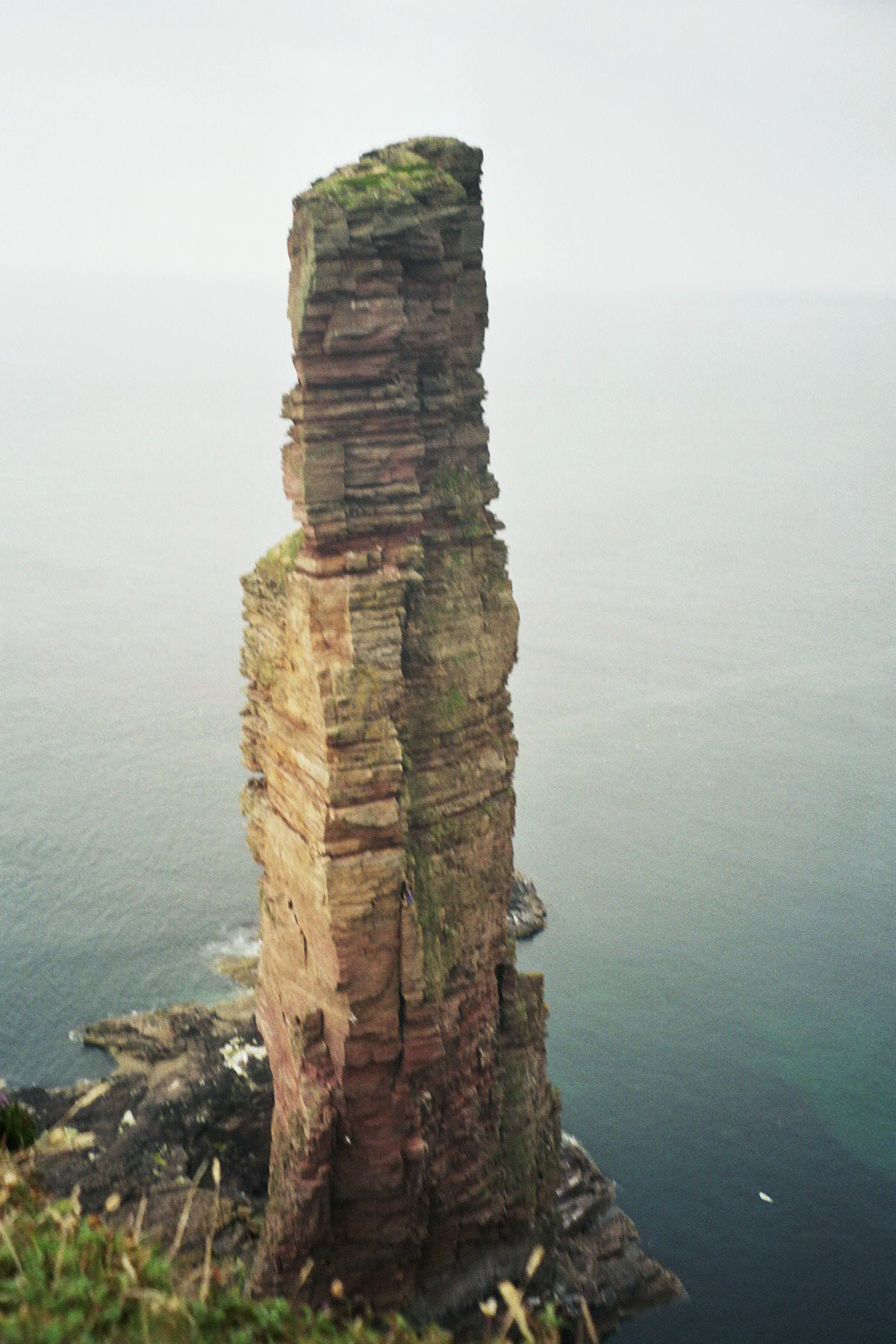
Old Man of Hoy
Fifteen million people watched live on the BBC in July 1967 as three teams of climbers scaled a red sandstone pillar rising 137 metres from the Atlantic surf off the west coast of Hoy, in Orkney. The Old Man of Hoy had been first climbed only a year earlier, and The Great Climb -- broadcast over three nights -- turned a geological oddity into a national icon. What most viewers did not know is that the stack they were watching is geologically young, probably less than 250 years old, and that it is slowly being destroyed by the same forces that created it. The Old Man is living on borrowed time.
Born from a Headland
The Orkneyinga Saga, written around 1230, makes no mention of the Old Man. A Blaeu map from 1600 shows a headland where the stack now stands, not a freestanding pillar. Sometime between the 17th and 18th centuries, sea erosion cut through the headland to isolate the column. A further storm in the early 19th century washed away one of its two original legs, leaving the single-legged pillar that stands today. The stack is formed from Old Red Sandstone perched on a plinth of basalt, and the forces that carved it -- hydraulic action from Atlantic waves, gales that blow above 8 metres per second for nearly a third of the year -- continue to work. The sea floor drops to 60 metres close to shore, generating high-energy waves that make the western coast of Hoy one of the most erosion-prone shorelines in Britain.
Climbers, Cameras, and Firsts
Chris Bonington, Tom Patey, and Rusty Baillie made the first ascent in 1966, and the 1967 BBC broadcast made them household names. Joe Brown, Ian McNaught-Davis, Pete Crew, and Dougal Haston climbed new routes during the televised event. In 1968, Christine Crawshaw became the first woman to reach the summit. The stack was first soloed in October 1985 by Scots climber Bob Duncan, though Catherine Destivelle's 1997 solo ascent -- made while four months pregnant and captured in the film Rock Queen -- received far more attention. Red Szell became the first blind person to climb it in 2013, and Jesse Dufton became the first blind climber to lead an ascent in 2019, a feat documented in the film Climbing Blind.
From Bonington at 80 to BASE Jumpers
In 2014, Chris Bonington returned to climb the Old Man again to mark his 80th birthday, raising funds for Motor Neuron Disease research after the death of his wife Wendy. The youngest female to reach the summit is Sophia Wood, who was ten years old when she completed the climb in June 2023. Seven routes ascend the stack, the most popular being the original East Face Route, graded E1 5b -- Extremely Severe. A logbook in a Tupperware container sits in a cairn on the summit. Around fifty ascents are made each year. In 2008, Roger Holmes, Gus Hutchison-Brown, and Tim Emmett made the first BASE jump from the top. Hutchison-Brown died eleven days later during a jump in Switzerland.
A Landmark on a Clock
The Old Man can be seen from the Scrabster-to-Stromness ferry, and from certain angles it resembles a human figure standing at the cliff edge -- which is, in geological terms, exactly what it is doing. Erosion is constant. Storms strip material from the base. The basalt plinth that supports the sandstone column is harder than the rock above it, but it is not immune. Geologists consider it possible that the Old Man could collapse overnight. When it does, it will vanish as suddenly as it appeared -- a feature that existed for perhaps three centuries in a landscape shaped over hundreds of millions of years. Until then, it stands: improbable, temporary, and magnificent.
From the Air
Located at 58.886N, 3.432W on the west coast of Hoy, Orkney. The 137m (449 ft) sea stack is clearly visible from the air and from the Scrabster-Stromness ferry route. Best viewed at 1,500-3,000 ft AGL. Rackwick Bay lies immediately to the south. Nearest airports: Kirkwall (EGPA) 20 nm northeast, Wick (EGPC) 30 nm south.