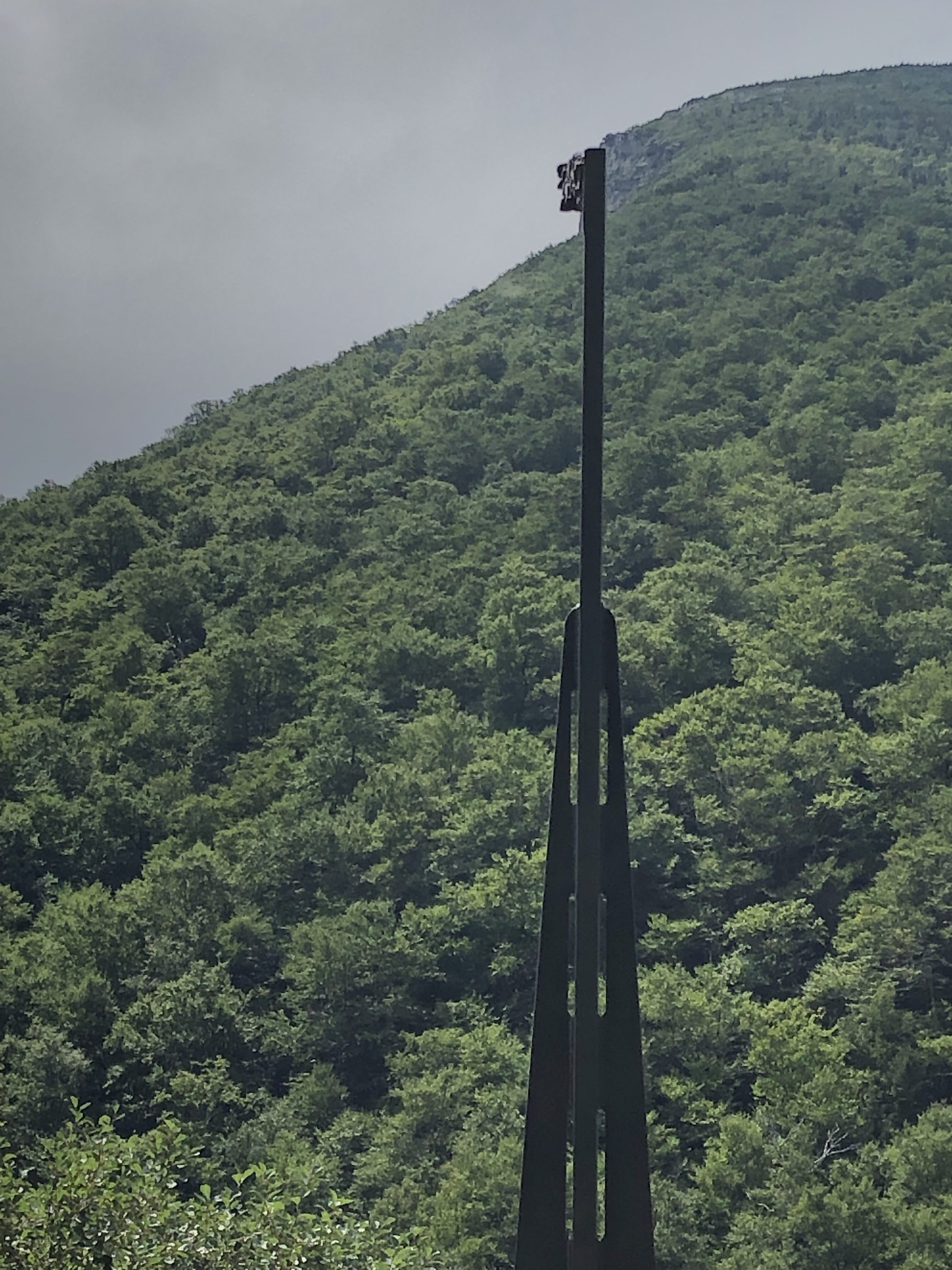
Old Man of the Mountain
Daniel Webster put it best: 'Up in the Mountains of New Hampshire, God Almighty has hung out a sign to show that there He makes men.' The sign he meant was a jagged arrangement of five granite cliff ledges on Cannon Mountain in Franconia Notch that, viewed from the north, resolved into the unmistakable profile of a human face. The Abenaki called it Stone Face. Nathaniel Hawthorne called it the Great Stone Face. New Hampshire put it on license plates, road signs, and eventually the state quarter -- popularly promoted as the only U.S. coin with a profile on both sides. For nearly two centuries, this accidental sculpture of ice and erosion stared out across Profile Lake, the most famous face in New England. Then, between midnight and 2 a.m. on May 3, 2003, it was gone.
Carved by Ice, Claimed by Legend
Franconia Notch is a U-shaped valley gouged by glaciers during the Wisconsin glaciation, the most recent ice age to bury New England under miles of ice. As the glaciers retreated roughly 12,000 years ago, cycles of freezing and thawing cracked the granite bedrock of Cannon Mountain's eastern cliff face. Over millennia, the erosion shaped five distinct ledges into a profile visible from Profile Lake below. The Abenaki told the story of Nis Kizos, born during an eclipse, who became a great leader and fell in love with an Iroquois woman named Tarlo. When sickness called her home, he climbed to the mountaintop and vowed to watch for her return, lighting fires each night to guide her back. She died in her village. When his brother Gezosa climbed to retrieve him the following spring, Nis Kizos had vanished -- but looking back from the trail below, Gezosa saw a stone face gazing out from the cliff. A modern addition to the legend holds that when the Old Man fell in 2003, Nis Kizos was finally reunited with Tarlo.
A Face That Built an Identity
Francis Whitcomb and Luke Brooks, surveyors working Franconia Notch in 1805, became the first white settlers to record the formation. But it was Daniel Webster's writings in the early 1800s that spread the Old Man's fame across the nation. Nathaniel Hawthorne visited in 1832 and published 'The Great Stone Face' in 1850, a short story describing the formation as 'a work of Nature in her mood of majestic playfulness.' President Ulysses S. Grant made the pilgrimage in 1869. By 1945, the profile was enshrined as New Hampshire's official state emblem. It appeared on every passenger car license plate beginning in 1987, and in 2000 it was struck onto the New Hampshire state quarter. Visitors could view it from special pulloffs along Interstate 93 in Franconia Notch State Park. The formation stood roughly 1,200 feet above the lake surface -- the most recognized natural landmark between Maine and the Adirondacks.
Chains, Cement, and a Losing Battle
The same freeze-thaw cycles that created the Old Man were slowly destroying it. By the 1920s, fissures in the formation's 'forehead' had widened enough that workers mended them with chains. In 1957, the state legislature appropriated $25,000 for a more ambitious intervention: 20 tons of fast-drying cement, plastic covering, steel rods, and turnbuckles, plus a concrete gutter to divert rainwater from above. A team from the state highway and park divisions returned each summer to maintain the patchwork. Reverend Guy Roberts had first publicized signs of deterioration as early as 1906, and Governor Rolland H. Spaulding launched a formal preservation effort in 1916. By 1986, vandalizing the Old Man was classified as a criminal offense, punishable by fines up to $3,000. Niels Nielsen and later his son David served as official state-appointed caretakers. Despite all this effort, the mountain had its own timeline.
The Night the Profile Fell
Nobody witnessed the collapse. Sometime between midnight and 2 a.m. on May 3, 2003, the five ledges that composed the Old Man slid from Cannon Mountain's cliff face and tumbled to the talus slopes below. The news traveled across the state like a death in the family. Hundreds gathered at Profile Lake to pay their respects. An official task force led by former Governor Steve Merrill considered proposals for a replica but rejected them all. An architect named Francis Treves designed a walk-in glass profile on the original site -- 250 structural glass panels on a steel and concrete frame connected by a tram -- that won an American Institute of Architects Un-Built Project Award. A state representative proposed a copper reconstruction. None were built. Instead, in 2004, the Old Man of the Mountain Legacy Fund installed coin-operated viewfinders at the base of the cliff, offering a 'before and after' comparison of what had been and what remained -- bare rock.
The Ghost on Every Plate
The Old Man is everywhere in New Hampshire and nowhere on Cannon Mountain. The profile still appears on every state license plate, on highway signs, and in the state emblem. It remains the most potent symbol of the Granite State's identity, perhaps more powerful in absence than it ever was in stone. The Abenaki reading of the loss -- that Nis Kizos was at last freed from his vigil, reunited with Tarlo, the Great Circle rejoined -- offers a gentler way to understand the collapse. Nature created the face through erosion. Nature reclaimed it through the same process. For 12,000 years the mountain held the profile; for 200 of those years, people stared back. Today, visitors stand at the viewfinders, peer up at a blank cliff, and try to imagine what everyone before them saw without trying.
From the Air
Located at 44.16N, 71.68W on Cannon Mountain in Franconia Notch, New Hampshire. The former site of the Old Man sits on the eastern face of Cannon Mountain, visible from Profile Lake below. Franconia Notch State Park and Interstate 93 run through the valley. Nearest airports: Franconia Airport (private), Mount Washington Regional Airport (KHIE) approximately 25 nm northeast, and Lebanon Municipal Airport (KLEB) about 60 nm south. Recommended viewing altitude: 4,000-6,000 ft AGL for the Franconia Notch corridor. Cannon Mountain's Aerial Tramway terminal is a useful visual landmark. Expect turbulence and rapidly changing weather conditions in the White Mountains.