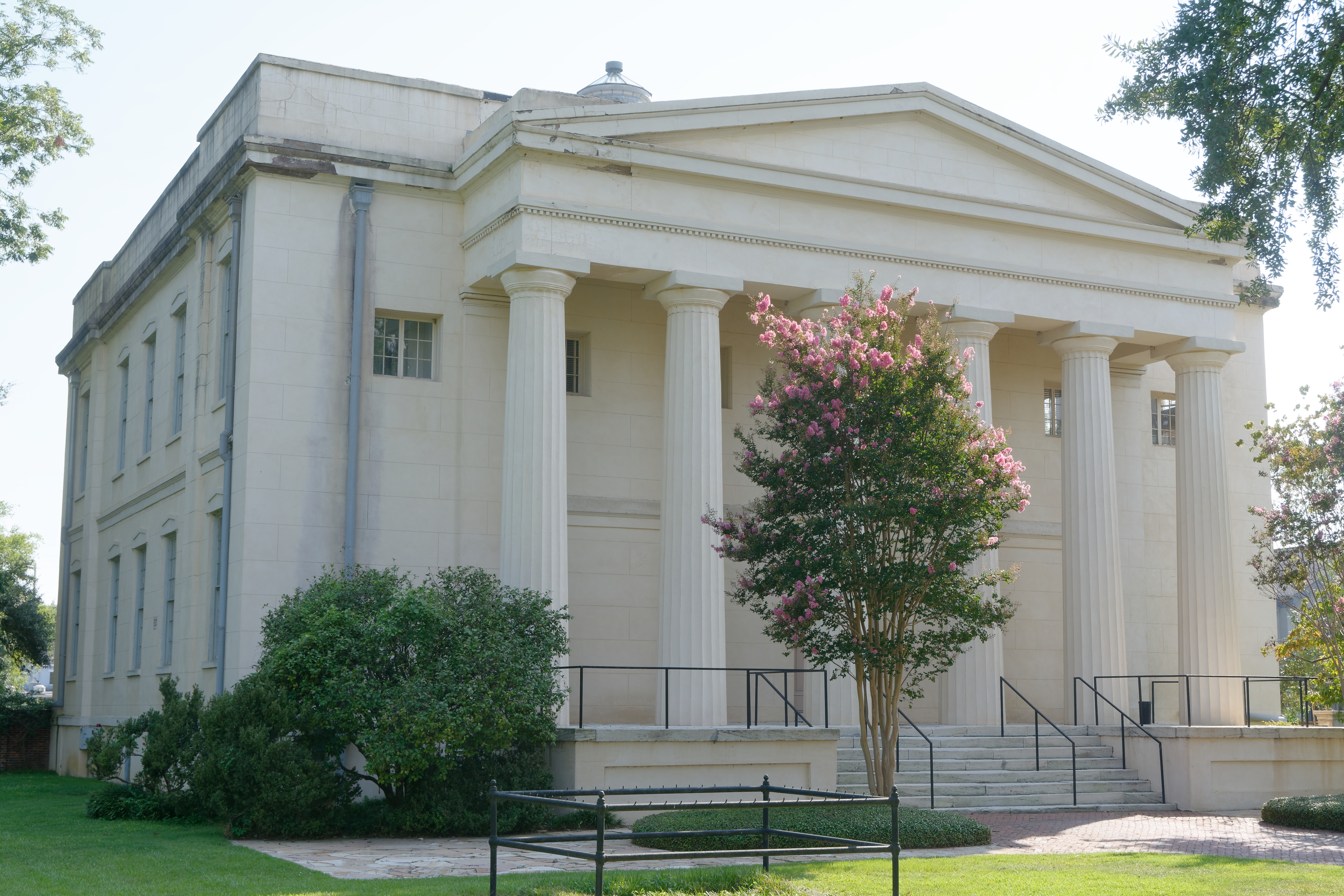
Old Medical College Building
The six Doric columns look like they belong in Athens, not Augusta. Massive, fluted, and supporting a full temple pediment, they front a building that was never a temple at all but a medical school, one that would help reshape how America trains its doctors. Designed by Charles Blaney Cluskey in 1835 for the Medical College of Georgia, the Old Medical College Building cost just $14,567 to construct, ten thousand from the state and five thousand from the city. For that modest sum, Augusta received one of the finest Greek Revival structures in the South, a building so admired for its Classical proportions that it earned praise from architecture critics the moment it was completed. Nearly two centuries later, the columns still stand, the dome still rises, and the building's story reads like a compressed history of American medicine, Southern architecture, and the stubborn persistence of beautiful things.
Where Doctors Learned to Be Doctors
The Medical College of Georgia was chartered in 1829 as a state-chartered private institution, one of the few medical schools in the antebellum South. When Cluskey's building opened six years later, it offered what were generous quarters for the era: lecture halls, laboratory spaces, an anatomy dissecting room lit by a skylight, and a library. Medical education in the 1830s was rough by modern standards, more apprenticeship than science, but the college pushed for rigor. Its faculty became one of the principal forces behind the establishment of the American Medical Association in 1847, advocating for standardized practices, uniform education requirements, and accreditation guidelines at a time when anyone with a shingle could call themselves a physician. The AMA's founding is one of the pivotal moments in American healthcare, and the professors who helped make it happen walked these halls.
Stone That Isn't Stone
Cluskey was one of America's early formally trained architects, and his design for the medical college shows both ambition and resourcefulness. The building is brick, not marble, but its stucco exterior is scored to resemble dressed stone, a common trick of the Greek Revival era that still fools the casual observer. The front portico projects forward with its six columns, giving the building the profile of a Greek temple. Behind the facade, the structure is two stories tall, five bays wide on each side, with a parapet concealing a shallow hip roof that rises to a central dome. Seven small square windows line the second floor above the entrance, their restraint emphasizing the grandeur of the columns below. The effect is one of proportion and authority, a building that announces that what happens inside matters.
A Building Between Lives
The medical school outgrew its temple in 1913, moving to new quarters and eventually becoming part of what is now Augusta University. The building's second act began immediately: the adjacent Richmond Academy claimed it as a vocational training center until 1926. Then came decades of varied tenants. The Sand Hills Garden Club took up residence and left a lasting mark, commissioning the latticework brick fence in 1933 and landscaping the grounds that still frame the building today. Other organizations cycled through, each using the old lecture halls and laboratories for purposes Cluskey never imagined. Through it all, the columns stood, the dome held, and the building waited for someone to recognize what it was.
Resurrection on Telfair Street
Recognition came in stages. The building was listed on the National Register of Historic Places, and then in 1987, the Medical College of Georgia Foundation acquired it and undertook a careful restoration, returning the interior to its nineteenth-century appearance while modernizing the mechanical systems hidden behind the historic walls. In 1996, the building received its highest honor: designation as a National Historic Landmark, recognized not only for Cluskey's architecture but for the medical school's role in founding the AMA and standardizing American medical practice. Today the Old Medical College stands behind Augusta City Hall at the corner of Telfair and 6th Streets, a building that has served as school, training center, garden club headquarters, and landmark. It endures because someone always saw value in those six columns and the ideas they sheltered.
From the Air
Located at 33.47°N, 81.96°W in central downtown Augusta, Georgia, behind Augusta City Hall at the corner of Telfair and 6th Streets. The building's distinctive Greek Revival portico with six Doric columns and central dome are identifiable from lower altitudes. Augusta Regional Airport (KAGS) is approximately 6 miles south. Daniel Field (KDNL), a general aviation airport, sits about 1 nautical mile west of downtown. From altitude, the building is part of Augusta's historic government and institutional core, south of the Savannah River. Look for the cluster of civic buildings near the river's broad southward bend. Best viewed below 2,000 feet AGL to appreciate the columned facade and dome.