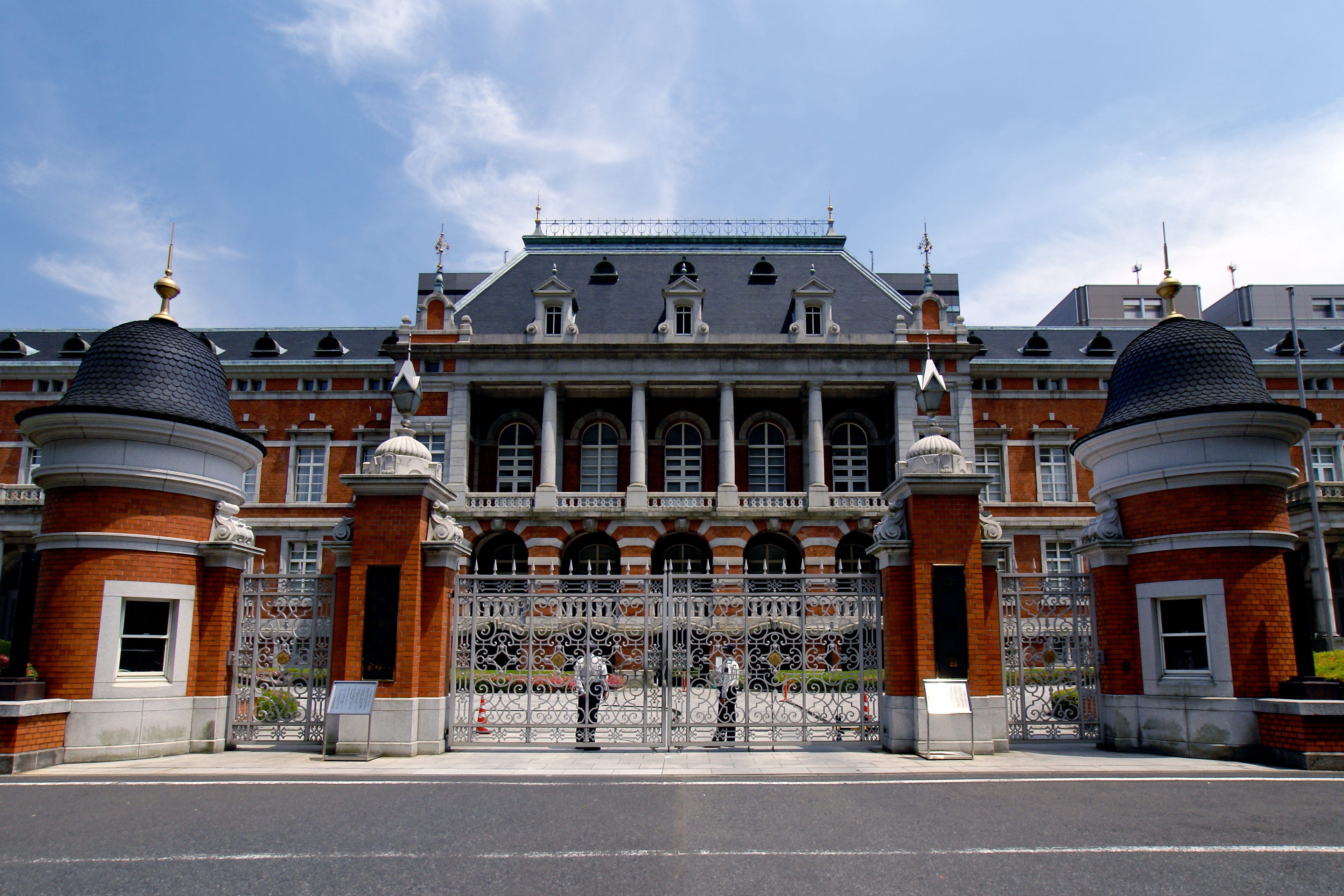
Old Ministry of Justice Building
Among the grey towers of Kasumigaseki, Tokyo's bureaucratic nerve center, a building the color of dried blood refuses to disappear. The Old Ministry of Justice Building -- known simply as the Red-Brick Building, or akarenga-to -- has stood on this ground since 1895, designed by two German architects who never imagined it would outlast an earthquake, a firebombing, and the empire that commissioned it. Before them, the Uesugi clan of the Yonezawa Domain kept their Edo-period residence here, where samurai politics played out behind wooden walls. What replaced those walls was something entirely different: a European-style government palace meant to announce that Japan had arrived among modern nations.
Berlin on the Sumida
Foreign Minister Inoue Kaoru's campaign to modernize Japan's government architecture brought Hermann Ende and Wilhelm Bockmann from Berlin to Tokyo in the late 1880s. The duo designed a cluster of government buildings in the Kasumigaseki district, and the Ministry of Justice headquarters, completed in 1895, became their signature achievement alongside the Supreme Court of Judicature building. The red-brick facade, with its neo-Baroque ornamentation and German precision, was deliberately European -- a visual argument that Japan's legal system now matched the sophistication of its Western counterparts. The building rose on land that had belonged to feudal lords just three decades earlier, embodying the speed of the Meiji transformation. Ende and Bockmann's work represented a specific strategy: hire foreign experts, learn their methods, then build a nation that could stand on equal footing with the powers demanding unequal treaties.
Earthquake and Fire
The Great Kanto Earthquake struck on September 1, 1923, leveling vast swaths of Tokyo and killing over 100,000 people. The Red-Brick Building barely flinched. Its steel-reinforced construction -- unusual for government buildings of its era -- held firm while wooden structures across the city collapsed and burned. The building's luck ran out twenty-two years later. On the night of March 10, 1945, American B-29 bombers dropped incendiary clusters across Tokyo in the deadliest air raid in human history. The firestorm gutted the Ministry of Justice Building, consuming everything inside while the thick brick walls and floor structures held. When the smoke cleared, the shell stood like a hollow tooth among the ruins of Kasumigaseki. The building reopened in 1950, patched together with modifications including a redesigned tiled roof that bore little resemblance to the original.
Restoration and Reinvention
For four decades, the building soldiered on in its compromised form while the Ministry of Justice conducted business inside. In 1990, the ministry relocated its headquarters to a modern 21-story tower next door -- Central Government Office Complex No. 6-A -- and the question of what to do with the aging red-brick structure became urgent. The answer was restoration. In 1994, craftsmen painstakingly returned the building's exterior to its original 1895 appearance, stripping away postwar modifications and recreating the decorative elements that Ende and Bockmann had specified a century before. On December 27, 1994, the restored building was designated an Important Cultural Property, a status that ensures its protection. Today, the building houses the Research and Training Institute of the Ministry of Justice, the Ministry of Justice Library, and a public museum dedicated to the history of Japan's legal system.
Standing Witness in Kasumigaseki
The Old Ministry of Justice Building now occupies an unusual position in Tokyo's landscape. Kasumigaseki is a district of glass and steel high-rises -- the National Diet Building, the Supreme Court, and rows of ministry towers dominate the skyline. The red-brick survivor sits among them like a punctuation mark from another century, a physical reminder that Japan's modern government was literally built by foreign hands during the Meiji era. Visitors entering through the main gate pass guards and step into the museum, where exhibits trace the evolution of Japanese law from feudal codes to modern democracy. The building sits just steps from Sakuradamon Station on the Yurakucho Line, named for the nearby gate where a famous assassination shook the Tokugawa shogunate in 1860. In Kasumigaseki, centuries of Japanese governance compress into a single city block.
From the Air
Located at 35.676N, 139.753E in Kasumigaseki, Chiyoda ward, central Tokyo. From the air, the red-brick building is identifiable by its distinctive rust-colored roof among the modern grey and glass towers of the government district, immediately southeast of the Imperial Palace grounds and moat. Nearest airports: Tokyo Haneda (RJTT) approximately 8 nm south, Narita International (RJAA) approximately 37 nm east-northeast. Best viewed at 2,000-3,000 feet AGL. The Imperial Palace moat system and surrounding gardens provide strong visual reference for locating the Kasumigaseki government complex.