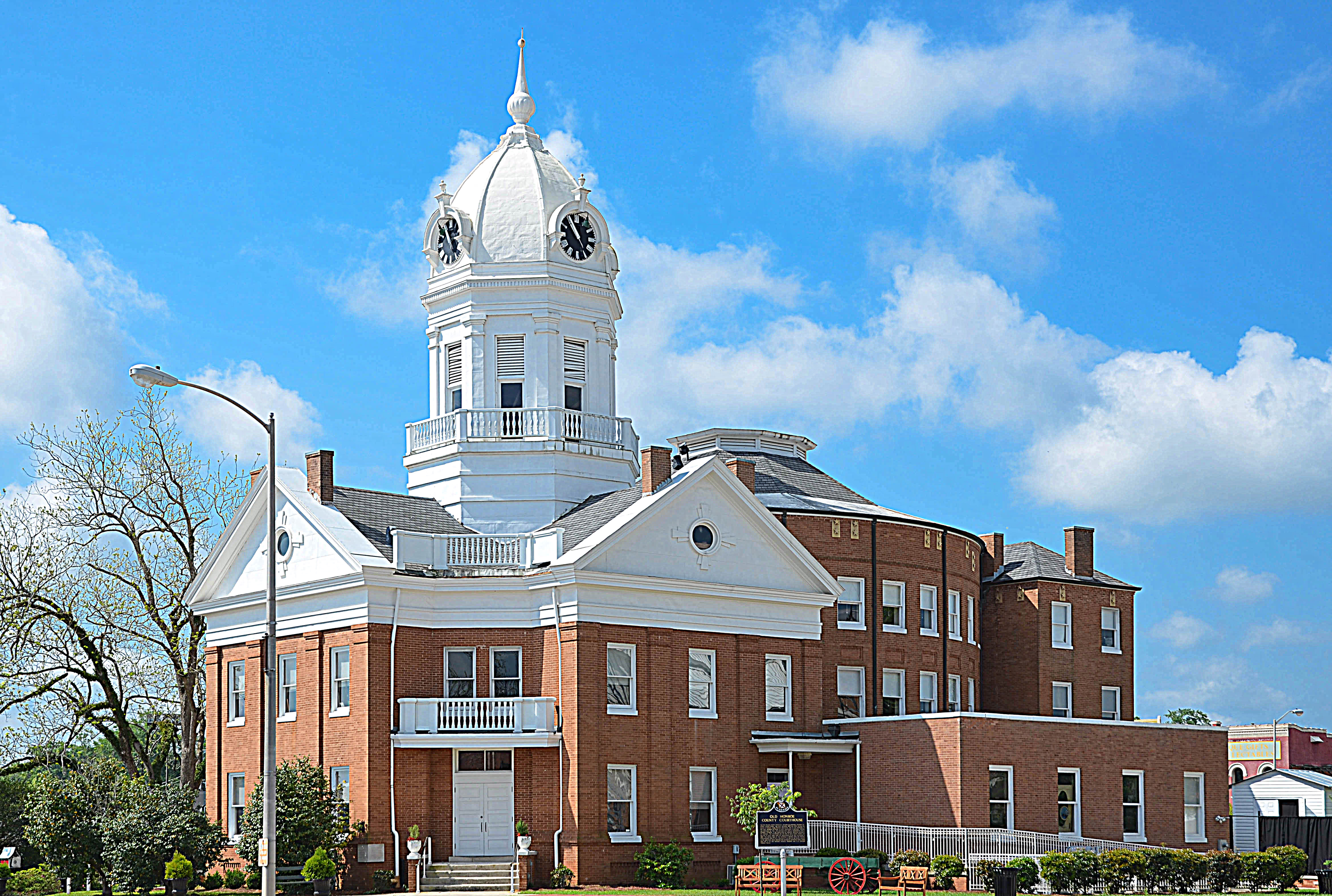
Old Monroe County Courthouse
Two children once played in the yard next door to this courthouse, spinning stories and sharing a typewriter given to them by one of their fathers. Those children were Harper Lee and Truman Capote, and the small brick courthouse on the square in Monroeville, Alabama, would become the most famous courtroom in American fiction. Built in 1903 and designed by architect Andrew Bryan, the Old Monroe County Courthouse stood at the center of a town so steeped in literary history that the Alabama legislature officially designated Monroeville the "Literary Capital of Alabama" in 1997.
Where Fiction Met the Courtroom Floor
Harper Lee grew up just blocks from the courthouse square, and as a girl she sat in the balcony watching her father, attorney Amasa Coleman Lee, practice law. Those afternoons soaked into her imagination. When she published To Kill a Mockingbird in 1960, the fictional Maycomb County Courthouse was unmistakably this building, right down to the segregated balcony seating where Scout Finch watches Atticus defend Tom Robinson. The novel won the Pulitzer Prize in 1961 and has never gone out of print. When Hollywood came calling for the 1962 film starring Gregory Peck, production designers traveled to Monroeville, measured the courtroom, photographed every angle, and recreated it so faithfully on a Universal Studios soundstage that many Alabamians still believe the movie was filmed right here in Monroeville.
Two Writers, One Small Town
Lee and Capote met as children around 1929 when they were both about five years old, growing up as next-door neighbors in Monroeville. While Capote was sensitive and bookish, Lee was tomboyish and fierce, sometimes serving as his protector against bullies. Despite their differences, they became inseparable, inventing stories together and dreaming of literary fame. Both achieved it spectacularly. The character of Dill in To Kill a Mockingbird is widely understood to be based on the young Capote. Today the courthouse museum honors both writers, with permanent exhibits dedicated to each: "Harper Lee: In Her Own Words" and "Truman Capote: A Childhood in Monroeville."
A Stage Inside a Landmark
The courthouse served Monroe County until 1963, when county operations moved to a new building. Rather than let the old structure fade, the community transformed it into a museum restored to its 1930s appearance. It was listed on the National Register of Historic Places in 1973 and designated a National Historic Landmark in 2021. But the building's most remarkable second life happens every April and May, when the Mockingbird Players stage their acclaimed production of To Kill a Mockingbird. The first act unfolds on the courthouse lawn under the Alabama sky. Then the audience files inside, climbs the stairs, and takes seats in the same courtroom balcony where a young Harper Lee once watched her father argue cases. The trial of Tom Robinson plays out on the courtroom floor below, in the very space that inspired it.
The Square and the Story
Monroeville's town square still feels like the small Southern place Lee described. The courthouse sits at its center, a modest brick building with a clock tower, surrounded by the kind of storefronts that define Alabama county seats. The pace is unhurried. An Atticus Finch monument stands near the courthouse entrance, and historical markers dot the surrounding blocks tracing the footsteps of both Lee and Capote. Visitors come from around the world, drawn by a novel that turns sixty-six this year but has lost none of its moral urgency. The building endures not just as architecture but as a physical threshold between fiction and the real place that made it possible.
From the Air
Located at 31.527N, -87.324W in Monroeville, Alabama. The courthouse sits at the center of the town square and is visible as part of the small downtown grid. Monroe County Airport (KMVC) is approximately 3 nautical miles south of town. Best viewed at 2,000-3,000 feet AGL. The town is situated in the coastal plain of southwestern Alabama, with gently rolling terrain and pine forests surrounding the settlement. Mobile Regional Airport (KMOB) lies roughly 80 nautical miles to the south.