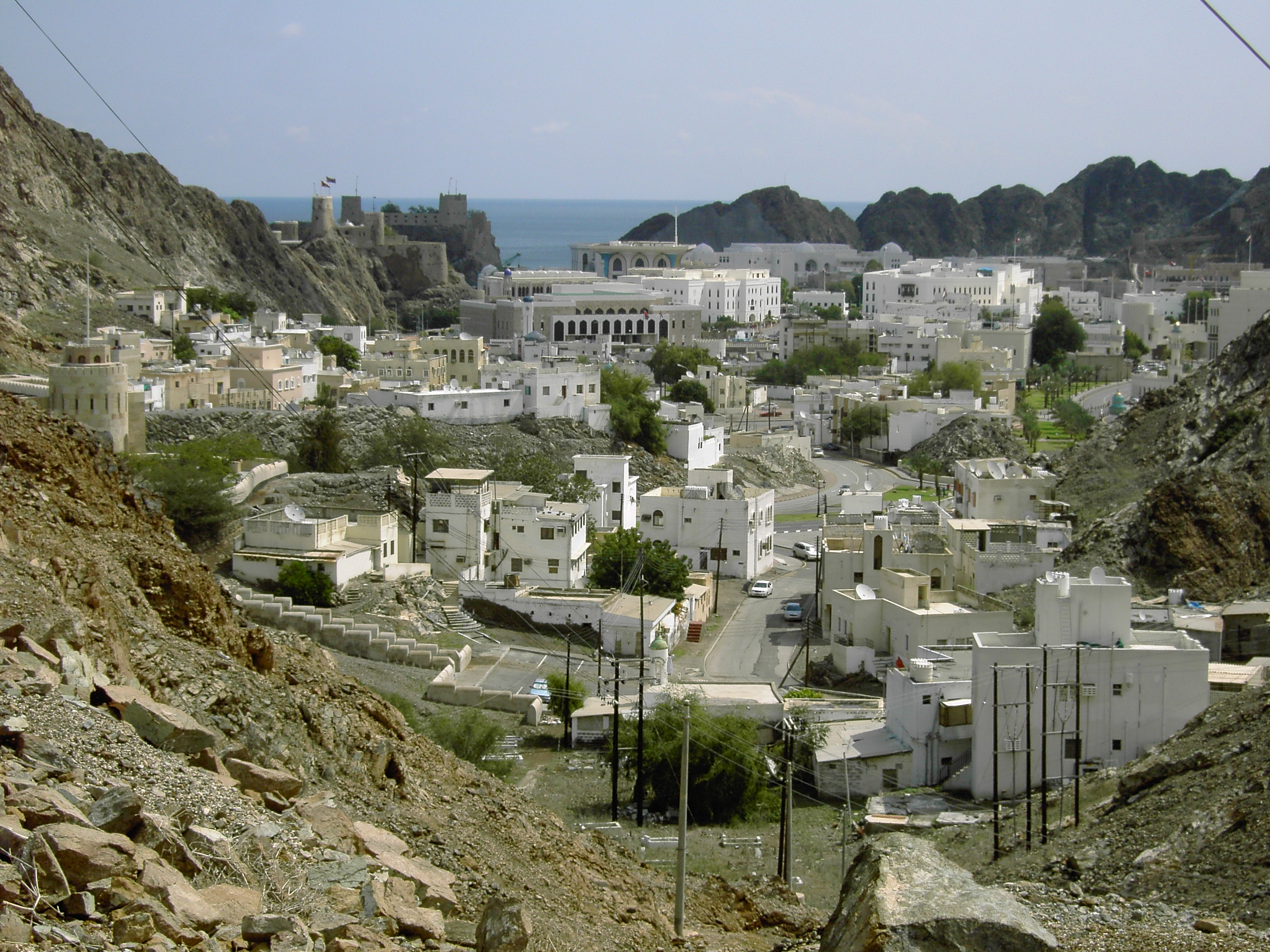
Old Muscat
Until the mid-20th century, the gates of Old Muscat closed three hours after dusk. Anyone found on the streets after that had to carry a lantern. Smoking was banned on main thoroughfares. Public music was forbidden. These were not the rules of a medieval fortress -- they were enforced within living memory, in the original capital of a nation that would soon become one of the wealthiest in the Gulf. Old Muscat operated under a severity that seems almost theatrical now, but the walls and watchtowers that enforced it still stand.
A City Behind Mountains
Old Muscat is separated from the rest of modern Muscat by coastal mountains -- a geographic fact that shaped its entire history. The city sits on a bay on the Gulf of Oman, accessible from the landward side only through passes in the surrounding rock. The Portuguese built a defensive wall with round towers on the western and southern flanks in 1625; the sea and mountains completed the enclosure on the other sides. This natural fortress quality made Muscat both strategically valuable and psychologically isolating. The Muttrah Corniche road now connects Old Muscat to the broader metropolitan area, entering through the Muscat Gate Museum, but the sense of passing through a boundary -- from modern city into something older and more enclosed -- persists.
The Compressed Capital
Within this small perimeter, an extraordinary density of historical landmarks crowds together. Al Alam Palace, the ceremonial seat of the Sultan, faces a 250-meter arcaded plaza. Fort Al Jalali and Fort Al-Mirani guard the harbor from opposing headlands. The National Museum sits across the plaza from the palace. Bait Al Zubair houses a private collection of Omani heritage. The Muscat Gate Museum occupies the entrance portal itself. The Omani French Museum documents the diplomatic relationship between the two nations. And one of the oldest Hindu temples in the Middle East -- the Shiva temple -- testifies to the Indian Ocean trade networks that brought South Asian communities to these shores centuries ago.
Under the Curfew
The strict regulations that governed Old Muscat until Sultan Qaboos took power in 1970 reflected the rule of his father, Said bin Taimur, who spent most of his time in Salalah and kept the capital under tight control. The curfew was not merely a security measure -- it expressed a philosophy of governance that kept Oman isolated from the modernizing forces sweeping the Gulf. The bans on public music and smoking on main streets were part of the same impulse. When Qaboos overthrew his father in a British-supported coup, the opening of Old Muscat to the rhythms of modern life was among the most visible changes. The gates that once closed at dusk now stand permanently open, and the streets host tourists rather than lantern-carrying residents hurrying home.
Between Port and Palace
Old Muscat occupies a thin strip of coast between Port Sultan Qaboos to the west and Al Bustan Beach to the east. The modern government buildings surrounding the palace maintain architectural discipline -- white walls, crenellated rooftops, wooden balconies in traditional Omani style -- creating a visual unity that belies the centuries separating the oldest structures from the newest. The harbor that attracted Ptolemy's attention in the 2nd century, drew Portuguese conquerors in the 16th, and housed the Sultan's navy into the 20th still defines the district's orientation. Everything in Old Muscat faces the water. The mountains at its back are barriers, not vistas. This is a city that has always looked outward, toward the Gulf of Oman and the trade routes beyond.
From the Air
Old Muscat is at approximately 23.61N, 58.59E, a compact walled district on the Gulf of Oman coast. From the air, the twin forts on rocky headlands framing the harbor are the most visible features, with Al Alam Palace between them. The surrounding mountains clearly separate Old Muscat from the broader Muscat metropolitan area. The Muttrah Corniche connects westward to Port Sultan Qaboos. Nearest airport: Muscat International (OOMS).