Old Oakland
The cast-iron columns are the giveaway. Walk along 9th Street between Washington and Broadway, and you will notice them -- tall, slender, decorative pillars framing oversized plate-glass windows that were cutting-edge retail technology in the 1870s. These storefronts were designed to seduce: narrow shop after narrow shop, each window a separate temptation, so that a pedestrian could not walk half a block without passing a dozen chances to spend money. The strategy worked when the Central Pacific Railroad's terminus on 7th Street made this neighborhood the beating commercial heart of a young Oakland. It worked again, more than a century later, when preservationists bet that the same architecture could anchor a very different kind of downtown.
When the Trains Brought Everyone Here
Old Oakland owes its existence to iron rails. In the 1860s, the Central Pacific Railroad constructed a terminus on 7th Street, and Oakland's first real downtown coalesced around it. By the 1870s, elegant brick Victorian hotels were rising in the surrounding blocks to accommodate travelers arriving by train. Their ground floors followed a distinctive pattern: series of narrow shops designed so pedestrians would pass many storefronts in a single block -- an early, physical version of what shopping malls would later attempt with winding corridors. The architectural vocabulary was High Victorian commercial: cast-iron columns, ornamental cornices, and the largest plate-glass windows the era could produce. The Oakland Tribune rented its first small office here, on 9th Street, before growing into the media institution that would define the city's voice for a century.
The Earthquake's Long Shadow
It was not the 1906 San Francisco earthquake that destroyed Old Oakland -- the buildings survived the shaking -- but the demographic shift that followed. As refugees poured across the bay, Oakland's commercial gravity migrated north, pulling the shopping district toward the blocks above 14th Street. The original downtown, suddenly off the main path, began a long, quiet decline. For decades, the Victorian buildings stood half-occupied, their ornamental facades growing dingy, their upper floors emptying out. By mid-century they were architectural orphans: too old to compete with modern retail, not yet old enough for anyone to call them historic. It was the kind of neglect that precedes either demolition or rediscovery, and for years the outcome was genuinely uncertain.
Victorian Row's Careful Revival
Rediscovery won. In the 1970s and 1980s, developers undertook a careful rehabilitation of the block along 9th Street between Washington Street and Broadway, christening it Victorian Row. The work was painstaking -- restoring original brickwork, preserving cast-iron details, matching period-appropriate finishes -- and the result was a streetscape that felt genuinely of its era rather than a theme-park approximation. The 1878 Nicholl Block building anchors the row, its facade a catalog of Victorian commercial design. The restoration attracted attention not just for its aesthetics but for its argument: that old buildings, sensitively handled, could generate the kind of street life that new construction rarely achieved. A weekly Friday farmers' market took root on 9th Street, filling the block with produce stalls and the hum of neighborhood commerce.
A Market Within a Market
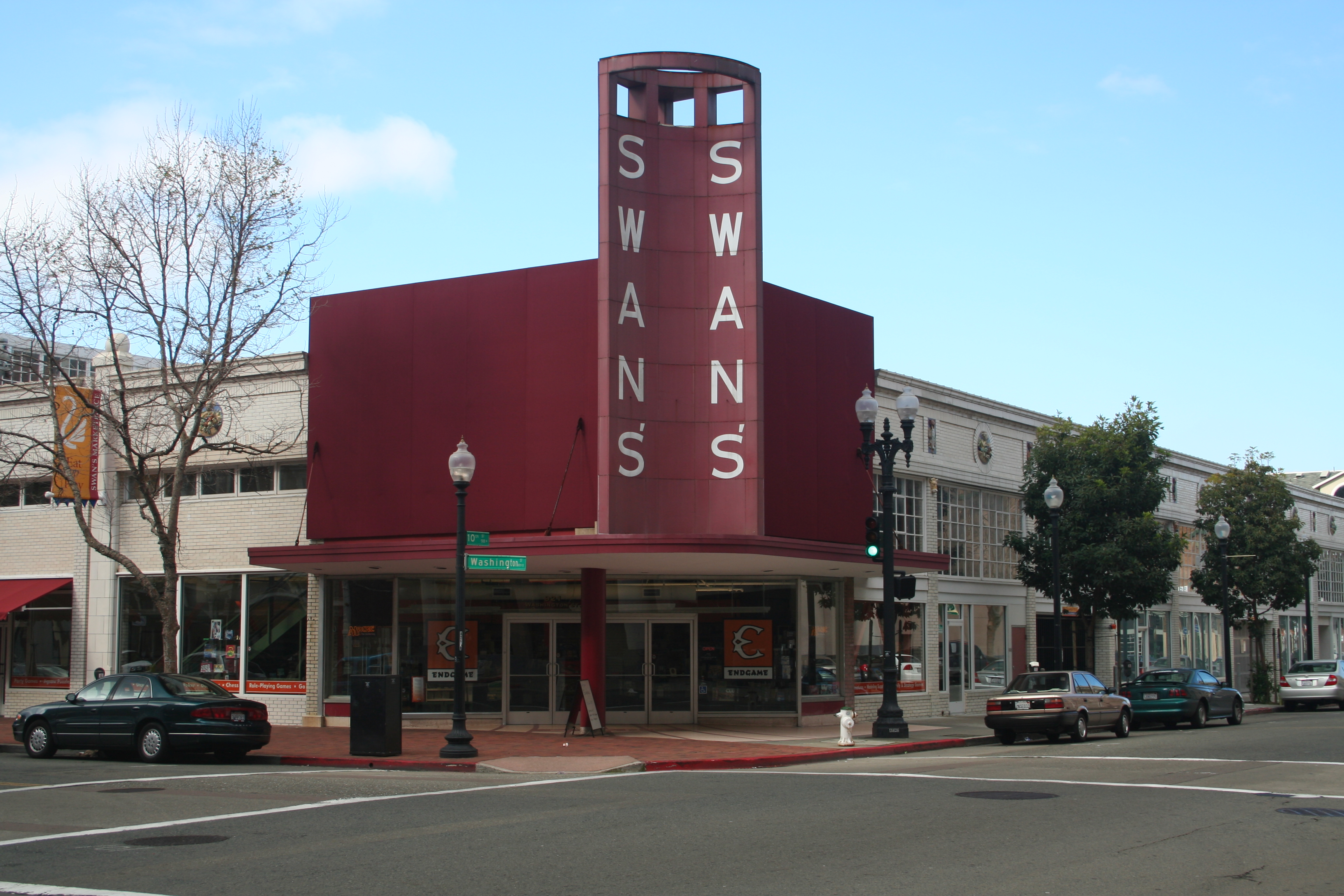
The transformation deepened in the 2000s. Swan's Market, originally the 10th Street Market when it opened in the early twentieth century, was reimagined as an indoor-outdoor gathering place housing restaurants, small businesses, and nonprofits under one roof. It became a model of adaptive reuse -- the bones of a century-old marketplace serving a contemporary community in ways its builders could not have imagined. Bistros and boutiques multiplied along the surrounding blocks. Market-rate condominiums rose nearby, drawn by the transit-oriented logic of a neighborhood flanked by BART stations. In 2022, the Museum of Art and Digital Entertainment relocated here, adding a layer of digital culture to a district defined by nineteenth-century brick. Old Oakland had become what urban planners dream about: a place where preservation and density reinforce each other rather than competing.
The District Between Districts
Part of Old Oakland's appeal is geographic. It sits on the northwest side of Broadway, wedged between the City Center office complex and the waterfront energy of Jack London Square, with Chinatown directly across the street. This position makes it a hinge point -- a place you pass through on the way to somewhere else, which is exactly what the original shopkeepers intended. The narrow storefronts still work their old magic: you slow down, you look in the windows, you stop. On Fridays, when the farmers' market takes over 9th Street, the district feels closest to its founding purpose -- a place built to make strangers linger. The difference is that the strangers now arrive by BART instead of by Central Pacific, and the temptations are organic produce and craft coffee rather than dry goods and haberdashery. The cast-iron columns do not mind.
From the Air
Coordinates: 37.8011°N, 122.274°W. Old Oakland occupies several blocks northwest of Broadway in downtown Oakland, identifiable from the air by the low-rise Victorian rooflines surrounded by taller modern buildings. Best viewed at 2,000-3,000 feet AGL. Metropolitan Oakland International Airport (KOAK) is 5 nm south. The district sits between the distinctive Oakland City Hall tower and the Jack London Square waterfront. The I-880 freeway runs nearby to the west, and the 12th Street BART station is immediately adjacent.