Old Oton Church
Six towers crowned the old church at Oton, two on each arm of its Greek cross floor plan, the dome at the center rising 68.28 meters above the town. It was one of the largest churches in the Philippines, and it mixed architectural traditions the way the Philippines itself mixes cultures - Greek proportions, Byzantine spatial ambition, Gothic verticality, and classical ornamentation, all built by Augustinian friars who had been working this corner of Panay since 1572. For fifty-seven years after its consecration in 1891, the Immaculate Conception Parish Church stood as the monumental heart of Oton, the second Spanish settlement in the Philippines after Cebu. Then, on January 25, 1948, the Lady Caycay Earthquake struck with a magnitude of 7.8, and the six towers fell.
The Second Settlement, The First Chapel
Oton - originally Ogtong - was founded by the Spaniards in 1566, making it the second Spanish settlement in the Philippines after Cebu. The first chapel went up the same year. In 1572, Augustinian friars led by Friar Martin de Rada arrived from Dumangas, where they had been evangelizing the local population, and founded their chapter house in Oton on May 3 - the third such Augustinian establishment after Cebu and Manila. That same year, the church dedicated to Our Lady of the Immaculate Conception was declared a parish. The settlement's strategic importance, however, made it a target. Dutch privateers led by Georges Spillberg destroyed the initial church on September 29, 1614. British forces attacked in 1593. The Dutch returned in 1630. Moro raiders struck in 1662. Each time, the Augustinians rebuilt. The persistence of the mission through four centuries of assault is itself a story of institutional determination bordering on stubbornness.
A Cathedral Built Across Decades
The church that would become one of the Philippines' largest took nearly four decades to complete. Construction began under Friar Demetrio Cobos between 1845 and 1853, establishing the basic structure. Work continued under Friar Joaquin Fernandez, who completed the building in 1882. Interior decorations followed between 1889 and 1890 under Friar Nicolas Gallo, and the church was officially consecrated in 1891. The result was architecturally extraordinary. Designed in the shape of a Greek cross - all four arms of equal length - the church departed from the standard Latin cross plan used in most Philippine churches. Each arm featured two towers, giving the building six towers total. At the center, a large retablo mayor occupied the altar position, a distinctive feature uncommon in Philippine ecclesiastical architecture. The dome's height of 68.28 meters made it visible from considerable distance, a navigational landmark as much as a spiritual one.
Sixty Seconds on a January Morning
The Lady Caycay Earthquake of January 25, 1948, registered an estimated magnitude of 7.8 and caused extensive damage across the western Visayas. For the old Oton Church, the earthquake was final. The six towers that had survived Dutch privateers, British raiders, and Moro attacks could not survive the shaking of the earth beneath their foundations. The church was severely damaged and reduced to rubble. In the aftermath, the ruins were demolished to make way for a replacement. Only two bells and scattered stone remnants survived. The new Immaculate Conception Church, initiated by Fr. Ernesto L. Calvo - the first Filipino parish priest in Oton - took two decades to build, finally blessed on Christmas Day, December 25, 1972. A marker commemorating the consecration was installed at the main entrance by Fr. Renato Elmido in 1988.
The Grotto in the Ruins
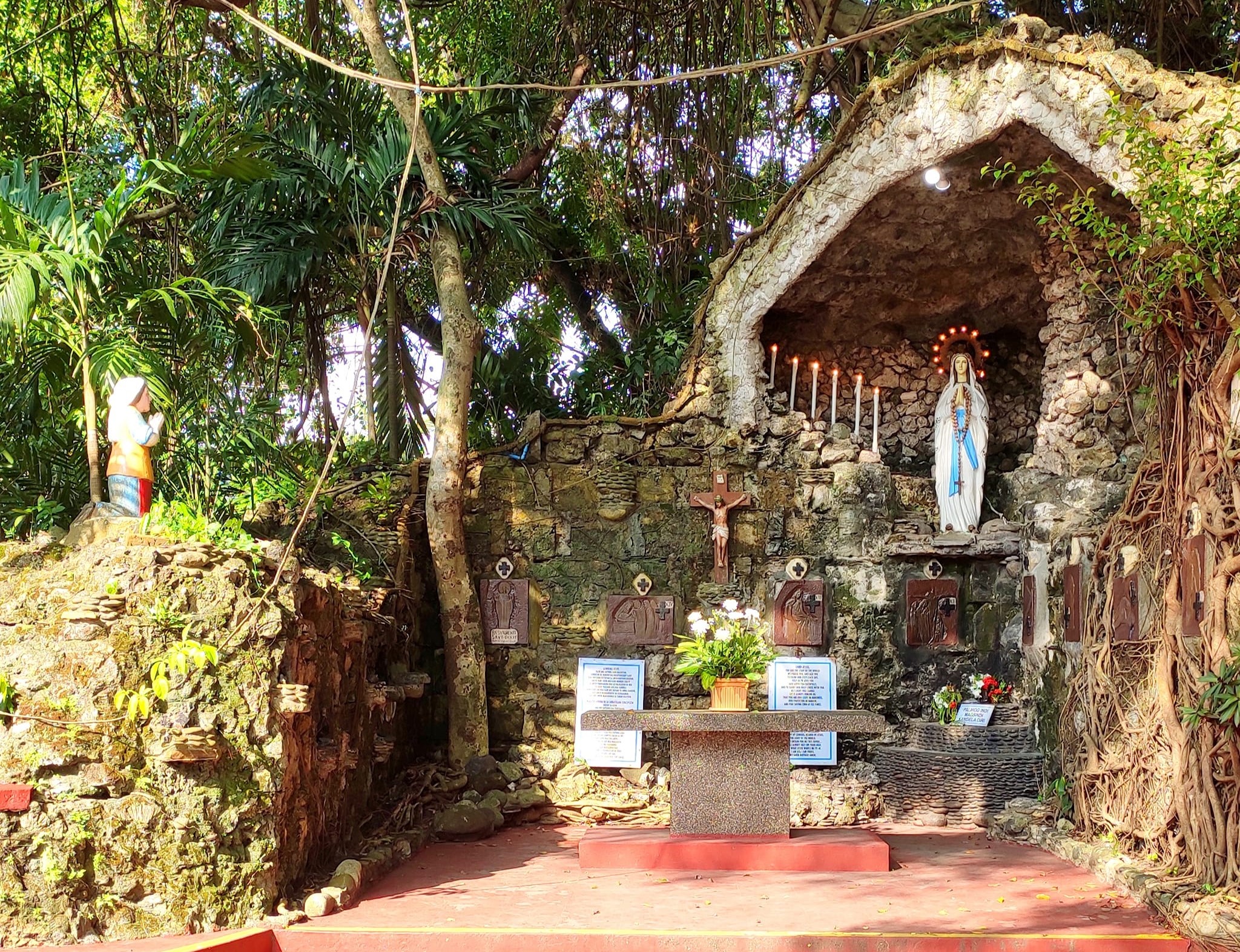
What remains of the old church is small enough to seem like a garden ornament rather than the remnant of a monumental building. A section of the original stone walls survives beside the new church, and the community has transformed it into a grotto - a Catholic devotional space built within the ruins of the structure it replaced. The conversion is quintessentially Filipino: pragmatic, devotional, and unwilling to let anything go entirely to waste. The grotto preserves the physical memory of the old church in a form that continues to serve the community's spiritual life, turning archaeological remnant into living religious space. Photographs from the 1890s and early 1900s show what has been lost - the massive interior naves, the central altar, the six-towered exterior that dominated the Oton skyline. The grotto holds what can be held. The photographs carry everything else.
From the Air
Located at 10.693°N, 122.479°E in Oton, Iloilo, approximately 10 km west of Iloilo City Proper along the coast. The current Immaculate Conception Church occupies the site, with the small remaining ruins of the old church visible as a grotto beside it. Iloilo International Airport (RPVI / ILO) is approximately 15 km to the north-northeast. Best viewed at 1,500-3,000 ft AGL. The town of Oton sits along the coast facing the Panay Gulf.