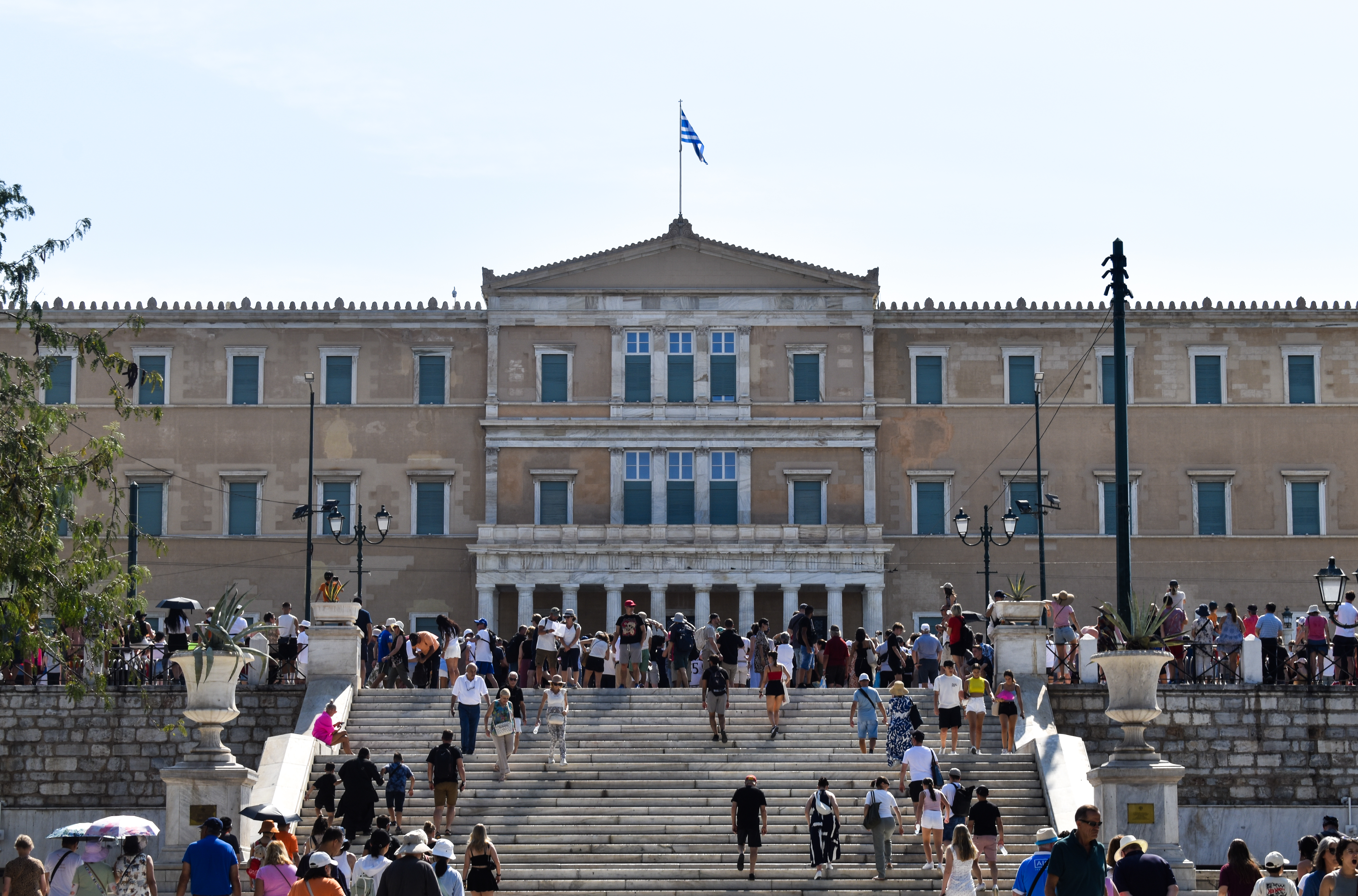
Old Royal Palace
Friedrich von Gartner submitted his designs for the new Greek royal palace to King Ludwig of Bavaria in 1836, and Ludwig, who was paying for the building as a personal loan to his son Otto, took out a red pencil and crossed out the decorative elements one by one. The architect, watching his Renaissance facades reduced to classical austerity, is said to have remarked that the result would look like a barracks. The king did not disagree. The building Gartner finally produced between 1836 and 1843 has stood at the head of Syntagma Square ever since, surviving fire, revolution, and the abolition of the monarchy whose seat it was meant to be. Today it houses the Hellenic Parliament. The barracks remark turned out to be more accurate than anyone intended.
A Capital from Scratch
Athens in 1834 was barely a town. The War of Independence had ended a few years earlier, and the new Greek state had just decided to move its capital from the well-kept port of Nafplio to the dust and ruins of the ancient city. The seventeen-year-old Bavarian prince who had been chosen as King Otto needed a palace, and the four most prominent architects of the day each proposed something different. Stamatios Kleanthis and Eduard Schaubert wanted to build at Omonoia, where the modern city would naturally cluster. Leo von Klenze proposed Kerameikos. Karl Friedrich Schinkel, the great Prussian neoclassicist, suggested putting the palace directly on top of the Acropolis. Ludwig of Bavaria, Otto's father, vetoed that one with particular firmness. Gartner himself made the final choice in 1835, picking a gentle hill where Stadiou and Ermou Streets met, with healthy air and a long view east across the new capital. The foundation stone was laid on 6 February 1836, with Ludwig present and the ambassadors of Britain, France, and Russia in attendance.
The Barracks Aesthetic
Gartner produced 247 detailed drawings from his office in Munich, sourcing the materials with care. Stone came from Hymettus and Lycabettus, marble from Penteli with smaller quantities from Tinos, Paros, Naxos, and even Carrara and Genoa. The wood was Evian. Volunteers from the islands, particularly Tinos, Sifnos, Paros, and Naxos, came to work on the palace without pay, treating the construction as a national project. Gartner returned in 1840 to oversee the interior, bringing the historical painters Johann Schraudolph, Ulrich Halbreiter, and Josef Kranzburger to fill the Trophy Hall with murals of Greek mythology and the Revolution of 1821. King Otto and Queen Amelie moved in during 1843. The building Ludwig had insisted on stripping bare turned out to be exactly what Greek neoclassicism needed: a long, pediment-faced, Doric-porticoed mass that did not compete with the marble ghost on the hill above it.
Constitution Square
Otto had been crowned in 1832, but he had not given Greece a constitution. By September 1843, the Athenians had grown tired of waiting. On the night of 3 September, General Dimitrios Kallergis led a peaceful uprising of soldiers and citizens to the windows of the new palace and demanded a constitutional government. Otto, weighing his options against the soldiers in his courtyard, agreed. The square in front of the palace acquired its modern name that night: Plateia Syntagmatos, Constitution Square. The king who had to be persuaded by a polite revolution to share power was eventually deposed altogether in 1862. His successor George I moved into the palace in 1864, and a fire in 1909 drove the royal family out for good. After the abolition of the monarchy in 1924, the building was used variously as a hospital, a refugee shelter for Greek families fleeing Asia Minor, and a museum, before finding its current vocation.
From Crown to Parliament
In November 1929, the Hellenic government decided to relocate the parliament from its old neoclassical home on Stadiou Street, which is now the National Historical Museum. The architect Andreas Kriezis converted the old throne rooms and ballrooms into legislative chambers, and the Senate took its first sitting in the building on 2 August 1934. The Fifth National Assembly followed on 1 July 1935. The monarchy was restored later that year, but the building stayed parliamentary, an arrangement that survived another period of monarchy, the Axis occupation, the civil war, and the colonels' junta. Out front, the Tomb of the Unknown Soldier was unveiled on 25 March 1932 on the building's western side, the spot facing the square where Kallergis had brought his troops eighty-nine years earlier. The Evzones of the Presidential Guard now keep watch there in the white pleated fustanella, changing the guard every hour, every day, in the rhythm that has come to symbolize the modern republic.
The Building
The palace is a rectangular three-story block, ninety meters along the eastern and western facades and about eighty along the others, with two interior courtyards flanking a tall central wing where the official reception rooms once stood. Doric porticoes mark every entrance except the southern one, which uses Ionic columns instead. Look closely at the windowsills and you can see the two horizontal bands Gartner used to break up the surfaces, the small concession he won from Ludwig's red pencil. The stylistic restraint that Gartner once compared to a barracks reads now as confidence. From the steps of the Old Royal Palace, looking north up Ermou Street, the longest avenue in nineteenth-century Athens still runs straight to the Acropolis on the secondary axis. Gartner planned that alignment too. The building knows what it is looking at.
From the Air
The Old Royal Palace stands at 37.975 N, 23.737 E in central Athens, facing west onto Syntagma Square at the eastern end of Ermou Street. The building is part of a tightly packed neoclassical district near the Acropolis (1.5 km southwest) and the National Garden (immediately east). Best viewed from 2,000-4,000 ft AGL, particularly during the morning Grand Change of the Guard on Sundays. Nearest airport: Athens International Airport Eleftherios Venizelos (LGAV / ATH), 30 km east. Athens has restricted airspace over the city center; respect VFR corridors and minimum altitudes.