Old Sacramento: Where the Gold Rush Never Ended
Beneath the wooden boardwalks of Old Sacramento, tunnels run in the dark. They are the original ground level, sealed away when the city made one of the boldest infrastructure decisions in American history: rather than abandon a flood-prone downtown, Sacramento raised its streets an entire story. Walk through Old Sacramento today and you are walking on a second floor that became the first, above storefronts and sidewalks that were simply filled in and forgotten. The district that grew up along the Sacramento River waterfront in the 1850s now looks much as it did when gold seekers, railroad barons, and Pony Express riders defined what California could become.
A City Built on Mud and Ambition
Sacramento owed its existence to John Sutter's fort, established in 1839, but the fort sat too far from the Sacramento River to capture the commerce flowing to and from San Francisco. So the city grew along the waterfront instead, and the river punished it for the choice. Floods struck with regularity, turning streets into canals and basements into swimming pools. By the 1860s, the city had had enough. Rather than relocate, Sacramento raised its downtown by as much as a full story, jacking up buildings and filling in the gaps. The old street level became a subterranean world of abandoned storefronts and passageways. Some of those tunnels survive today, accessible through guided tours that take visitors into the buried city beneath the modern one.
Wrought Iron and Spanish Ghosts
Visitors often assume Old Sacramento's architecture reflects Victorian gold miners and their rough frontier tastes. The reality is more surprising. The wrought-iron balconies, arched doorways, and full-height windows that line 2nd Street owe more to Havana, Seville, and San Juan than to London or New York. During California's years under Spanish and then Mexican rule, immigrants arrived from across the Atlantic world, including Spain, the Canary Islands, and the Spanish colonies. They brought with them an architectural vocabulary that took root in the Sacramento Valley and persisted through the Gold Rush building boom. Sacramento's oldest structures actually predate the Haussmann-era renovation of Paris, which produced a similar style of wrought-iron-accented facades. The resemblance is coincidental; if anything, Sacramento got there first.
Landmarks That Rewrote the Map
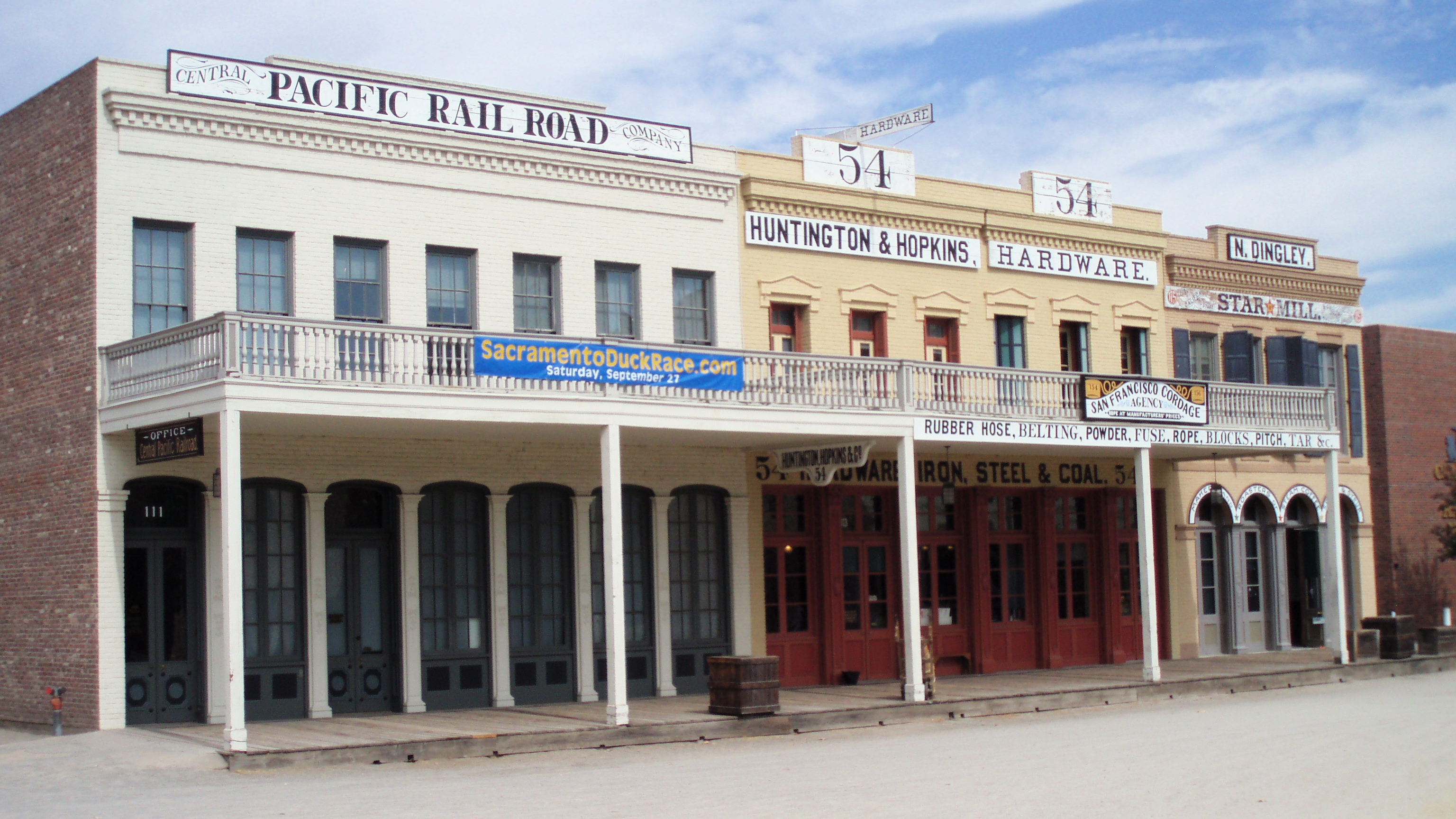
Several buildings in the district played outsized roles in American history. The B. F. Hastings Building, an unassuming two-story brick structure at the corner of 2nd and J Streets, served as the western terminus of the Pony Express from 1860 to 1861, the far end of an 1,800-mile chain of riders stretching to St. Joseph, Missouri. The same building housed the first California Supreme Court. A few blocks away stands the Big Four House, where Collis Huntington, Mark Hopkins, Leland Stanford, and Charles Crocker planned the Central Pacific Railroad, the western half of the transcontinental line that would stitch the continent together. The Lady Adams Building, the oldest non-residential structure in Old Sacramento, dates to an era when Sacramento was less a city than a collection of tents and raw lumber arranged around an overwhelming sense of possibility.
Rescue from the Wrecking Ball
By the 1960s, Old Sacramento had deteriorated into a district of flophouses and empty storefronts, and demolition seemed inevitable. Instead, preservationists mounted a campaign modeled on Colonial Williamsburg, the Virginia outdoor history museum. Historically significant buildings were stabilized, moved, or painstakingly reconstructed. Those beyond saving were demolished to make room for faithful reproductions. The effort produced the Old Sacramento Historic District, a National Historic Landmark District stretching between the river and Interstate 5. The state park occupies roughly a third of the total acreage, including half the waterfront and the railroad features. Few buildings still serve their original purpose. The 1853 firehouse is now a restaurant. The old schoolhouse is a museum. But the streetscape reads like an honest approximation of the 1850s, and more than five million visitors a year walk through it.
Gold Rush Days and the Delta King
Every Labor Day weekend, the park transforms for Gold Rush Days. Paved streets disappear under tons of dirt, automobile traffic vanishes, and costumed reenactors turn Old Sacramento into a living version of the 1850s boomtown it once was. The rest of the year, the California State Railroad Museum anchors the district's northern end, horse-drawn carriages clatter along the boardwalks, and the Delta King, a restored sternwheel riverboat moored at the waterfront, operates as a hotel, restaurant, and theater. Visitors can board historic trains at the former Central Pacific Railroad passenger station or simply walk the embarcadero at the river's edge, watching the Sacramento River slide past the same waterfront that once received ships full of fortune seekers from around the world.
From the Air
Located at 38.58N, 121.50W along the Sacramento River waterfront in downtown Sacramento. The historic district is visible from the air as a compact grid of 19th-century buildings between the river and the I-5 freeway corridor. The Delta King riverboat moored at the waterfront is a distinctive landmark. Sacramento Executive Airport (KSAC) lies 3nm south; Sacramento International (KSMF) is 10nm northwest. The Capitol Mall provides a clear visual corridor from the state capitol to the riverfront. Best viewed at 2,000-3,000 feet AGL.