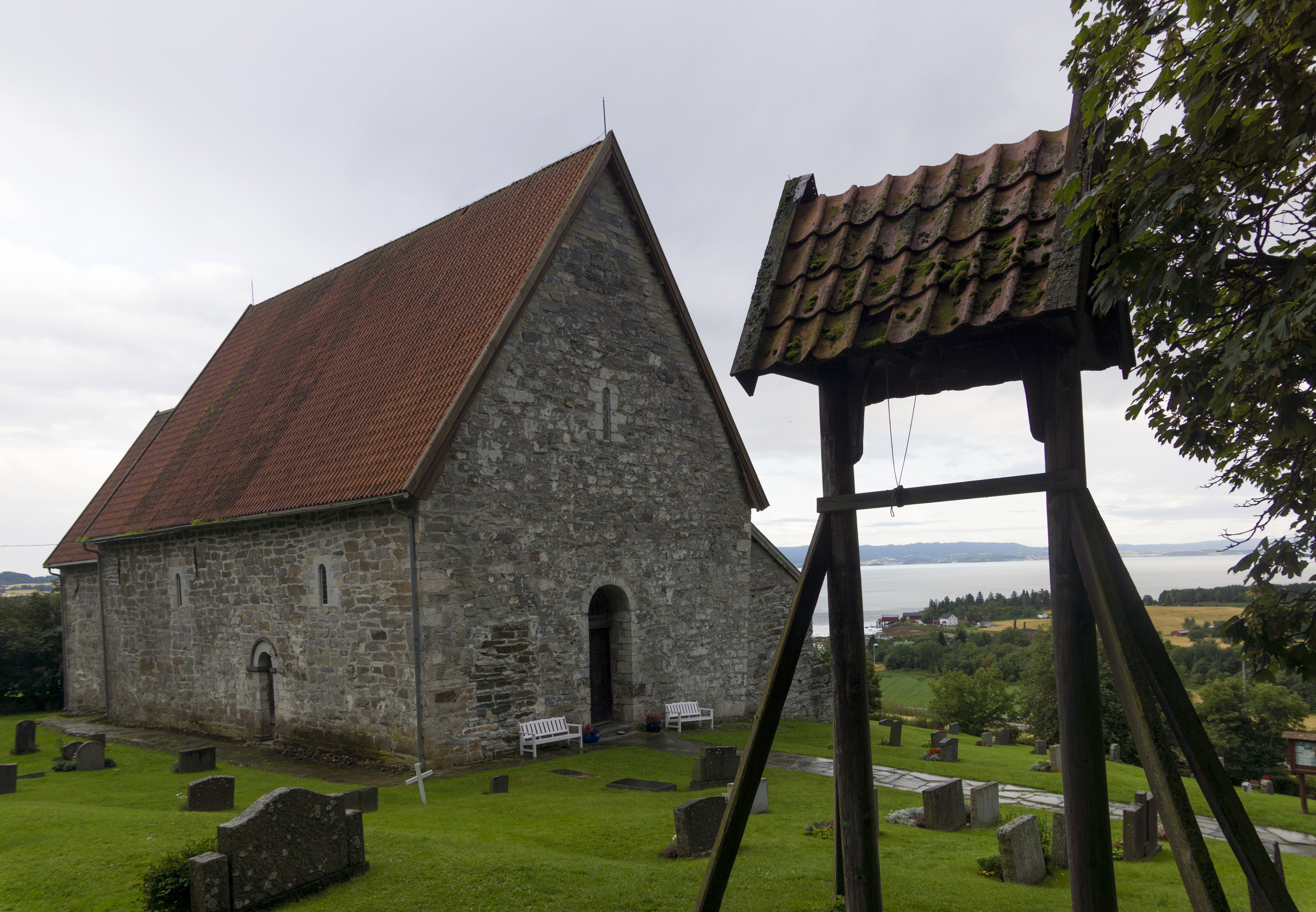
Old Sakshaug Church
The chevron carvings on the north gate of Old Sakshaug Church are the kind of detail you do not expect to find at 63 degrees north. Romanesque arches, Gothic choir renovations, a pulpit from 1646 -- this small limestone building on the shores of the Trondheimsfjord packs eight centuries of architectural ambition into a nave that seats two hundred. That it exists at all is remarkable. After a new church was built 500 meters away in 1871, Old Sakshaug was abandoned, stripped of its roof, tower, and woodwork, and left as a shell of stone walls. It took more than eighty years to put it back together.
Consecrated by an Archbishop
The choir, the oldest surviving part of the building, dates to about 1150. The nave followed over the next two decades, and an inscription discovered in the 18th century records that Archbishop Eysteinn Erlendsson consecrated the church in 1184. Erlendsson was one of medieval Norway's most influential churchmen, and his involvement suggests Sakshaug held genuine importance within the Diocese of Nidaros. The walls are built of local limestone, solid enough to endure where timber would not. Around 1200, the choir received Gothic modifications -- early for this latitude, where architectural fashions from continental Europe arrived slowly and adapted to harsher conditions. A sacristy was added around 1440. The church once possessed a west tower, but it had to be demolished during the Middle Ages, the reasons lost to time.
Artisans and Electors
In 1646, the Trondelag craftsman Johan Johansen carved the wooden pulpit, which was then painted by Johan Hanssonn -- the same artistic pair responsible for work in several other Norwegian churches of the period. The baroque altarpiece followed in 1692, adding a layer of 17th-century ornamentation to the Romanesque shell. But Old Sakshaug's most unusual role came in 1814, when it served as an election church -- one of more than 300 parish churches across Norway used as polling stations for the Norwegian Constituent Assembly. Parishioners gathered here to choose electors who would represent their county at Eidsvoll Manor, where Norway's constitution was written. A building designed for medieval worship thus became, briefly, an instrument of democratic self-determination.
Abandoned and Stripped
When the new Sakshaug Church opened in 1871, the old building's usefulness ended abruptly. The wooden roof, tower, interior fittings, and decorative elements were removed and sold. What remained were the bare limestone walls, open to rain and frost, slowly accumulating moss. Ownership passed to the Society for the Preservation of Ancient Norwegian Monuments in 1873, but decades elapsed before any restoration work began. The ruins sat quietly on their hillside above the fjord, visited by sheep and weather, while Norway industrialized around them. It was not until the early 20th century that efforts began in earnest, and even then progress was slow -- the ruins did not receive a new roof until 1926.
A Slow Resurrection
The restoration stretched across thirty more years after the roof went on, with work continuing through economic depressions, war, and postwar rebuilding. When Old Sakshaug was finally re-consecrated in 1958, it had been out of service for nearly nine decades. The pulpit, the altarpiece, and the Romanesque portals with their rounded arches survived the long exposure, and today the church stands again as both a place of worship and a monument to medieval craftsmanship in central Norway. The supporting walls added on the south side around 1400 still brace the structure, visible evidence of the engineering challenges that stone builders faced on this terrain. From outside, the limestone gleams pale against green farmland, a building that seems to grow from the ground it was quarried from -- which, in a sense, it does.
From the Air
Located at 63.88N, 11.28E in the village of Sakshaug, Inderoy Municipality, Trondelag, Norway. The church sits just west of the municipal center of Straumen, overlooking the Trondheimsfjord. Nearest major airport is Trondheim Airport, Varnes (ENVA), approximately 90 km south-southwest. The newer Sakshaug Church is visible about 500 meters to the southeast. Best viewed at 1,500-3,000 feet AGL, where the limestone structure is distinguishable against the green landscape. The Trondheimsfjord shoreline provides clear geographic orientation.