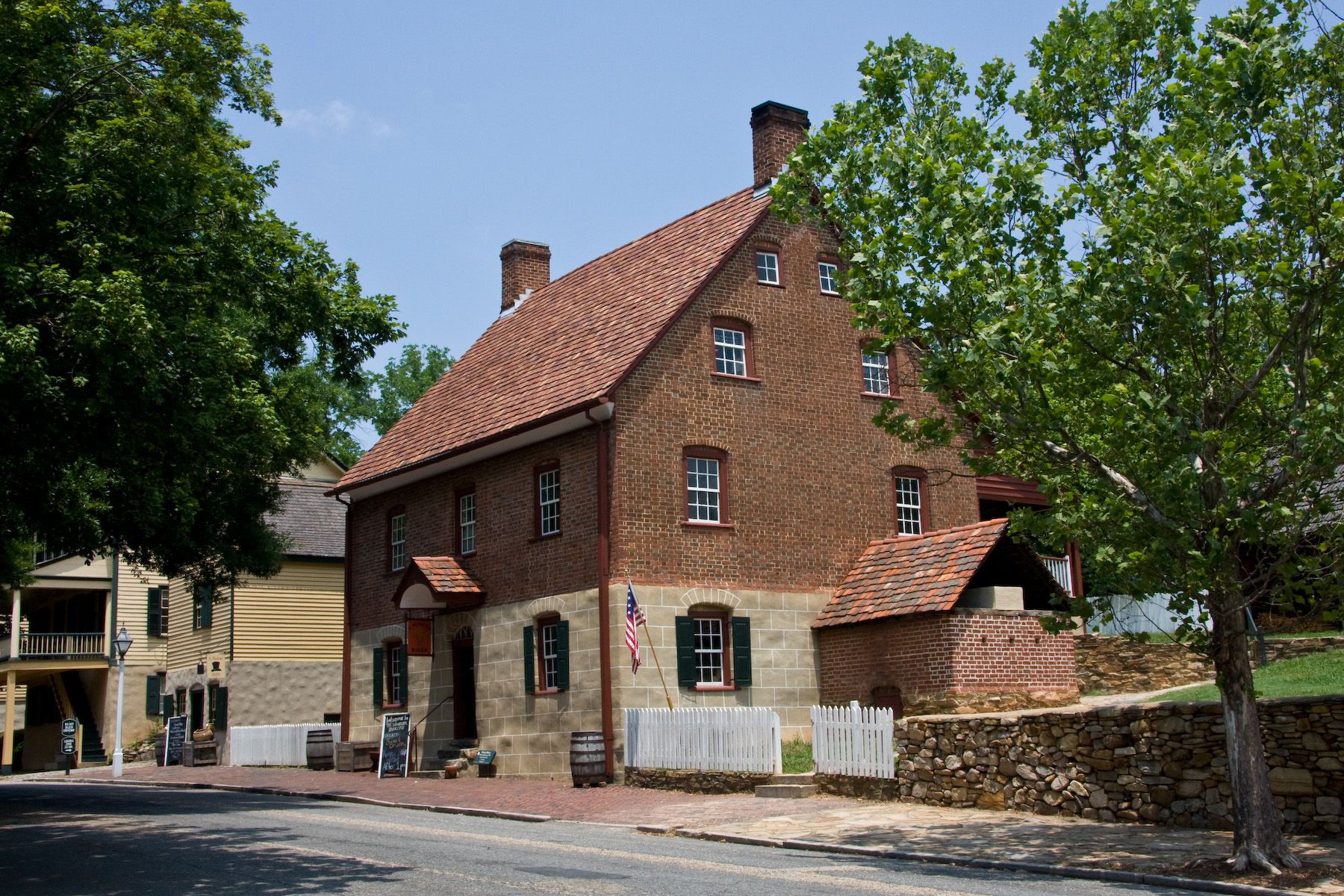
Old Salem
George Washington slept here -- two nights, in fact, on May 31 and June 1, 1791, during his Southern Tour. He stayed at the Salem Tavern, a building that still stands on Main Street, and he was not visiting a quaint backwater. Salem in the late 18th century was a precisely engineered community, every detail governed by the Moravian Church, a Protestant denomination whose roots stretched back to the followers of Jan Hus in 15th-century Bohemia. The church owned all property, leased land for construction, and could expel anyone who violated community regulations. Today, Old Salem survives as a National Historic Landmark district in the middle of Winston-Salem, its cobblestone paths and timber-framed buildings staffed by tinsmiths, blacksmiths, cobblers, gunsmiths, bakers, and carpenters who practice their trades exactly as their predecessors did more than two centuries ago.
The Moravians' Long Road to Carolina
The Moravian Church began in 1457 among followers of the martyred Czech reformer Jan Hus in the kingdoms of Bohemia and Moravia. Centuries of persecution drove the German-speaking faithful across Europe until 1722, when Count Zinzendorf, a Saxon nobleman, offered them refuge on his estate. They built the village of Herrnhut and from there launched missions across the Atlantic. They settled first in Savannah, Georgia, in 1735, then moved to Pennsylvania in 1740, founding Bethlehem, Nazareth, and Lititz. But development pressures pushed them south. In 1753, they purchased a large tract in the Piedmont of North Carolina from John Carteret, 2nd Earl Granville, one of the British Lords Proprietor. They named the tract Wachovia and founded the transitional settlement of Bethabara -- "House of Passage" -- in 1753. Salem, the central town, began construction in 1766 as the economic, religious, and administrative hub of the whole community.
A Town Run by the Church
Salem was not a democracy. The Moravian Church owned every parcel and only leased land for construction; the worldwide church held the deed until Salem Congregation purchased the town lot outright in 1826. Every resident had to be a member, and the governing bodies kept meticulous records -- copies sent to archives in Bethlehem, Pennsylvania, and Herrnhut, Germany -- that now fill thirteen published volumes called the Records of the Moravians in North Carolina. This obsessive documentation is precisely why Old Salem's restoration is so accurate. In 1849, newly created Forsyth County needed a county seat, but Salem refused. Instead the town sold property to the north, and the courthouse town of Winston grew into a thriving industrial center. The church divested control of Salem in 1857, and the two towns merged in 1913 to become Winston-Salem. By the mid-20th century, the old Moravian quarter had become a depressed neighborhood threatened by encroaching development.
Rescue and Resurrection
Preservation came early. In 1948, a local architectural review district -- the first in North Carolina and likely the fifth in the country -- was created to protect what remained. Two years later, Old Salem Inc. was formed as a nonprofit corporation to restore buildings and operate a museum. Today, approximately 70% of the buildings in the historic district are original structures, and the rest are careful reconstructions. Two buildings carry individual National Historic Landmark designations: the Salem Tavern, where Washington stayed, and the Single Brothers' House, where unmarried men lived and worked under the Moravian communal system. The visitor center, designed by Venturi Scott Brown and Associates and completed in 2003, features a serpentine glass wall with interpretive panels and houses the 1800 Tannenberg Organ. The Museum of Early Southern Decorative Arts, founded in 1965, showcases furniture, textiles, ceramics, and silverware from across the colonial and early American South.
The Oldest African-American Church in the State
Old Salem's story is not only one of European settlers. St. Philip's Moravian Church, completed in 1861, is the oldest surviving African-American church in North Carolina built specifically for that purpose. The Moravians had originally worshipped together with enslaved and free African-Americans at Home Moravian Church, but a congregational vote in 1816 -- in compliance with state law -- segregated worship. The Emancipation Proclamation was read to the congregation in 1865 by the chaplain of the 10th Ohio Regiment. The congregation eventually moved to new locations in 1952 and later, but returned to hold services in the restored brick church in 2019. Since December 2016, the Hidden Town Project has undertaken archaeological and historical research into Salem's African-American population, locating sites of slave dwellings and integrating the narrative of the enslaved into the visitor experience.
Easter City
Salem is called the "Easter City" for good reason. The traditional Moravian Easter sunrise service has been held annually since 1772 by the Salem Congregation, drawing thousands of people to Salem Square and the Moravian graveyard known as God's Acre, an 18th-century burial ground where the flat gravestones testify to the Moravian belief in equality in death. In December, the Candle Tea fundraiser fills the Single Brothers' House for two weeks. A giant coffee pot -- a former tin-shop sign -- marks the north end of the district, a whimsical landmark that was moved when Interstate 40 was built nearby. The Market-Fire Engine House, constructed in 1803, once served dual duty: half as a fresh meat marketplace and half as storage for firefighting equipment in use since 1785, when the Salem Tavern was destroyed by fire -- making it likely the first fire company in North Carolina.
From the Air
Old Salem is located at 36.0872N, 80.2422W in the Piedmont region of North Carolina, within the city of Winston-Salem. The historic district is compact and best identified from the air by the cluster of colonial-era buildings and Salem Square near the intersection of Main Street and Academy Street. Best viewed from 3,000-5,000 feet AGL. Smith Reynolds Airport (KINT) is just 3 nautical miles north. Piedmont Triad International Airport (KGSO) is approximately 10 nautical miles east. Look for the Salem College campus and Home Moravian Church steeple as visual references.