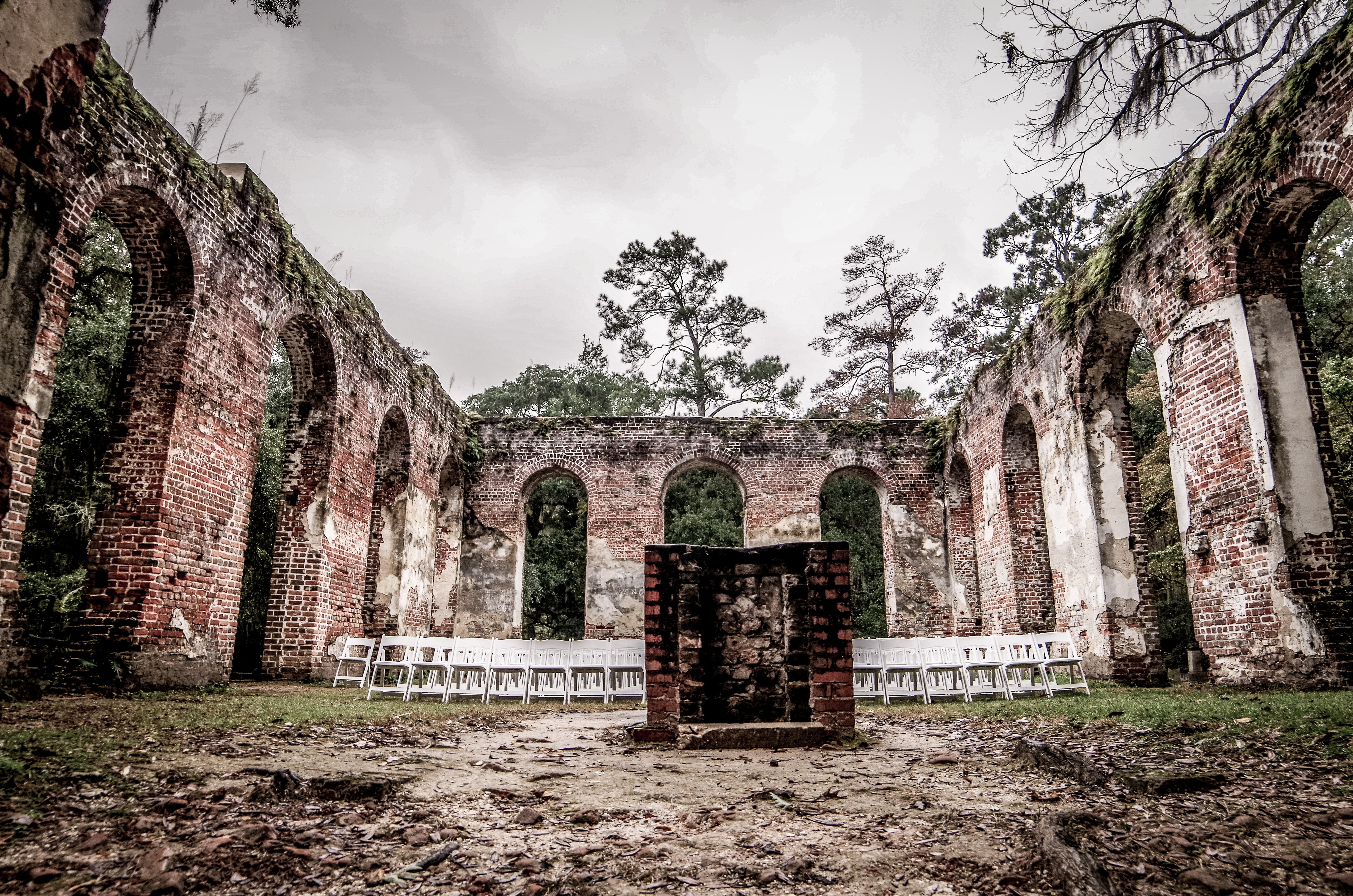
Old Sheldon Church Ruins
Four brick columns rise from the forest floor like the ribs of some enormous skeleton. No roof, no windows, no congregation -- just the bare bones of Prince William's Parish Church standing open to the Carolina sky, wrapped in the arms of live oaks dripping with Spanish moss. Built between 1745 and 1753 as a chapel of ease for planters who lived too far from the parish seat, the church was designed in the English Georgian style using the Roman Tuscan order. It was meant to serve a community. Instead, it became a monument to what war leaves behind.
Burned by the British, Rebuilt by the Faithful
In 1779, during the Revolutionary War, British troops put the church to the torch. The fine Georgian brickwork survived, but the interior was gutted. For nearly half a century the ruins stood open to the elements, a parish without a church. Then in 1826, the local community rebuilt the structure on its original walls and columns, restoring the Tuscan columns and the sense of order that the original builders had intended. For another four decades, services resumed among the same bricks that had withstood British fire. The rebuilt church served its parish through the antebellum era, a period when the Lowcountry plantations around Sheldon produced rice and cotton on the labor of enslaved people.
Sherman's March and the Second Burning
In 1865, Union forces under General William T. Sherman swept through South Carolina on their devastating march north from Savannah. The traditional account holds that federal troops burned the church a second time, leaving it once again as a hollow shell. But a letter dated February 3, 1866, from Milton Leverett tells a different story: "Sheldon Church not burn't. Just torn up in the inside, but can be repaired." In this alternative reading, the interior was stripped of usable materials -- wood, metal, anything that could help rebuild the homes Sherman's army had destroyed. Either way, the result was the same. The walls remained. The roof did not. This time, no one rebuilt.
A Governor Among the Graves
Within the roofless walls lie the remains of Governor William Bull, one of colonial South Carolina's most consequential figures. Bull helped General James Oglethorpe establish the physical layout of Savannah, Georgia, surveying the land in 1733 to create the grid of streets and squares that still defines that city today. His grave rests among scattered headstones and the roots of ancient oaks, keeping company with other colonial-era burials in a churchyard that has accumulated the dead of three centuries. The juxtaposition is striking: a man who planned one of America's most celebrated cities lies in a church that no one ever finished rebuilding.
The Living Ruin
Every year since 1925, on the second Sunday after Easter, clergy from the Parish Church of St. Helena in Beaufort have held a service among the columns. Worshippers gather in the open air, the sky serving as their ceiling, the oaks their nave. For decades, the ruins also drew photographers and couples seeking dramatic wedding backdrops -- the play of light through empty window frames, the moss-draped columns, the sense of standing inside something that time is slowly claiming. That practice ended in 2015 when the site was closed to private ceremonies, but the annual service continues, an unbroken thread connecting a twenty-first-century congregation to an eighteenth-century foundation.
From the Air
Old Sheldon Church Ruins sits at 32.619N, 80.780W in northern Beaufort County, South Carolina, approximately 17 miles north of Beaufort. From the air, look for a clearing among dense live oak canopy along Old Sheldon Church Road, off US-21. The ruins are modest in footprint but the surrounding grove of mature oaks is distinctive. Best viewed at 1,500-2,000 feet AGL. Nearest airports: Beaufort County Airport (KARW) approximately 15nm south, Hilton Head Island Airport (KHXD) 25nm south-southeast.