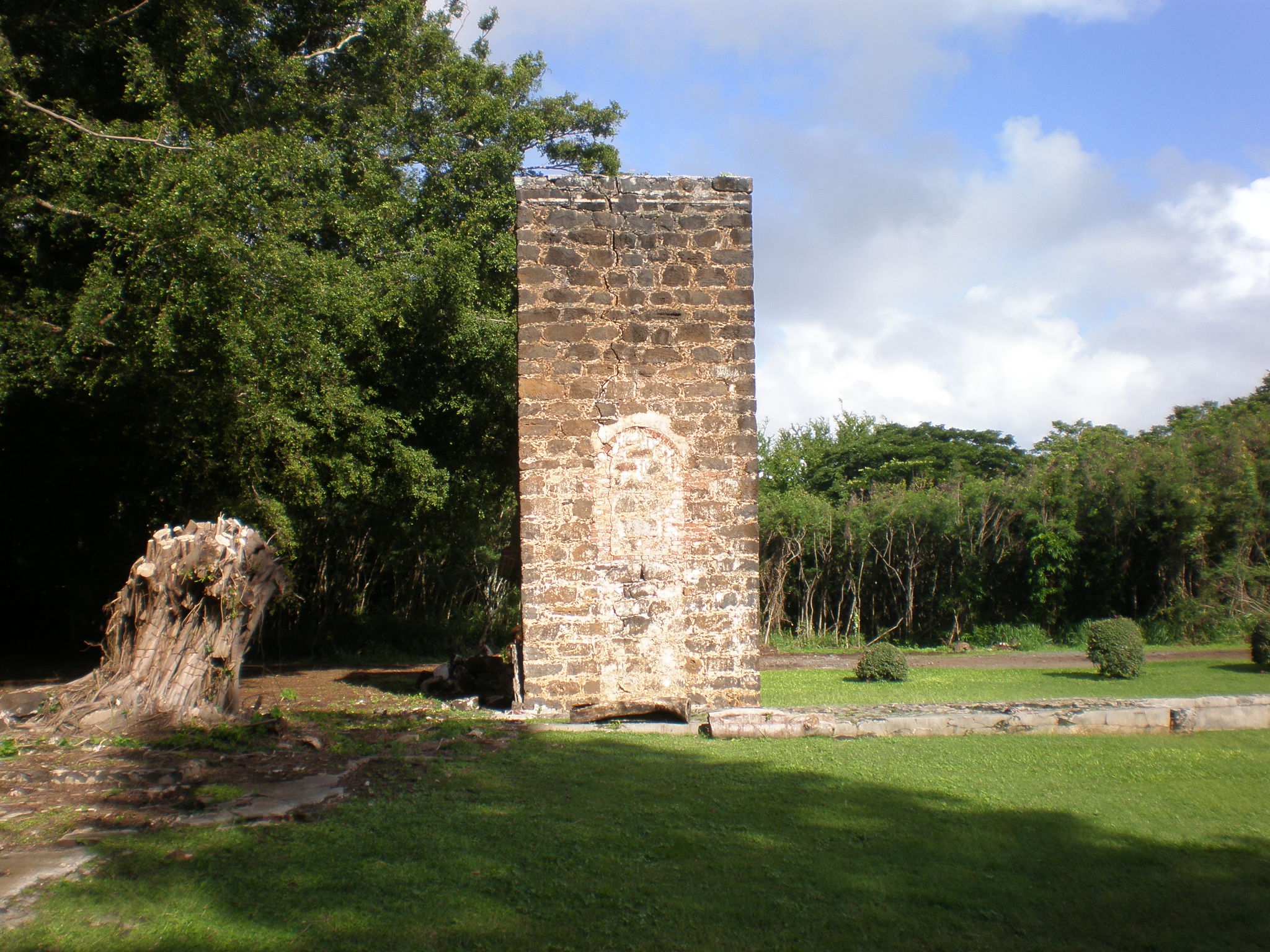
Old Sugar Mill of Koloa
A stone chimney and an overgrown trough are what remain of the mill that launched an empire. In 1835, three New England merchants founded a sugarcane plantation in Koloa, on the south shore of Kauai, and it worked. Not the first attempt at sugar in Hawaii, but the first to turn a profit. From that modest beginning grew the industry that would dominate the Hawaiian economy for more than a century and a half, transforming the islands' demographics, politics, and landscape beyond recognition.
Missionaries, Rum, and Ambition
The idea of using Hawaiian soil for commercial agriculture had been floating around the mission stations for years. Joseph Goodrich at the Hilo mission and Samuel Ruggles at the Kona Mission had experimented with farming to support their work and employ their students. But sugarcane presented a problem that made the conservative missionaries uncomfortable: molasses, a byproduct of sugar processing, could be distilled into rum, and rum was exactly what the missionaries were trying to keep off the islands. When William Ladd, Peter Brinsmade, and William Northey Hooper formed Ladd and Company and secured a lease for land in Koloa, their missionary connections helped smooth the way. Hooper moved to the property as manager despite having no training in engineering or agriculture. The lease itself was difficult to acquire, and Native Hawaiians resisted it, initially refusing to sell provisions to the plantation managers.
The Workforce and Its Costs
The plantation's early labor relations set a pattern that would repeat across Hawaii for generations. Managers expressed open contempt for Hawaiian laborers, and as the sugar industry expanded across the islands, planters turned to imported workers from China, Japan, Portugal, and eventually the Philippines. Each wave of immigration reshaped Hawaiian society, creating the multiethnic culture the islands are known for today, but also establishing a rigid hierarchy in which the newest arrivals occupied the lowest rungs. The plantation system that began at Koloa generated extraordinary wealth for its owners while paying its workers subsistence wages. The building was designated a National Historic Landmark on December 29, 1962, recognizing its role as the starting point of Hawaii's sugar era.
161 Years of Sugar
The plantation that Ladd and Company started in 1835 operated, under various owners, until 1996. Over those 161 years, the sugar industry drove nearly every major development in Hawaii: the overthrow of the monarchy, the push for annexation by the United States, the construction of irrigation infrastructure that redirected entire watersheds, and the immigration policies that built the islands' population. The Koloa mill passed through multiple hands before falling under the umbrella of Grove Farm. In 2000, Steve Case, the co-founder of AOL, purchased Grove Farm for twenty-five million dollars while assuming sixty million in debt. His grandfather, A. Hebard Case, had worked on the plantation. The purchase was contested by other shareholders who noted that Case's father had served as the company's lawyer, but the lawsuit was dismissed in 2008.
What the Ruins Remember
Today the Old Sugar Mill of Koloa is a ruin that speaks more eloquently than most monuments. The stone chimney rises above a tangle of vegetation, and a bronze sculpture by Jan Gordon Fisher commemorates the workers who built the industry. A National Historic Landmark plaque, placed in 1965, identifies the site's significance. But the real story is in the landscape surrounding it: the red dirt roads, the irrigation ditches now choked with tropical growth, the small town of Koloa itself, which exists because this mill existed. The sugar is gone, the workers' camps have been demolished or repurposed, and the fields have returned to scrub. What remains is the starting point of a transformation that made Hawaii what it is.
From the Air
Located at 21.899N, 159.446W in Koloa on Kauai's south shore. The mill ruins are in the center of the small town of Koloa, identifiable by the old chimney stack. Lihue Airport (PHLI) is approximately 9 nautical miles northeast. Best viewed at 1,000-2,000 feet AGL. The surrounding area features former cane fields, now largely developed or returned to vegetation, and the nearby Poipu resort coast.