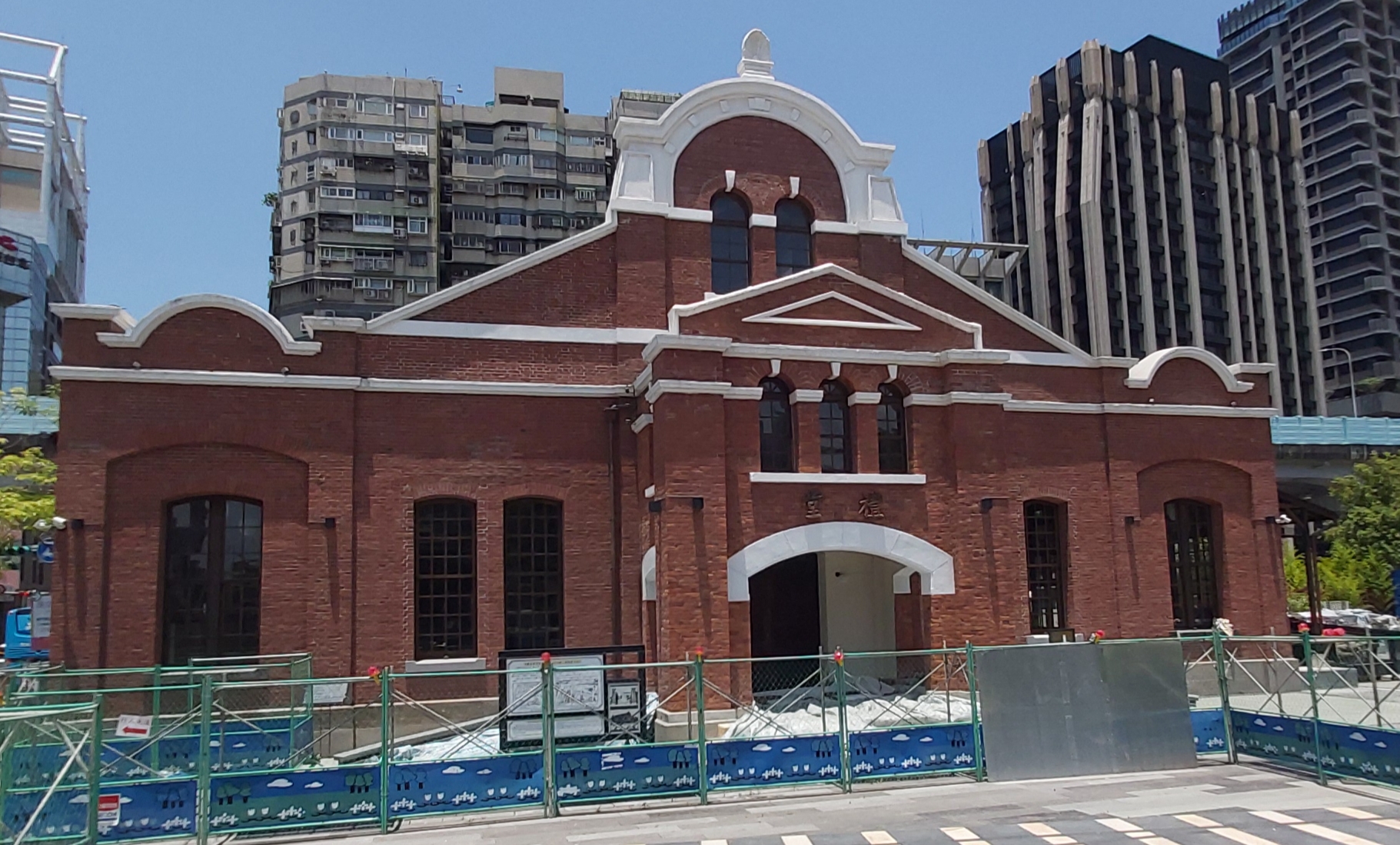
Old Taipei Railway Workshop
The building that stands near Taipei Main Station has had more identities than most cities. It began as a weapons factory under the Qing dynasty, became a railway workshop under Japanese colonial rule, served as an auditorium for the Taiwan Railway Administration after World War II, and then sat largely forgotten while the city grew up around it. Its designation as a national monument in 2007 marked the beginning of yet another transformation -- this time into a preserved artifact of the industrial infrastructure that built modern Taiwan.
From Cannons to Locomotives
The story begins with the Taipei Machinery Bureau of the Qing dynasty, which operated a weaponry repair center on the site. In 1899, the new Japanese colonial administration renamed it the Taipei Artillery Factory. A year later, the Railway Department took over the entire facility, converting it from weapons production to railway vehicle assembly and maintenance. The Taipei Workshop, as it was initially called, became the first of three major railway workshops in colonial Taiwan, followed by the Takow (Kaohsiung) Workshop in 1901 and the Hualien Port Workshop in 1918. By 1908, the complex had grown from seven main buildings to thirteen, a sprawl of industrial structures serving the railway network that was binding the island together.
The Workshop That Moved Away
In 1909, the Taipei Railway Workshop expanded eastward, and a new Vehicle Maintenance Workshop was built as part of the expansion. But by 1934, the entire workshop operation had relocated to a larger facility in Songshan, leaving the original premises to be carved up for other uses. The Railway Department converted some buildings into administrative offices and others into employee dormitories. Over the following decades, most of the original workshop structures were demolished. What survived was the 1909 Vehicle Maintenance Workshop, which the Taiwan Railway Administration repurposed as its auditorium after the war -- an industrial space awkwardly dressed for institutional ceremonies.
Layers of Recognition
Recognition came slowly and in stages. In 2005, the Taipei City Government designated the surviving workshop as a historic site at the municipal level. Two years later, in 2007, the Executive Yuan's Cultural Development Committee elevated it to national monument status. In 2010, the Department of Cultural Affairs revised the site's official name to the Railway Department, Office of the Governor-General of Taiwan (Taipei Railway Workshop) -- a title that acknowledges both the building's administrative lineage and the colonial system that created it. The renaming was not merely bureaucratic; it reflected a growing willingness in Taiwan to confront and preserve, rather than erase, the material legacy of its Japanese colonial period.
Restoring What Remains
In 2020, the Taipei City Government's Department of Rapid Transit Systems sponsored a restoration project for the historic site, designed and supervised by Hsu Yu-Chien and Associates. The restoration faces the particular challenge of working with a structure that has been continuously modified -- an entrance foyer added between 1950 and 1952, a podium installed during earlier renovations, various repairs that altered the building's character across decades of use. The current site sits in a slightly different location from the original workshop footprint, a detail that complicates efforts to connect the physical building with its historical context. What remains is a single surviving fragment of what was once a sprawling industrial complex, an artifact of the railway infrastructure that transformed Taiwan from a Qing frontier outpost into a connected modern territory.
From the Air
Coordinates: 25.049N, 121.511E. Located near Taipei Main Station in central Taipei. The historic workshop building is surrounded by modern urban development. Nearby airport: RCSS (Taipei Songshan Airport, ~4 km northeast). Best viewed at 2,000-3,000 feet. Look for the older structure near the large Taipei Main Station railway complex, which is a major transportation hub visible as a cluster of rail lines converging.