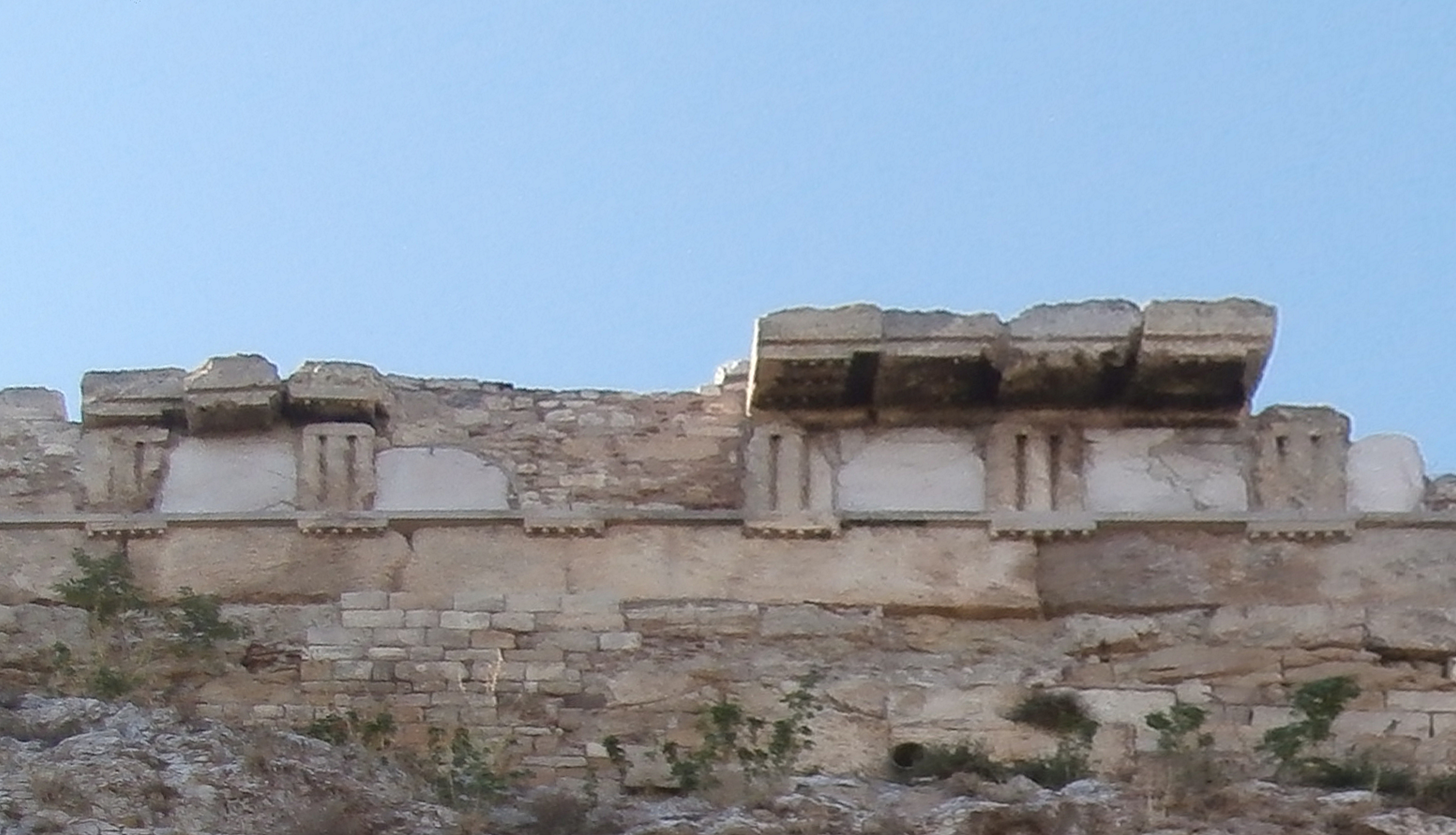
Old Temple of Athena
Wilhelm Dorpfeld looked down into a freshly opened trench on the Athenian Acropolis in 1885 and realized he was looking at something nobody had been able to see for two thousand years. Beneath the raised terrace between the Parthenon and the Erechtheion, the foundations of a sixth-century temple had emerged from the soil for the first time since the Persians sacked Athens in 480 BC. The literary references had always existed. Homer mentioned it. Herodotus and Thucydides referenced it. But the building itself had been a rumor, an outline guessed at from broken column drums embedded high in the Acropolis wall. Now it was a foundation, in stone, exactly where the texts had said it would be.
What Homer Knew
The Old Temple of Athena, or Archaios Neos in Greek, housed the xoanon, an ancient olive-wood cult statue of Athena Polias, Athena of the city. Homer alluded to it. The poet refers to Athena's temple and the strong house of Erechtheus, in language vague enough that scholars have argued for centuries about which buildings he meant. Herodotus, writing in the fifth century, was clearer. In recounting the seventh-century coup attempt of Kylon, he located the killing on holy ground near a shrine of Athena Polias. He also described the Persian siege of 480 in terms of a megaron and a naos burning. Thucydides, his great rival, made similar references. None of this was specific enough to draw on a map. For 2,400 years, what had stood on the Acropolis between the time of the Bronze Age citadel and the Periclean reconstruction was guesswork, until Dorpfeld's trench.
The Dorpfeld Foundations
The German archaeologist Wilhelm Dorpfeld, then director of the German Archaeological Institute in Athens, recognized within months that the foundations he had uncovered belonged to a peripteral temple, the colonnaded type with columns running all the way around. Excavations along the inside of the Acropolis north wall produced a series of poros limestone column drums and capitals, embedded in the wall by Themistocles after the Persian destruction. Dorpfeld saw what others had missed: the embedded fragments and the new foundations belonged to the same building. Striking peculiarities emerged. There was room for only two steps below the colonnade rather than the canonical three. The pronaos was unusually shallow. The cella had two rows of interior columns. The opisthodomos at the back was almost vestigial. The inner foundations were blue Acropolis limestone; the outer courses were larger and pinkish, made from kara limestone quarried at Mount Hymettus and worked with a claw chisel.
The Hekatompedon Decree
Two years later, excavators turned over a deeper layer south of the Parthenon and pulled out fragments of one of the most important Greek inscriptions ever found. The Hekatompedon decree had been carved into two slabs that were originally metopes from a sixth-century temple, and the inscription dates to 485 BC, just five years before the Persian sack. It is the only contemporary description of the archaic Acropolis that survives. The text mentions a temple, an altar, a hekatompedon (the hundred-footer), and oikemata, the rooms inside. Dorpfeld concluded that the cella of his newfound temple was the hekatompedon and the oikemata were the three western rooms, identifiable with the opisthodomos referenced in the later Kallias decrees of the 430s. This reading prevailed until 1936, when W. H. Schuchhardt published the marble sima fragments from the Parthenon terrace and showed they could not have come from any building that fit on the Dorpfeld foundations. William Bell Dinsmoor reread the decree, the names started shifting around, and the certainty unraveled.
Two Theories
There are now two main theories about which building stood where. In one, a modest seventh-century temple occupied the central terrace until the second quarter of the sixth century, when it was replaced by a larger structure called the Bluebeard Temple, named for the painted limestone pediment of a triple-bodied man with a snake tail, now in the Acropolis Museum. The Bluebeard Temple was then dismantled in the last quarter of the sixth century and replaced by the Archaios Neos that Dorpfeld found. In the other theory, the modest seventh-century shrine survived until the late sixth century and was replaced directly by the Archaios Neos. The grand Bluebeard Temple stood instead on the south Acropolis, where the Parthenon now rises, and was popularly known as the Hekatompedon. The arguments are technical, the evidence fragmentary. The disagreement is the kind that keeps classical archaeology alive.
Memorial in Ruin
Whatever the building was called, the Persians burned it in 480 BC. After their defeat at Plataea the following year, the Greek allies took an oath that the destroyed temples would be left as memorials, not rebuilt. The Athenians honored the oath until the Peace of Callias in 450 BC released them from it, and even then the Periclean program rebuilt the south side of the Acropolis first. The classicist Gloria Ferrari has argued, following Dorpfeld, that the blackened shell of the Old Temple of Athena was kept standing as a memorial and a treasury, like the Kaiser Wilhelm Memorial Church in modern Berlin, where the bombed-out tower was preserved beside the new building as a deliberate scar. The Praxiergidae decree of around 460 BC mentions a stele to be set up behind the ancient temple, suggesting it still functioned as a landmark. Eventually, perhaps under Pericles or perhaps later, what remained was cleared. The foundations stayed where they were, waiting for Dorpfeld's trench.
From the Air
The foundations of the Old Temple of Athena lie at 37.972 N, 23.726 E on the central terrace of the Acropolis of Athens, between the Parthenon to the south and the Erechtheion to the north. The site is at approximately 156 meters elevation, the summit of the Acropolis. Best viewed from 2,000-3,500 ft AGL, particularly with morning light when shadows reveal the foundation outline. The Acropolis sits in restricted airspace; commercial overflights are not permitted. Nearest airport: Athens International Airport Eleftherios Venizelos (LGAV / ATH), 30 km east.