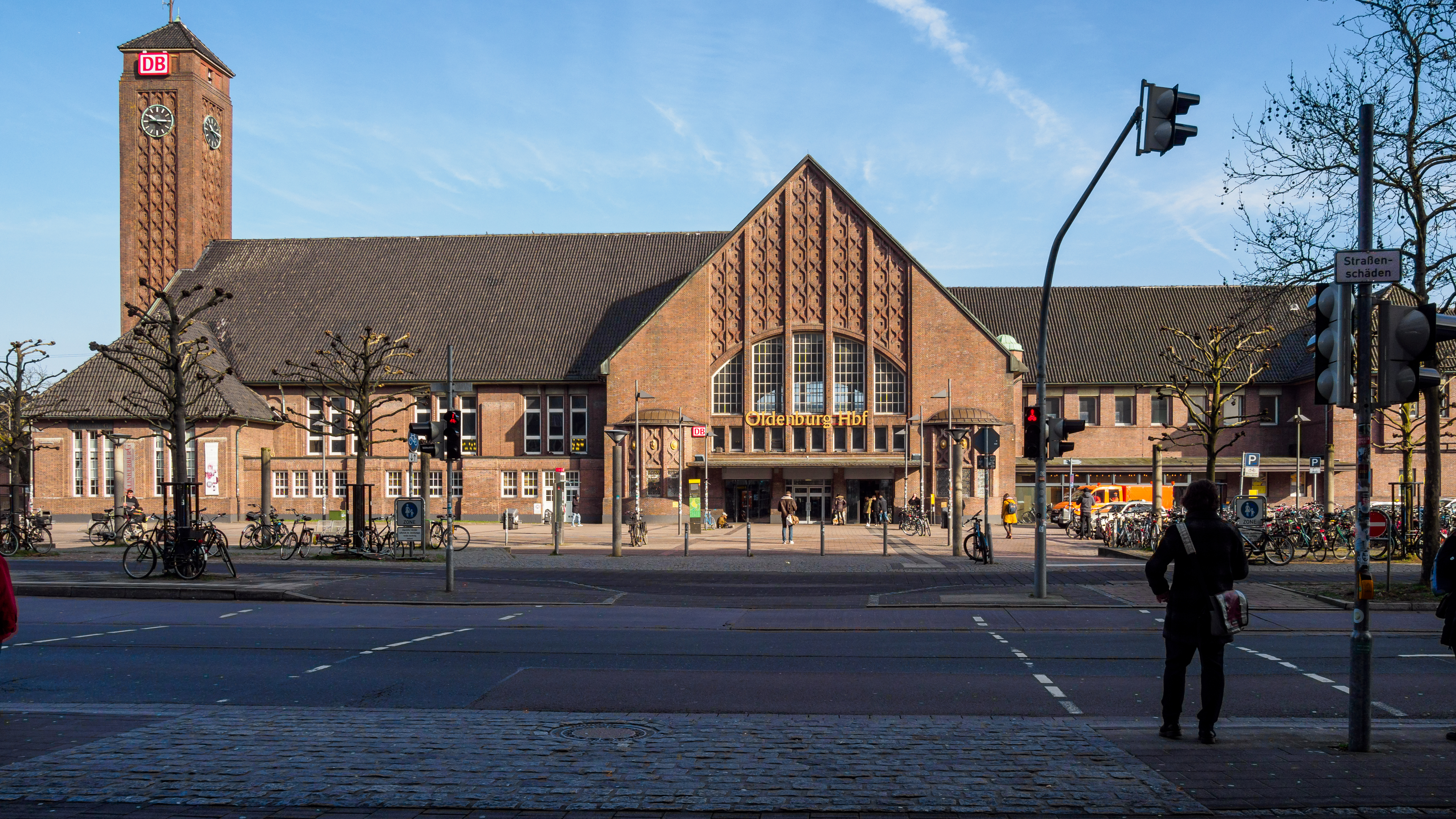
Oldenburg Hauptbahnhof
The Grand Duke needed his own door. When Oldenburg's new main station opened on August 3, 1915, after four years of construction, the architect Friedrich Mettegang had built into it a separate Prince Hall, a private reception wing reserved for the Grand Duke of Oldenburg and his guests. The opening was deliberately quiet. Germany was a year into the First World War and ceremonies for new buildings felt wrong. Three years later, the November Revolution swept the monarchy away and the door was never used again as designed. The Art Nouveau hall still stands, restored and busy, the platforms beneath it raised three and a quarter metres above the old ground level, the through tracks slicing where a terminus once dead-ended.
Twelve Years in a Freight Shed
The first railway reached Oldenburg on July 15, 1867, when the Grand Duchy of Oldenburg State Railways opened the line to Bremen via Delmenhorst. Two months later a second line, financed by Prussia, ran north to Heppens, the village that would soon be renamed Wilhelmshaven. The Grand Duchy planned its first proper station for Cäcilienplatz, but by 1868 the design was already too small for the traffic the railway was generating. The project collapsed. For twelve embarrassing years the capital of a grand duchy welcomed passengers in a converted freight shed. The first real station finally opened on May 21, 1879, on the site the present building still occupies.
The Most Romantic Building in Germany
That first proper station was a neo-Gothic confection by Conrad Wilhelm Hase, then one of the most celebrated architects in northern Germany, and contemporaries called it one of the most romantic railway buildings in Germany. Photographs survive showing pointed arches, steep roofs, and a faintly ecclesiastical air, as though one were boarding a train inside a small cathedral. It lasted barely thirty-five years. By the early 1900s the tracks needed reorganising into a through station so that travellers no longer had to change trains at Oldenburg merely to continue their journey, and Hase's romantic station was demolished to make way for Mettegang's Art Nouveau replacement. The new building was placed deliberately at the edge of the raised tracks, freeing the rails to keep running through.
The Burden of a Northern Line
Running a railway in a small grand duchy was expensive. In 1913, the Oldenburg State Railways bought the Wilhelmshaven line back from Prussia, a transaction that placed an enormous burden on the state's budget at exactly the wrong moment. By the end of the next year, the Grand Duchy was at war and its railways were carrying troops north toward the Imperial Navy's base at Wilhelmshaven. The line to Leer opened in 1869, the line to Osnabrück in 1875, and the lines have largely defined Oldenburg's character ever since: a junction city on the route from the North Sea ports south to the German interior. Electrification of the Leer line did not come until 1992.
Seven Tracks, Three Islands
Today the station has seven platform tracks arranged around three island platforms, with track 2 functioning as a through track without a platform. Long-distance traffic centres on the IC 56 InterCity service, which runs every two hours east to Leipzig via Hannover. Once a day an Intercity-Express train passes through on its way south. Most of the daily ridership, though, is regional: trains to Bremen every half hour, services up to Wilhelmshaven and Norddeich Mole, the slow line west to Leer where you can change for Groningen across the Dutch border. Since 2015, the small Oldenburg-Wechloy halt near the university has taken over local commuter duty. The older stations at Ofenerdiek and Osternburg lost their passenger service one quiet decade at a time.
What the Hall Still Holds
Walk into the reception hall today and the Art Nouveau interior is still the first thing that hits you: arched ceilings, ornamental ironwork, the soft restrained colour palette that Mettegang's generation associated with movement and modernity. Oldenburg's Hauptbahnhof is on the official list of monuments protected by the city, and unlike many German railway buildings of its era it survived the Allied bombing of 1945 essentially intact, the way most of Oldenburg did. The Prince Hall was eventually repurposed; the Grand Duke who was supposed to step through its doors, Friedrich August, abdicated on November 11, 1918, and retired to his country palace at Rastede, where his descendants still live.
From the Air
Oldenburg Hauptbahnhof sits at 53.1436 degrees N, 8.2225 degrees E, just northeast of the city centre and on the east bank of the Hunte. From altitude look for the rail corridor running north toward Wilhelmshaven and south toward Bremen, crossing the autobahn ring at the city's eastern edge. Bremen Airport (EDDW) lies 50 kilometres east; Hatten Airfield (EDWH) sits 17 kilometres southwest. The station is one of the largest single structures in the historic core, distinguishable from the Schloss by its long east-west platform sheds.