Older Parthenon
Look up at the north face of the Acropolis from the Plaka and you will see a row of column drums set sideways into the wall, perfectly horizontal, perfectly out of place. They are about waist-high, smooth on the curved face that should have pointed to the sky, and they have been there since 479 BC. They are the only piece of the Older Parthenon you can see today, repurposed by Themistocles as masonry in the rebuilt fortifications, displayed as a deliberate memorial to what the Persians had destroyed. The temple they came from was never finished. The temple that replaced it on slightly different foundations is the most famous building in classical antiquity. The first one, the older one, lasted only a few decades and never even acquired a name of its own.
After Marathon
The first endeavor to build a sanctuary for Athena Parthenos on what is now the Parthenon site began shortly after the Battle of Marathon in 490 BC. The Athenian victory over the Persians had felt like vindication, and the city responded with a building program that included a massive limestone foundation extending and leveling the southern crown of the Acropolis. The new temple replaced an older Hekatompedon, the hundred-foot temple, and would have stood beside the archaic temple of Athena Polias on the central terrace. Construction was proceeding steadily, with column drums being raised, when in 480 BC the Persians returned in much greater numbers under Xerxes, defeated the Athenian fleet's expectations at Thermopylae, and razed the half-finished sanctuary along with everything else on the Acropolis.
Why the Acropolis Stayed in Ruins
After the Greek victories at Salamis in 480 and Plataea in 479, Athens had a choice about its destroyed temples. The Greek allies had sworn an oath at Plataea that the sanctuaries the Persians had destroyed would be left as memorials, not rebuilt, a permanent visible accusation against the eastern empire. The Athenians honored the oath. The Old Parthenon foundations sat untouched for thirty-three years. There may have been pragmatic reasons too. Athens had been sacked twice, the city walls demolished, the harbor of Piraeus undeveloped. Reconstructing the city was expensive enough without rebuilding the temples. The oath was finally lifted with the Peace of Callias in 450 BC, when peace with Persia made the memorial unnecessary. Two years later, Pericles announced the great Acropolis building program. By 447 BC, work on the present Parthenon had begun on the same platform but slightly to the south of where its predecessor had stood.
Dorpfeld's Discovery
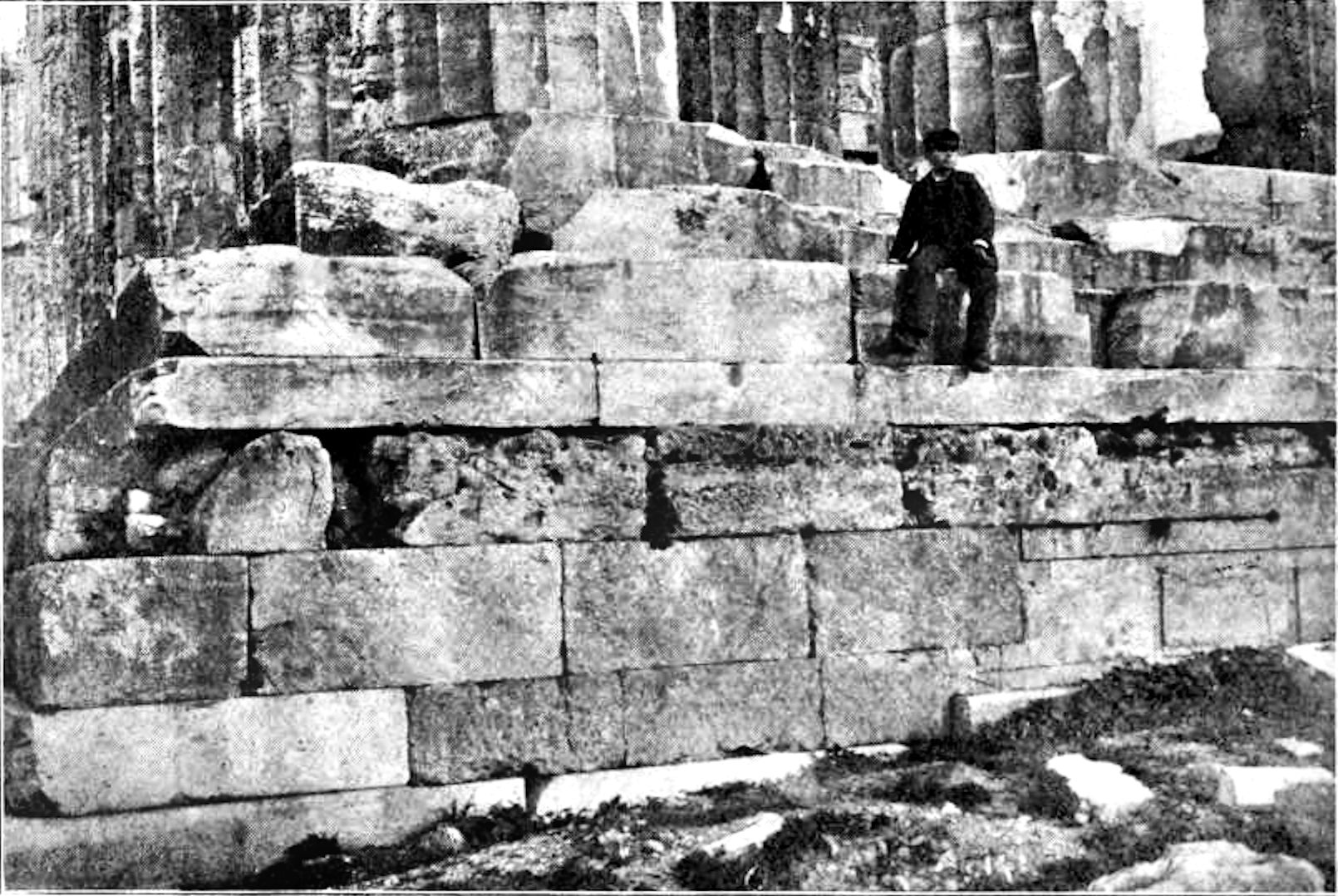
The existence of the Older Parthenon was always known from Herodotus and from those embedded column drums in the north wall, but the exact relationship between the older and newer buildings was unclear until the late nineteenth century. Panagiotis Kavvadias led excavations from 1885 to 1890 that exposed the foundations underneath the Periclean Parthenon. The German archaeologist Wilhelm Dorpfeld, then directing the German Archaeological Institute in Athens, made the key observation. The three steps of what he called Parthenon I consisted of two courses of poros limestone, the same as the foundations, topped by a final step of Karrha limestone. That top step was concealed by the lowest step of the Periclean building. The platform Dorpfeld identified was smaller than the present Parthenon and slightly to the north, indicating it had been built for a different and incompatible structure now completely covered.
The Bert Hodge Hill Problem
The Dorpfeld picture got more complicated. The American archaeologist Bert Hodge Hill, working in the early twentieth century, proposed that there had been not one but two pre-Periclean Parthenons. He argued that what Dorpfeld thought was the highest step of Parthenon I was actually the lowest step of a Parthenon II begun under Cimon after 468 BC, with stylobate dimensions Hill calculated at 23.51 by 66.888 meters. William Bell Dinsmoor, working from the potsherds that Graef and Langlotz had finally cataloged in 1925-1933, came back at the problem from yet another angle. He concluded that the latest possible date for Parthenon I was no earlier than 495 BC, which contradicted Dorpfeld's earlier dating. He also denied that Parthenon II had ever existed. Dinsmoor and Dorpfeld argued the question publicly in the American Journal of Archaeology in 1935, neither persuading the other. Excavations carried out in 1885 with the methods of 1885 had destroyed enough stratigraphy that the question can never be fully resolved.
The Persian Rubble
The destruction layer the Persians left behind became one of the most important archaeological finds in Athens. Called Perserschutt, German for Persian rubble, it consisted of the smashed sculptures and architectural fragments from the burned temples, swept by Themistocles into a kind of mass grave when he hurriedly rebuilt the Acropolis walls in 479 BC. The kouros and kore statues from this layer, with their archaic smiles and traces of original paint, are now among the masterpieces of the Acropolis Museum. The column drums in the north wall stayed where Themistocles put them, deliberately visible from the city below. They are still there, and you can still see them, the only above-ground remnant of a building that was destroyed before it could be finished and that gave its architectural ambition to the Parthenon that took its place.
From the Air
The Older Parthenon foundations lie at 37.972 N, 23.727 E on the southern crown of the Acropolis of Athens, partly visible at the southern edge of the present Parthenon platform. The embedded column drums are visible in the north wall of the Acropolis from the Plaka neighborhood below. Best viewed from 2,000-3,500 ft AGL during morning light. The Acropolis is restricted airspace; commercial overflights are not permitted. Nearest airport: Athens International Airport Eleftherios Venizelos (LGAV / ATH), 30 km east.