Oldmasters Museum
"About suffering they were never wrong, the Old Masters." W. H. Auden wrote that line in 1938, standing in this museum, looking at a painting that shows a ploughman who hasn't noticed a boy falling from the sky. The painting is called Landscape with the Fall of Icarus. The boy's pale legs vanish into the sea in one corner of the canvas while peasants tend their crops and a ship sails calmly past. The world, Auden realised, does not stop for tragedy. Today, when you stand in front of the work in the Oldmasters Museum's quiet rooms, the lesson lands twice - once for what it shows, and once for the visitors drifting past it on their way to Rubens.
Napoleon's Belgian Souvenir
The museum's origin story is, of all things, French. Napoleon founded it in 1801, the way a conqueror might toss a city a gift after taking everything else. The first collection was assembled from "old deposits" - works the French Republic had seized but then abandoned, sitting in storerooms after the revolutionary armies had moved on. Paris sent two more shipments in 1802 and 1811. Some looted pieces came back in 1815, after Waterloo, when Belgium's art could finally be Belgium's again. The museum opened in fourteen rooms of the old Palace of Charles of Lorraine, called the Old Court, where it stayed for most of the nineteenth century. The Belgians did the patient work of building it into something serious - one bequest at a time, one donation at a time, including the 1914 De Grez gift of more than four thousand drawings by Goltzius, de Gheyn, and Rembrandt.
The Bruegel Question
Pieter Bruegel the Elder painted in a Flemish world of peasants, harvests, hunters in snow, and biblical scenes restaged in Brabant villages. The Oldmasters owns The Fall of the Rebel Angels and Winter Landscape with a Bird Trap - both unambiguously his, both stunning. The Icarus, though, is the famous one and the contested one. Most experts now doubt that Bruegel actually painted it; it may be a copy after a lost original. None of which has dampened its hold on the imagination. The room around it also holds works by Bruegel's son Pieter the Younger, who turned his father's compositions into a family business, and by Jan Bruegel the Elder, who made flowers and forests glow as if they were lit from within. Several large altarpieces here - including Rubens panels - came from churches and monasteries dissolved during the revolutionary upheaval. They were not collected. They were rescued.
Rubens in Quantity
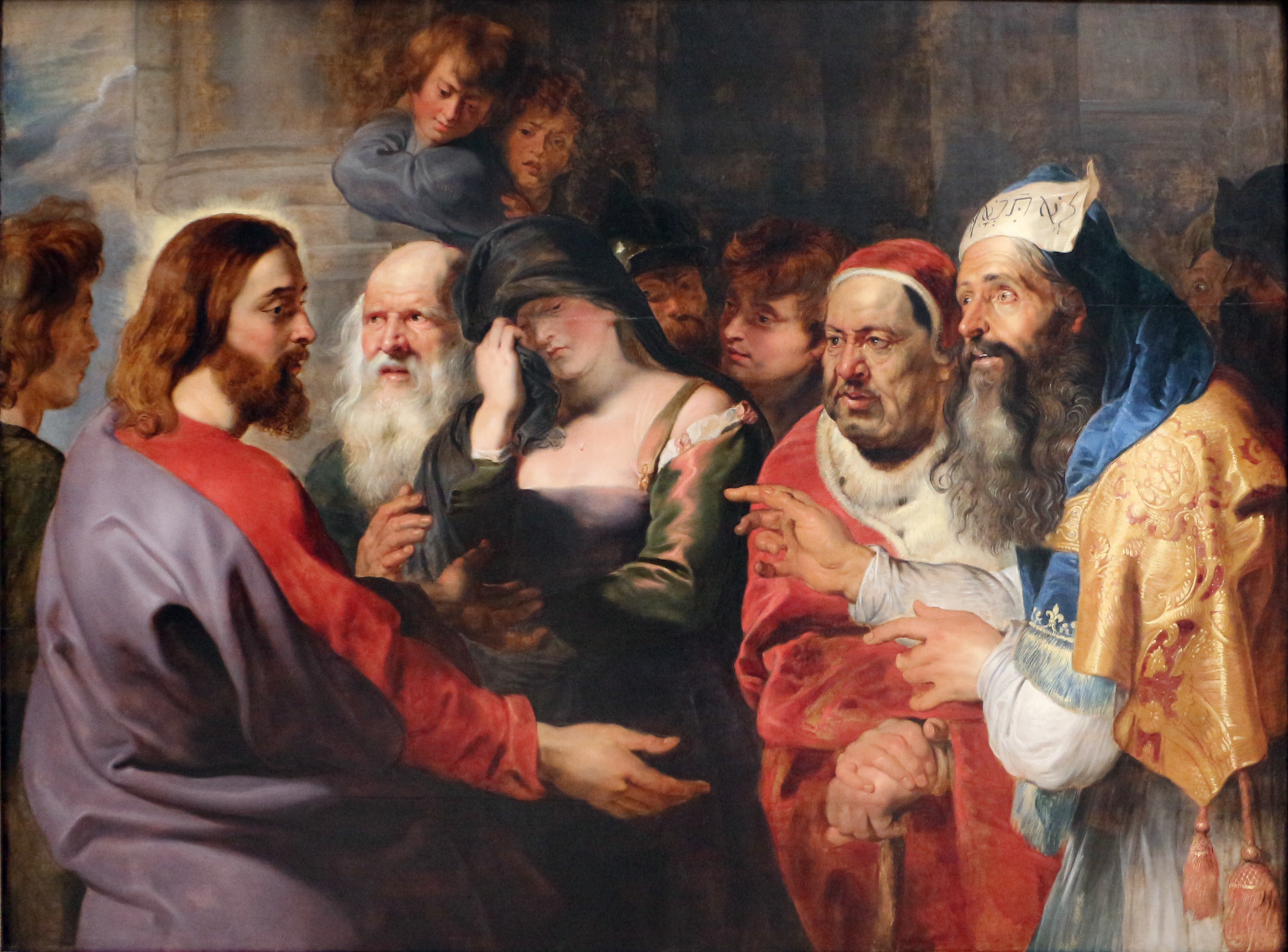
If one artist dominates the museum, it is Peter Paul Rubens. The Rubens Room sits near the heart of the building, off the Royal Staircase under a coffered ceiling that still carries Leopold II's monogram. The collection includes Christ and the Woman Taken in Adultery from 1614, the dramatic Martyrdom of Saint Lievin from 1633, and a magnificent group of small oil sketches - the working drawings Rubens used to plan his commissions before turning them over to his enormous studio. Studying these sketches is studying the man's brain at speed: a face roughed in three minutes, a swirl of drapery, a single gesture captured before the workshop could smooth it into something grander. Around Rubens orbit Anthony van Dyck (whose Portrait of the Sculptor Duquesnoy from 1622 is unforgettable), Jacob Jordaens, Frans Snyders, and David Teniers the Younger, whose Archduke Leopold Wilhelm in his Gallery is essentially a 1651 painting of someone else's painting collection.
The David at the End
Jacques-Louis David painted the Death of Marat in 1793, days after the assassination - the body slumped in the bathtub, the quill still in the hand, the wound just under the collarbone. It is one of the most famous paintings of the entire Revolutionary era, and it lives in Brussels because David lived in Brussels. Exiled after Napoleon's fall, the great propagandist of the Republic spent his last years here, and his very last painting, Mars Being Disarmed by Venus, was completed in this city in 1824. Hanging in the same museum is Gustaf Wappers' enormous Episode of the Belgian Revolution of 1830, painted almost immediately after Brussels' uprising against Dutch rule - a working-class crowd in motion, smoke and tricolour flags, the canvas pulsing with the conviction that history had just happened in the street outside. Two revolutions, two countries, one building.
Balat's Palace
The Oldmasters lives inside the Palace of Fine Arts on the Rue de la Régence, which was designed by Alphonse Balat and opened in 1880. Balat was Leopold II's principal architect, the man behind much of the king's monumental Brussels. The building moonlights as a museum but is itself a monument - rondels of Rubens, Van Ruysbroek and Giambologna over the entrance representing painting, architecture and sculpture; allegorical statues of Greek, Gothic, Roman and Renaissance Art lining the great central Forum hall under its colonnade and skylight. Along the western face is a sculpture garden landscaped in 1992, with works by Aristide Maillol and Emilio Greco. A small plaque on the side of the building remembers five members of the National Royalist Movement, a resistance group killed during the liberation of Brussels on 3 and 4 September 1944. The masters inside are old. The history on the walls outside is not.
From the Air
Located at 50.8417°N, 4.3582°E in the Royal Quarter of central Brussels, just southwest of Brussels Park and adjacent to the Place Royale. The Palace of Fine Arts is a long neoclassical building with a colonnaded central hall and a sculpture garden on its western side. Nearest international airport: Brussels Airport (EBBR), about 12 km northeast. Brussels South Charleroi (EBCI) lies roughly 50 km south. The Royal Quarter sits on the high ground above the lower town and is best identified from the air by the green rectangle of Brussels Park immediately to the northeast and the gilded dome of the Palace of Justice on the ridge to the southwest.