Olustee Battlefield Historic State Park
On the afternoon of February 20, 1864, Union and Confederate forces clashed in the pine flatwoods near the small railroad stop of Olustee, deep in what is now the Osceola National Forest. The engagement lasted roughly five hours. When the smoke cleared, it was the bloodiest day Florida would see in the entire Civil War -- and the only major battle fought on Florida soil. Today, the ground where those soldiers fell lies preserved under a canopy of longleaf pine, marked by a granite monument that took fifteen years to build and an annual reenactment that draws thousands from across the country.
Five Hours in the Flatwoods
The Battle of Olustee was part of a Union campaign to disrupt Confederate supply lines, recruit Black soldiers, and bring Florida back into the fold. Federal troops under Brigadier General Truman Seymour marched west from Jacksonville toward the interior. Confederate forces under Brigadier General Joseph Finegan chose the narrow corridor between Ocean Pond and a cypress swamp near Olustee as their defensive ground. The fighting began in the early afternoon and raged until dusk. Union forces suffered severe casualties and withdrew eastward toward Jacksonville. Among the Union regiments engaged were the 54th Massachusetts Infantry and the 35th United States Colored Troops, Black units whose presence underscored the war's evolving stakes. Florida remained in Confederate hands for the rest of the conflict.
A Monument Fifteen Years in the Making
The battlefield's transformation from forgotten flatwoods to preserved memorial began in 1897, when the Florida Division of the United Daughters of the Confederacy started raising funds for a monument at the site. Two years later, the Florida Legislature appropriated $2,500 and appointed a commission to oversee the project. Construction took more than a decade. The monument was finally completed and officially dedicated on October 23, 1912, with surviving veterans of the battle in attendance. The UDC administered the site until 1949, when the Florida Board of Parks and Historic Memorials assumed responsibility. The battlefield was added to the National Register of Historic Places on August 12, 1970, and today falls under the Florida Department of Environmental Protection.
Living History Every February
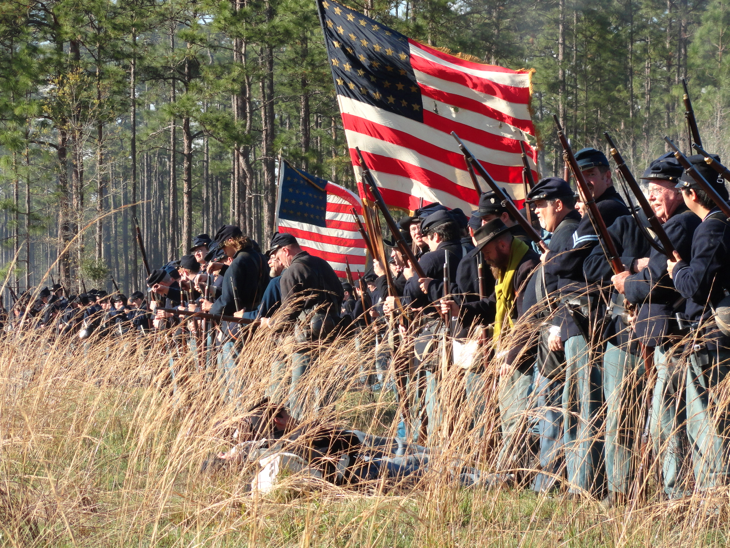
Each Presidents' Day weekend, the quiet pine forest around Olustee transforms into one of the largest Civil War reenactments in the United States. Thousands of reenactors arrive from across the country -- and sometimes from overseas -- to recreate the battle on the ground where it actually happened. Camp setup begins on Thursday. Friday is designated School Day, when thousands of students watch demonstrations and listen to living historians discuss life in 1860s America. Saturday and Sunday bring the full battle reenactments, complete with cannon fire and cavalry charges. Visitors can tour period camps, interact with costumed historians, and browse sutler tents selling authentic Civil War-era goods. The event is organized by a dedicated Citizen Support Organization of park volunteers and has run annually for decades.
Walking the Field Today
Outside of reenactment weekend, Olustee Battlefield is a quiet place. A one-mile interpretive hiking trail winds through the battlefield with displays explaining troop movements and key moments of the engagement. A small interpretive center near the entrance houses artifacts and accounts from both sides of the conflict. The Florida Trail, the state's long-distance hiking path, passes directly through the historic site, with the Olustee Trailhead located near the main entrance on U.S. Route 90. The park sits between Jacksonville to the east and Lake City to the west, surrounded by the dense pine and cypress of the Osceola National Forest. The State of Florida owns a small portion of the original battlefield but manages additional acreage under a Special Use Permit from the United States Forest Service.
From the Air
Located at 30.212N, 82.389W in Baker County, Florida, within the Osceola National Forest. The park sits along U.S. Route 90 between Jacksonville (~50 nm east) and Lake City (~15 nm west). From the air, the site appears as a maintained clearing and trail system within dense pine flatwoods. Nearest airports: Lake City Gateway Airport (KLCQ) ~15 nm west, Jacksonville Executive at Craig Airport (KCRG) ~45 nm east, Jacksonville International (KJAX) ~55 nm northeast. Best viewed at 1,500-3,000 ft AGL. The monument and interpretive area are near the U.S. 90 road corridor.