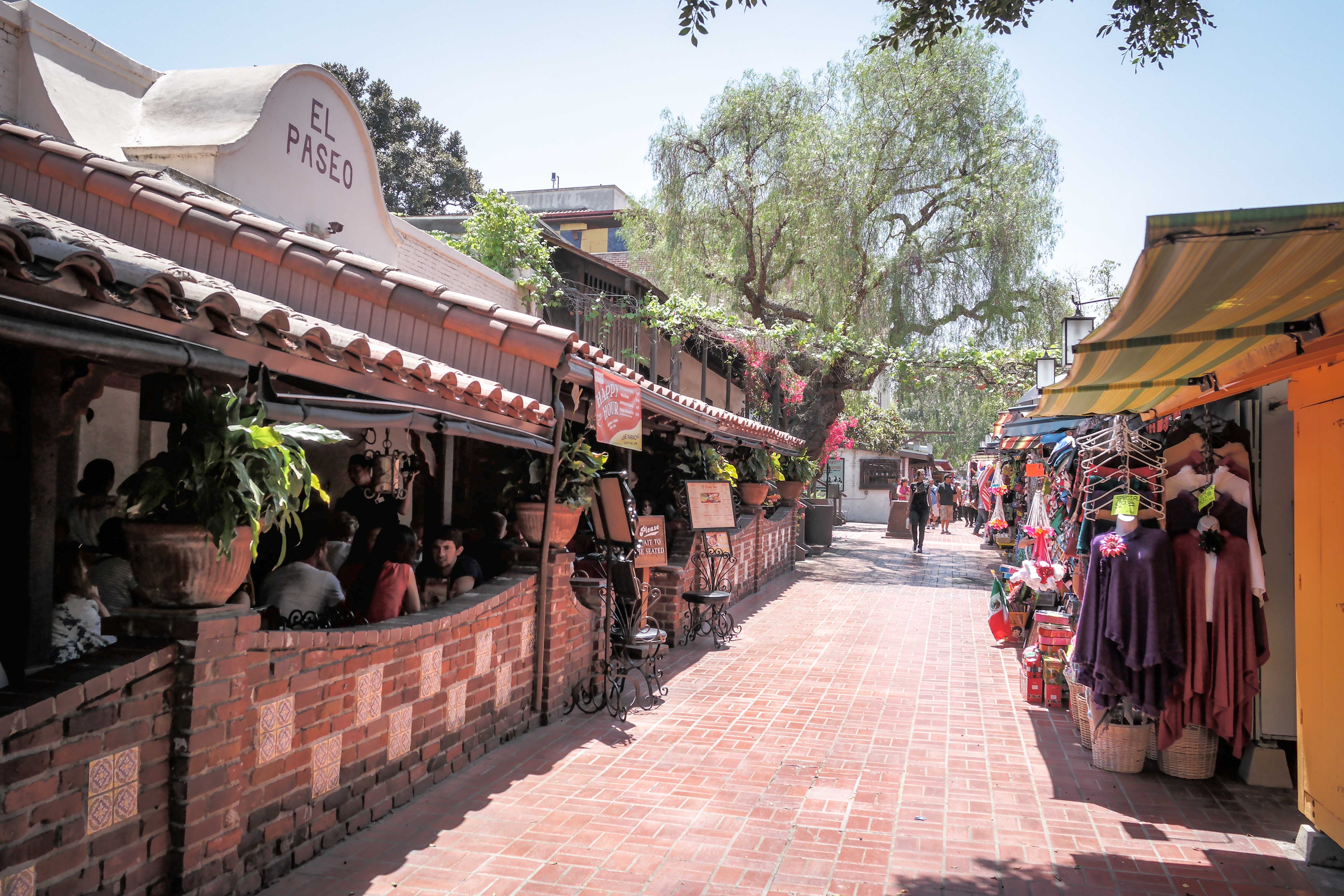
Olvera Street
The Avila Adobe at 10 Olvera Street was built in 1818 by Francisco Ávila, a wealthy cattle rancher, when California was still part of New Spain. Its adobe walls are two and a half to three feet thick. U.S. Navy Commodore Robert Stockton requisitioned it as his headquarters in 1846 when the United States first occupied the city. It is the oldest surviving residence in Los Angeles, and it stands on a street that is older still.
The Oldest Place in the Newest City
Olvera Street runs north from the Los Angeles Plaza to Cesar Chavez Avenue, between Main and Alameda streets in the northeast corner of downtown. This is not a reconstructed historic district or a theme park simulation of old California: the street itself is original, the plaza beside it was the center of city life through the Spanish and Mexican eras, and the buildings that line it include some of the most significant historic structures in Southern California.
The street takes its name from Agustín Olvera, a judge and politician who held Los Angeles's first county court sessions in his house on the block. The neighborhood around the Plaza served as the commercial and civic heart of the pueblo of Los Angeles from the city's founding in 1781 through the early American era following the Mexican-American War. When the city grew south and west, the original plaza area was left behind — which is why so much of it survived.
Christine Sterling recognized this in the 1920s. A civic activist who took up the cause of preserving the historic structures around the plaza, she led the effort to restore the Avila Adobe — threatened with demolition — and to transform the block into a pedestrian marketplace. In 1930, Olvera Street reopened as a Mexican marketplace. It has attracted close to two million visitors a year ever since.
The Buildings That Remain
The Avila Adobe is the anchor, but it is not the only historic structure on the block. The Sepulveda House, built in 1887 by Señora Eloisa Martínez de Sepúlveda in the Eastlake architectural style, represents the Victorian era that overlapped with the dying years of Mexican California. Born in Sonora, married into a California family, she built a structure that housed both commercial businesses and private residences — the kind of mixed-use building that planners now rediscover as a model for sustainable urbanism.
The Plaza Substation, also on Olvera Street, was built in 1904 as part of the electric streetcar system that once defined Los Angeles's geography. When the streetcar system closed in the 1940s, the substation became a relic of a transportation system that Los Angeles is now, three-quarters of a century later, beginning to rebuild.
The Pelanconi House at 17 Olvera Street, built in the 1850s, is the oldest surviving brick building in Los Angeles. In 1924, it was converted into a restaurant called La Golondrina — still operating, the oldest restaurant on the street.
Preservation and Its Discontents
The American Planning Association named Olvera Street one of the five great streets in the United States in 2015. The recognition was genuine, but it coexists with a long-standing debate about what exactly is being preserved, and for whom.
Critics have argued that Olvera Street presents a sanitized, curated version of Mexican and Latin American culture — a 'fake' Mexican presence designed to attract Anglo tourists rather than to serve or represent the actual Mexican American community that lives and works in Los Angeles. The marketplace atmosphere, with its vendors of crafts and food, can feel like a performance of ethnicity for an external audience.
Others argue that the preservation itself was radical — that when Sterling fought to save the Avila Adobe in the 1920s, she was fighting against a city that was perfectly willing to demolish the evidence of its Mexican past. Whatever its limitations as cultural representation, Olvera Street saved buildings that would otherwise be gone, kept a physical connection to the oldest layers of the city's history, and provided a place where the Spanish-language history of Los Angeles was not entirely erased.
Both things can be true. The street is imperfect and real, surviving and contested, a place where the oldest story of Los Angeles is told in accented, complicated ways.