Olympia (Washington)
The State Capitol dome catches the light like a beacon, its stone bulk rising 287 feet above Capitol Lake and visible for miles across the south Puget Sound lowlands. But Olympia is not the buttoned-up government town that dome might suggest. This is a city of 56,000 that punches far above its weight culturally - birthplace of the riot grrrl movement, home to the radically unconventional Evergreen State College, nursery to bands like Bikini Kill and Sleater-Kinney. The suits climb Capitol Hill each morning, but downtown Olympia belongs to record stores, independent bookshops, and coffeehouses where conversations run political and the espresso is taken seriously. Mount Rainier looms over the eastern horizon. The Olympics shimmer to the northwest. And the bureaucrats share sidewalks with activists who wouldn't live anywhere else.
The Capitol Campus
The Washington State Capitol building was the last state capitol constructed in the Beaux-Arts style, completed in 1928 with a dome modeled after St. Peter's Basilica. The Legislative Building anchors a campus of government buildings set on manicured grounds overlooking Capitol Lake, the whole complex designed as a monument to civic permanence. The dome remains the tallest masonry dome in North America.
Tours of the building reveal marble hallways, Tiffany chandeliers, and a rotunda where visitors can look straight up into the dome's interior. The State Reception Room holds a collection of Washington state art. Outside, the grounds offer walking paths through formal gardens and native plantings, with views across the lake to the city and the mountains beyond. It's a place designed to impress - and it does, even as the rest of Olympia cultivates deliberate anti-pretension.
Evergreen and the Alternative Scene
The Evergreen State College opened in 1971 as an experiment in education - no grades, no majors, no traditional departments, just interdisciplinary programs where students and faculty work together on sustained projects. The campus sprawls through a thousand acres of second-growth forest on the edge of town, its architecture deliberately unmonumental, its culture proudly weird. Evergreen has graduated musicians (Matt Groening characters), animators, activists, and a disproportionate number of people who've changed American culture from the margins.
The college's influence pervades Olympia. KAOS, the community radio station, broadcasts from campus, offering programming as eclectic as the school itself. The music scene that emerged in the early 1990s drew on Evergreen's DIY ethos - bands forming, recording, distributing their own work, creating an alternative to the mainstream music industry that would eventually be called independent rock. The riot grrrl movement started in living rooms here, feminist punk that spread worldwide through zines and cassettes.
Downtown Olympia
Fourth Avenue runs through downtown's heart, lined with the kind of locally-owned businesses that have vanished from most American cities. Browsers' Bookshop has occupied its corner for decades. Record stores still sell vinyl. Cafes cater to writers nursing single cups for hours. The Olympia Farmers Market, one of the oldest in Washington, fills the waterfront on weekends from April through December with local produce, artisan goods, and street performers.
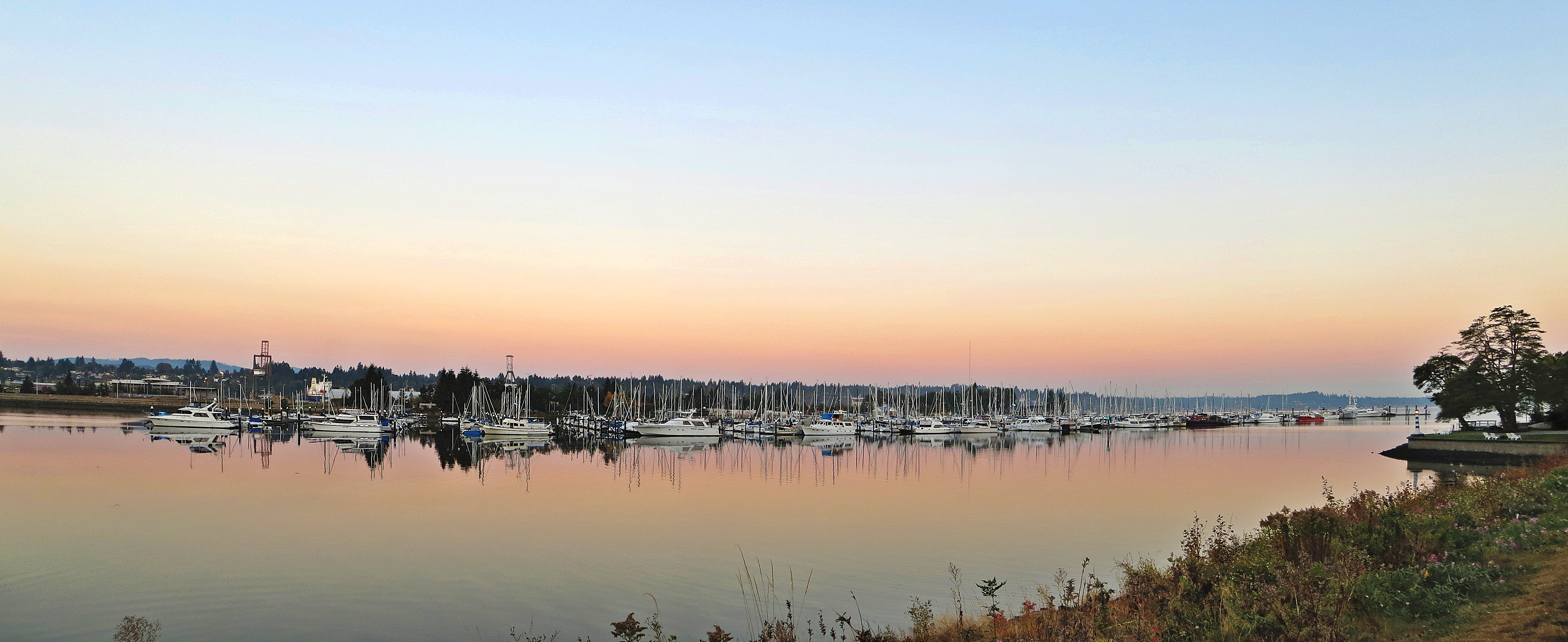
The city's downtown was designated a National Historic District, preserving buildings from the late 19th and early 20th centuries that now house galleries, brewpubs, and restaurants. Percival Landing, a waterfront park and boardwalk, offers views across Budd Inlet to the shipyard and the Olympic Mountains beyond. The scale remains human - no building overwhelms, no development has replaced the historic fabric with generic modern construction. Olympia looks like a real place, worn and layered and resistant to standardization.
Between Mountains and Sound
Olympia occupies one of the Pacific Northwest's most scenic settings - if you know where to look. From Capitol Hill, Mount Rainier fills the southeastern horizon, its glaciated bulk floating above the suburbs like an impossible vision. Turn northwest and the Olympics march along the skyline, their peaks snow-covered well into summer. Budd Inlet brings Puget Sound to the city's doorstep, tidal mudflats hosting shorebirds while harbor seals follow the salmon runs.
The city's parks and trails connect these natural spaces. Capitol Forest, a working forest managed for timber and recreation, spreads across 91,000 acres to the west - a maze of trails popular with mountain bikers, hikers, and equestrians. The Nisqually National Wildlife Refuge, northeast of town, protects wetlands at the mouth of the Nisqually River where migrating birds pause by the thousands. Even within the city, the urban forest canopy provides habitat for wildlife that thrives alongside the human population.
The Political City
As Washington's capital, Olympia lives with politics in a way most American cities don't. The legislative session brings lobbyists and advocates, protesters and petitioners. Environmental groups have headquartered here to be close to the action. Unions maintain a presence. The corridors of the Capitol Building echo with the business of governance - committee hearings, floor votes, the endless negotiation of democratic process.
But Olympia's political culture extends beyond the official chambers. Town halls draw engaged citizens. Coffee shop conversations turn to policy. The city's progressive reputation means that even local issues get debated with intensity. It's not a peaceful place, politically speaking - too many competing visions, too much at stake, too many people who care. But for those drawn to engagement, to the belief that government matters and citizens can influence it, Olympia offers something increasingly rare: a front-row seat to democracy in action.
From the Air
Located at 47.04°N, 122.89°W at the southern tip of Puget Sound's Budd Inlet. The State Capitol dome (287 ft tall) is the most prominent landmark - look for the white stone dome on the hill overlooking Capitol Lake. The lake itself was created by damming the Deschutes River estuary. Evergreen State College campus appears as a large forested area on the west side of town. Mount Rainier dominates the eastern horizon from this angle, appearing dramatically close on clear days. The Olympics are visible to the northwest. Nearest airports: Olympia Regional (KOLM) in adjacent Tumwater, Seattle-Tacoma International (KSEA) 55nm north. Marine influence keeps weather mild but often cloudy.