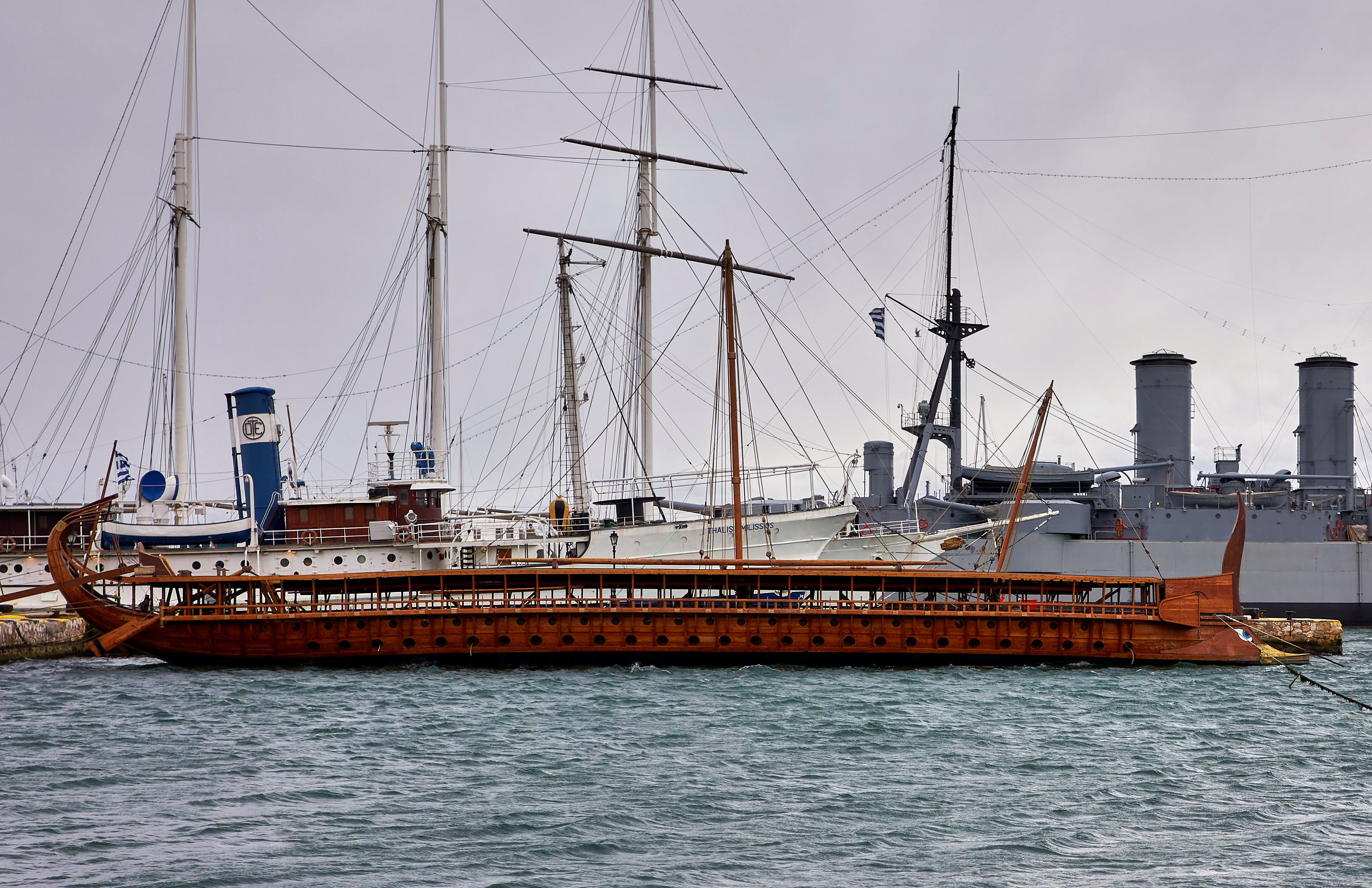
Olympias (trireme)
In 1987, with 170 inexperienced volunteer rowers seated in three banks below decks at Palaio Faliro, a 37-meter wooden warship pushed away from the dock and proved that Thucydides had been telling the truth. The Olympias is a working reconstruction of an Athenian trireme, the kind of ship that won at Salamis in 480 BC and ruled the Aegean for the next half century. Until 1987, classicists had spent the better part of two centuries arguing about how the trireme worked, whether the rowers really sat in three vertically stacked levels, whether the speeds reported by ancient historians were credible. A naval architect named John Coates and a classicist named John Morrison eventually built one, and the ship explained itself.
The Longest Letter to The Times
The Olympias began as a public argument. In the early 1980s, a correspondence about the trireme broke out in the letters page of The Times of London and ran longer than any other subject in the paper's history. John Morrison, the classicist who had spent a career on ancient warships, and John Coates, a naval architect with a passion for the same problem, exchanged ideas in print with Charles Willink, a classics teacher, and others. The argument was technical: how could you fit 170 oarsmen into a hull only 5.4 meters wide? Morrison and Coates eventually answered the question with drawings, and the drawings became a project. Together with the writer and banker Frank Welsh, they founded the Trireme Trust in 1982 to find money to build a real one. The Hellenic Navy agreed to commission the result. Construction took place in Piraeus from 1985 to 1987.
Building a Ship No One Had Built in 2,300 Years
The hull was built from Douglas fir with tenons of Virginia oak and a keel of iroko hardwood. The bronze ram on the bow weighs 200 kilograms, copied from an original ram preserved in the Archaeological Museum of Piraeus. One feature defeated authentic reconstruction. The hypozomata, the bracing ropes that ancient triremes ran beneath the deck from bow to stern, had to be replaced by steel cables because no available natural or synthetic fiber could match the elastic modulus of ancient hemp at any reasonable cost. The substitution caused unexpected problems. Where a hemp rope under steady tension would smoothly absorb the bending of the hull on waves, the steel cables surged with the flexing, raising the alarming possibility that one might part and snap through the rowers below. Protective measures were rigged. The ancient Athenians, it turned out, had engineered the hypozomata specifically as pre-tensioning, a technique modern construction reinvented in the twentieth century for prestressed concrete.
Nine Knots
The first sea trials took place in 1987 with 170 volunteer oarsmen and oarswomen, mostly amateurs, learning to row together as they went. Olympias reached a steady cruising speed of 9 knots and could turn 180 degrees in under a minute, swinging through an arc no wider than two and a half ship lengths. These were the kinds of speeds and maneuvers that Thucydides and Xenophon had reported as standard practice in the fifth century BC. The trials had a cleaner aim: not to break records but to determine whether the ancient figures were realistic. They turned out to be conservative. With trained crews, the trial speeds would have been higher. The estimated ramming speed of an ancient trireme exceeded 16 knots, which the modern reconstruction could not quite match, possibly because the modern hull was slightly heavier than its ancient counterpart. Further sea trials in 1990, 1992, and 1994 refined the picture without changing its central conclusion.
Two Hundred People in Forty Meters
The crew of a classical trireme came to 200 people. Five officers ran the ship: the trierarchos in command, the kybernetes steering and supervising sailing, the keleustes in charge of training and morale, the pentekontarchos handling administration, the prorates standing in the bow as lookout. One auletes, a flute player, gave the rowers their timing on a high reedy flute audible above the noise of 170 oars striking water. The oarsmen themselves were arranged in three banks: 62 thranitai on top, 54 zygitai in the middle, and 54 thalamitai working the lowest oars from the inner chamber that gave them their name. Ten sailors handled the single mast and sail when wind allowed. Fourteen marines, ten spearmen and four archers, stood ready for the close-in fighting that decided most ancient sea battles. The whole company fit into a hull about 37 meters long. The compression was an engineering achievement and a social one.
The Ship as Time Machine
Olympias did some ceremonial duty after the trials. The ship traveled to Britain in 1993 for events celebrating the 2,500th anniversary of Athenian democracy, rowed up the Thames, and rowed back. In 2004 she carried the Olympic Flame from Keratsini to the main port of Piraeus during the torch relay for the Athens Summer Olympics. Between 2016 and 2018, the Trireme Trust organized passenger trips in the Saronic Gulf, letting amateur rowers experience what it felt like to drive an ancient warship through Mediterranean swell. The Trust itself was wound up in 2018, with its archives transferred to Wolfson College, Cambridge. The ship now rests in a dry dock at the Naval Tradition Park in Palaio Faliro, fifteen minutes from central Athens. She is officially commissioned in the Hellenic Navy, the only such vessel in any of the world's navies, and she is the closest thing the modern world has to a working time machine for one specific moment of antiquity.
From the Air
The Olympias rests in dry dock at the Naval Tradition Park in Palaio Faliro, at approximately 37.934 N, 23.685 E, on the Saronic Gulf coast 6 km southwest of central Athens. The ship is housed in a covered shed beside the museum cruiser Averof and the destroyer Velos. Best viewed from 1,500-3,000 ft AGL approaching from the seaward side. Athens TMA is busy; expect ATC instructions. Nearest airport: Athens International Airport Eleftherios Venizelos (LGAV / ATH), 30 km east.