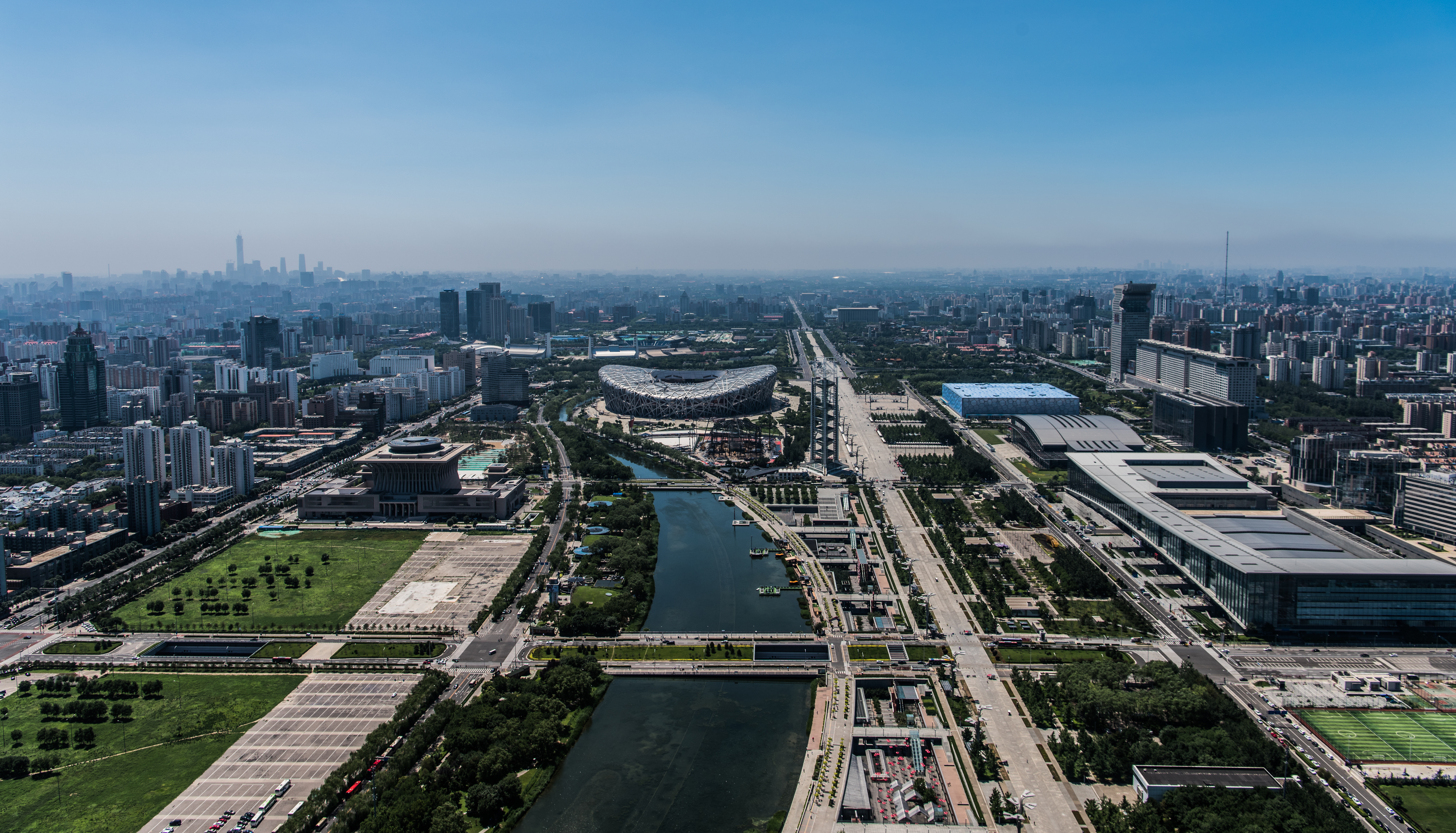
Olympic Green
No other city has hosted both the Summer and Winter Olympic Games, and the Olympic Green in Beijing's Chaoyang district bears the evidence of that distinction. The Bird's Nest Stadium, designed to hold 91,000 spectators for the 2008 Summer Olympics, hosted the opening and closing ceremonies again in 2022 when Beijing became the first city to welcome the Winter Games. The Water Cube, which once held swimming and diving events in a pool watched by 17,000, was converted into a curling venue for the winter edition. This adaptability, the ability to transform summer infrastructure into winter functionality, is central to the Olympic Green's story.
The Nest and the Cube
The Beijing National Stadium, universally known as the Bird's Nest, is the Olympic Green's most recognizable structure. Its interlocking steel beams create a lattice that looks organic rather than engineered, a nest woven from metal rather than straw. The stadium held 91,000 spectators during the 2008 Games, a number reduced to 80,000 afterward. Directly adjacent sits the National Aquatics Center, the Water Cube, its exterior made of translucent panels that glow blue at night. During the 2008 Olympics, it hosted swimming, diving, and synchronized swimming. For the 2022 Winter Olympics, the pool was covered with a temporary floor and the venue was rechristened the Ice Cube for curling. The National Indoor Stadium, called the Fan, added handball, artistic gymnastics, and trampolining to its resume in 2008 before hosting ice hockey in 2022. Together, these three structures define the park's skyline and its identity.
Beyond the Marquee Venues
The Olympic Green encompasses far more than its three famous buildings. The National Convention Center, covering 270,000 square meters, served as the fencing venue and International Broadcast Center during the 2008 Games and continues to operate as one of Asia's largest convention facilities. The Olympic Green Tennis Center, with 16 courts and a capacity of 17,400, opened in October 2007 and hosted both tennis and wheelchair tennis events. The Beijing National Speed Skating Oval, nicknamed the Ice Ribbon, was purpose-built for the 2022 Winter Olympics, adding a fourth signature structure to the park. Some venues were temporary by design. The Hockey Field, which seated 17,000 across 11.87 hectares, and the Archery Field, occupying 9.22 hectares, were both dismantled after the 2008 Games. The park's promenade hosted the racewalk events and portions of the marathon, its wide pathways doubling as athletic courses.
A Tower Disguised as Grass
The 246.8-meter Beijing Olympic Tower, completed in 2014, consists of five towers whose forms were inspired by blades of grass. Its circular rooftop platforms are meant to evoke the Olympic rings, though critics have described the structure as resembling a giant nail. It is the sixth tallest observation tower in China and the 22nd highest in the world. Visitors can look out over the entire Olympic Green and the sprawl of Beijing from five viewing platforms ranging from 186 meters to the full height of the structure. The Digital Beijing Building, designed by Chinese architect Pei Zhu, served as the data center during the 2008 Games. Its 57-meter, 11-story form was the only major Olympic facility designed by a Chinese architect. Viewed from two facades, it resembles a microchip; from the other two, a barcode. Since the Games it has been converted into a museum and exhibition space for digital technology companies, a transformation that mirrors the park's broader evolution from sporting venue to urban amenity.
What the Green Became
The Olympic Village, consisting of 22 six-story buildings and 20 nine-story buildings, housed athletes during the 2008 Games and has since been repurposed as residential housing. This conversion is part of a larger pattern in which the Olympic Green has evolved from a single-purpose athletic venue into a mixed-use district. The Ling Long Pagoda, originally part of the International Broadcast Center, now stands as a landmark near the 2008 cauldron on the northwest side of the Bird's Nest. Streets around the park have been used for exhibition racing, including a 2011 FIA GT1 World Championship street race. From the air, the Olympic Green appears as a concentration of distinctive architectural forms, each one designed to be recognizable from altitude. The Bird's Nest, the Water Cube, and the Olympic Tower form a visual cluster that is visible well before descent into Beijing Capital International Airport, a skyline signature that declares what happened here in 2008 and again in 2022.
From the Air
Located at 40.00°N, 116.39°E, in Chaoyang District. The Bird's Nest Stadium, Water Cube, and Olympic Tower are clearly visible from 5,000-10,000 feet as distinctive architectural forms. Nearest airport: Beijing Capital International (ZBAA), approximately 18 km northeast.