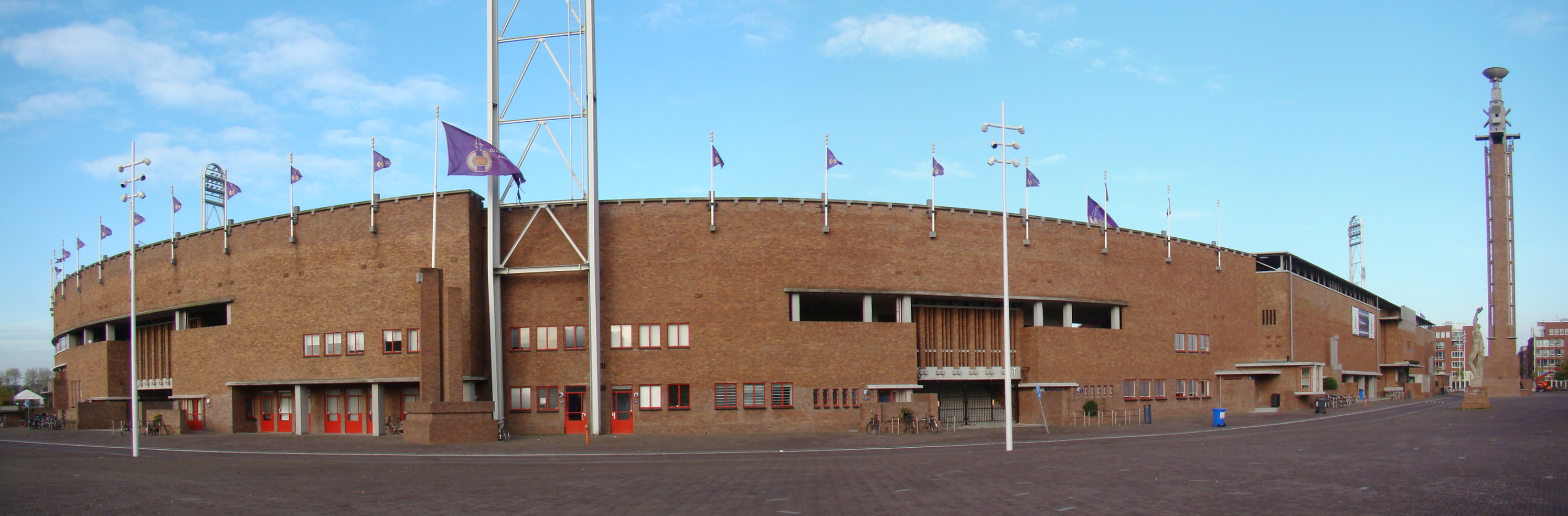
Olympic Stadium (Amsterdam)
The stadium won an Olympic gold medal before a single athlete ran in it. In 1928, when the Games still gave medals for the arts, the jury for the architecture competition awarded its highest prize to a young Dutch architect named Jan Wils for the venue he had just designed in the south-western edge of Amsterdam. The building was the prize, and the prize was the building. Nearly a century later, having been enlarged, almost demolished, then peeled back to what Wils first drew, the Olympic Stadium still stands as one of the cleanest expressions of the Amsterdamse School the city ever built.
Two Million Bricks on Sand
Amsterdam had to invent the ground before it could invent the stadium. Starting in January 1926, the site west of the existing Harry Elte stadium was raised with 750,000 cubic metres of trucked-in sand - the city's familiar trick of building the land before building on it. Piling for the foundations began in October. On 18 May 1927, Prince Hendrik laid the ceremonial first stone, and the masons followed with roughly two million more. Wils had drawn the stadium to complement H.P. Berlage's surrounding Plan Zuid neighbourhood, all warm brick and disciplined geometry. The capacity at opening was 31,600. A 400-metre running track surrounded the football pitch; an outer 500-metre cycling track ringed that, nine metres wide, ready for the cyclists who would compete there during the Games. The 1928 Olympics were the first to introduce the modern relay torch in spirit if not in its later form - the stadium's slim Marathon Tower, designed to hold an Olympic flame, was a quiet first.
An Extra Ring and a Long Career
Rotterdam built De Kuip in 1937, and Amsterdam responded the way cities do when they feel overtaken: it grew. Wils returned to add a second concrete ring to the north and south wings, lifting capacity to 64,000. The stadium took on a heavier, more massive silhouette and spent the next half-century as the city's biggest football venue. Ajax used it for international matches when the De Meer Stadion was too small or lacked the floodlights for midweek games - which was most of the time. The Dutch national team played here too, from a 0-2 loss to Uruguay during the 1928 Olympics to a 2-2 draw with Denmark on 6 September 1989. The 1962 European Cup final played out on this turf, Benfica beating Real Madrid 5-3 in a game still rated among the great finals. So did the 1966 Mistwedstrijd - the Fog Match - in which Ajax beat Liverpool 5-1 in a mist so thick spectators could barely see across the pitch.
Saved by Subtraction
By the 1990s the stadium was struggling. Ajax was moving to a new arena on the city's edge - the Amsterdam Arena, later renamed for Johan Cruyff in 2018 - and the Olympic Stadium faced demolition. What saved it was a decision to undo, not rebuild. In 1987 the stadium had been declared a national monument. Beginning in 1996, the 1937 second ring was removed entirely. Capacity dropped to 22,288. The original 1928 silhouette returned, lower and lighter, with the Marathon Tower rising again from a cleaner roofline. The running track was restored for athletics. In 2007 the Stadionplein square and the surrounding Olympic district were renovated; in 2008 a new pedestrian and cyclist bridge across the Schinkel was named, fittingly, the Jan Wilsbrug.
What the Stadium Holds Now
The Olympic Stadium is no longer the city's largest, but it does more than its bigger cousins. It hosted the 2016 European Athletics Championships. It is the start and finish line of the Amsterdam Marathon each October, the moment when 40,000 runners pour back through Wils's brick portal to applause that has been rolling out of those stands for nearly a hundred years. In 2014 and again in 2018 a long-track speedskating oval was laid temporarily over the field, hosting Dutch national championships and the World Allround Championships. In 1987 it staged the FIM Speedway World Championship Final, won by Denmark's Hans Nielsen. The Amsterdam Admirals played American football here in the mid-1990s. The Olympic Experience Amsterdam, a small sports museum, has been a tenant since 2005. Tour groups come from the Netherlands, Germany, Greece, Belgium, Canada. The stadium that won the gold medal in 1928 spent a century earning the prize again.
From the Air
Amsterdam Olympic Stadium, Stadionplein, Amsterdam-Zuid (52.343 N, 4.854 E). The stadium's distinctive brick oval and slim Marathon Tower sit just north of the Schinkel islands. Schiphol (EHAM) lies 6 km southwest - the stadium is often visible to the right on approach to runway 06 or departure from 36L. Best viewed at 1,500-3,000 ft AGL.