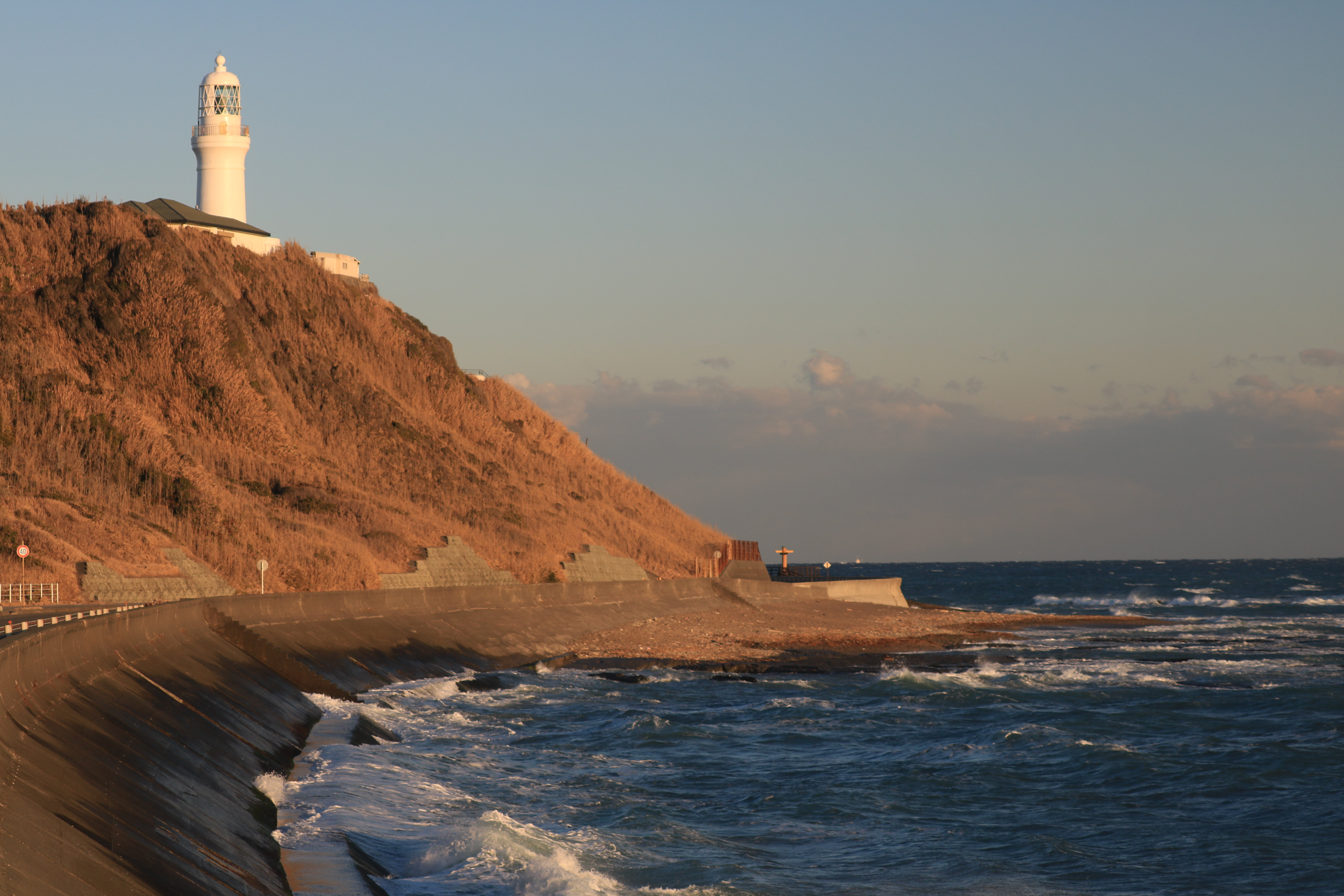
Omaesaki Lighthouse
Rows of graves once lined the cliffs below Cape Omae, markers for sailors who never made it past the rocks. The Tokugawa Shogunate recognized the danger as early as 1635, establishing a primitive light at the cape's outermost point after too many vessels shattered against the coast of Totomi Province. For over two centuries, that light burned while ships continued to founder in the treacherous waters where Suruga Bay meets the open Pacific. It took a grounding of a Japanese navy vessel in 1871 and the arrival of a Scottish engineer with no lighthouse experience to finally give Cape Omae the beacon it deserved.
The Scotsman's Lanterns
Richard Henry Brunton arrived in Japan in August 1868 with a peculiar distinction: the British government had recommended him to build lighthouses, yet he had never actually built one. A railway engineer by training, Brunton had been selected by the Stevenson brothers of Edinburgh, the legendary lighthouse-building family. Over the next seven and a half years, this self-taught lighthouse builder would design and supervise the construction of 26 western-style lighthouses along Japan's coastline, earning the title 'Father of Japanese Lighthouses.' Omaesaki was among his most urgent commissions. When a Japanese navy vessel ran aground on the rocks off Cape Omae on April 8, 1871, the Meiji government moved the project to the top of the priority list. Construction began on May 26, 1872, and Brunton's crew completed the tower on May 1, 1874, at a cost of 25,000 yen. What made this lighthouse truly special was its optic: Omaesaki became the first lighthouse in Japan to use a Fresnel lens, the same prismatic technology that had revolutionized lighthouse design across Europe.
Fire, War, and Resurrection
For decades, the lighthouse's Fresnel lens threw its beam across waters that had swallowed ships for centuries. The light was upgraded to a more powerful beam in 1917, keeping pace with the growing volume of maritime traffic along the coast. Then World War II arrived at Cape Omae. United States Navy warships bombarded the lighthouse, cracking the irreplaceable Fresnel lens and tearing into the structure itself. The tower that Brunton had built to save lives became a casualty of war. But the rocks off Cape Omae did not care about geopolitics. Ships still needed guidance. After the war ended, crews repaired the damaged structure and installed a third-order Fresnel lens, a worthy successor to the original. On March 24, 1949, the light returned to service, once again sweeping across the dark waters where Suruga Bay opens into the Pacific.
Sentinel on the Cape
Today Omaesaki Lighthouse stands as both a working navigational aid and a monument to Japan's maritime modernization. The Japanese government has registered it as an A-grade Lighthouse for historic preservation, and the Japan Lighthouse Association lists it among the 50 Lighthouses of Japan. Visitors can climb the tower for a panoramic view that explains everything about why this spot demanded a light: the Pacific stretches to the horizon in every direction, and the rocky coastline below reveals just how unforgiving these waters remain. The Japan Coast Guard still operates the lighthouse, maintaining the tradition that began when the Tokugawa Shogunate first recognized that Cape Omae was killing sailors nearly four centuries ago. The graves beneath the cliff may be weathered, but the light above them has not gone dark since 1949.
A Treaty Written in Shipwrecks
Omaesaki Lighthouse is also a physical artifact of one of the most transformative periods in Japanese history. The Anglo-Japanese Treaty of Amity and Commerce of 1858 had specifically mandated the construction of eight lighthouses to protect foreign shipping. Omaesaki was not among those eight, but the sheer volume of wrecks at Cape Omae forced the Meiji government's hand. The lighthouse thus represents the moment when Japan's own maritime safety became as important as treaty obligations to foreign powers. Brunton, the Scotsman who built it, went on to contribute far beyond lighthouses. He surveyed and drew the first detailed maps of Yokohama, planned its sewage system, and helped found Japan's first school of civil engineering. But it is the lighthouses, including this one on the windswept cape of Omaezaki, that remain his most visible legacy.
From the Air
Omaesaki Lighthouse sits at 34.596N, 138.226E on the tip of Cape Omae, the southernmost point of the Shizuoka coastline jutting into the Pacific. The white lighthouse tower is visible against the dark rocky cape at altitudes below 5,000 feet. Mt. Fuji Shizuoka Airport (RJNS) lies approximately 22 km to the northeast. Hamamatsu Air Base (RJNH) is roughly 60 km to the west. The cape itself is a distinctive geographic feature visible from higher altitudes, marking the boundary between Suruga Bay to the east and Enshu-nada to the west. Best viewed on approach from the south over open water.