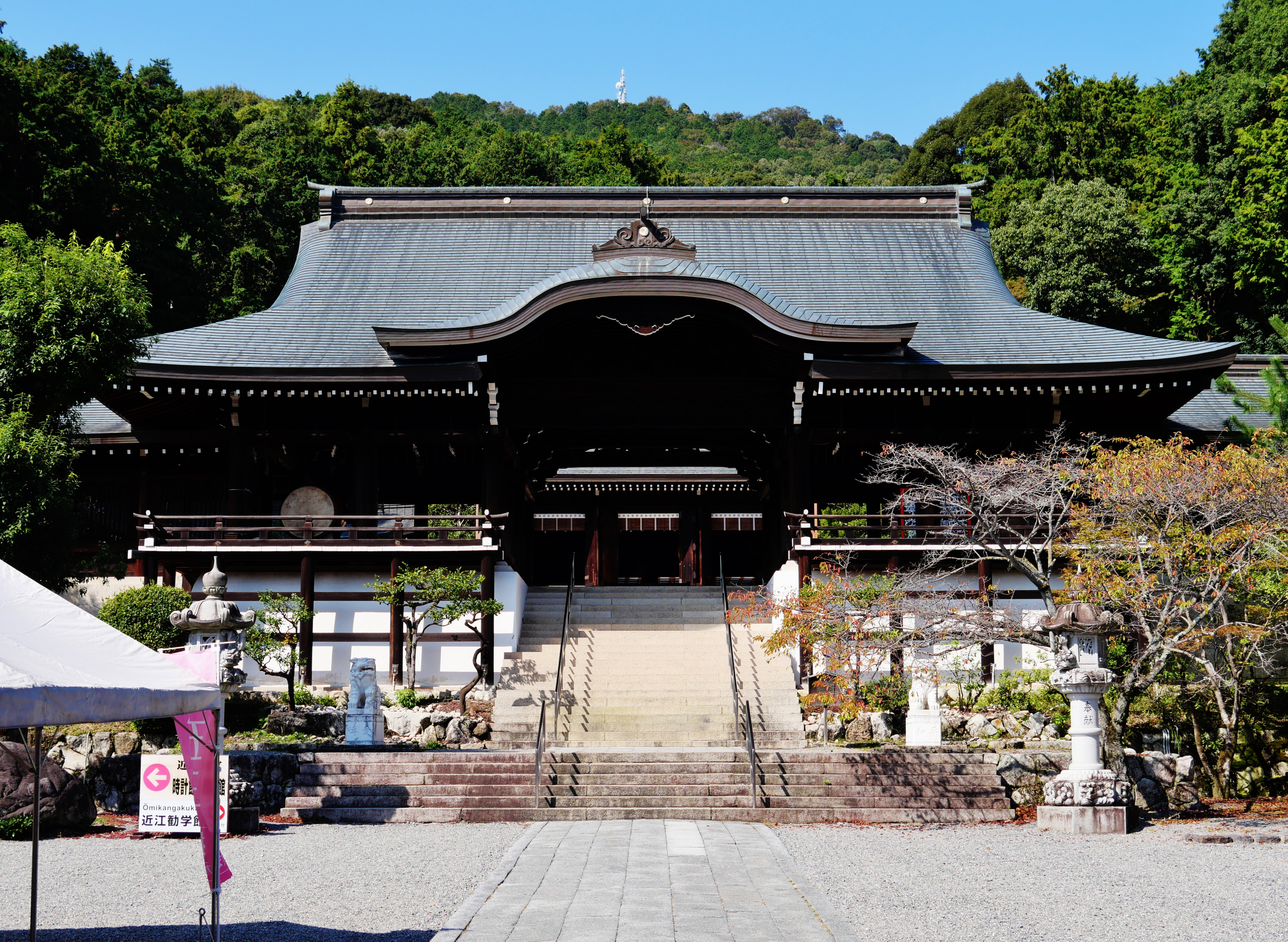
Omi Shrine: Where Time Began and Poetry Lives in Stone
Every January, over a thousand competitors descend on a shrine in Otsu, Shiga Prefecture, to play cards at terrifying speed. The game is karuta, and the cards bear poems written more than a thousand years ago. The shrine is Omi Jingu, dedicated to Emperor Tenji, who composed the very first poem in the Ogura Hyakunin Isshu -- the anthology of one hundred poems that forms the basis of the game. A reciter chants the opening syllables of a poem, and players lunge to snatch the matching card from rows laid out on tatami mats. Reaction times are measured in fractions of a second. Champions earn the title Meijin for men and Queen for women, and anyone who wins seven times becomes an Eternal Master. The shrine where all of this happens is relatively young by Japanese standards, completed in 1940, but the emperor it honors shaped the country in ways that still echo through daily life -- including the simple act of knowing what time it is.
The Emperor Who Measured the Hours
Emperor Tenji reigned from 668 to 672, and during those few years he changed Japan fundamentally. He moved the capital from Asuka to Omi Otsu no Miya, the ancient lakeside palace that once stood near the grounds of the present shrine. He initiated the Taika Reforms that centralized government through land and tax restructuring, and he ordered the compilation of Japan's first legal code. But the achievement that binds him most directly to Omi Jingu is timekeeping. In 671, Emperor Tenji installed a roukoku -- a water clock -- and used it to strike bells and drums to announce the hours. It was the first system of official timekeeping in Japanese history, an event recorded in the Nihon Shoki chronicle. June 10th, the anniversary of that moment, is now celebrated as Time Day in Japan, and the shrine marks it each year with a ceremony attended by representatives from the Japanese clock and watch industry.
Clocks, Water, and the Passage of Centuries
Inside the shrine precincts, the Omi Jingu Clock Museum makes the connection between Emperor Tenji and timekeeping tangible. The museum displays a replica roukoku water clock alongside a collection of Japanese clocks, watches, and timepieces spanning centuries of design. Traditional Japanese clocks divided daylight and darkness into six equal periods each, meaning the length of an 'hour' shifted with the seasons -- a concept that demanded inventive mechanical solutions. The museum's second floor holds treasures associated with the shrine itself: ceramics, lacquerware, masks, glassware, and folding screens. But the water clock remains the centerpiece, a reminder that the rhythms governing modern life -- commuter trains running to the second, meetings scheduled to the minute -- trace a lineage back to a lakeside palace and an emperor who decided his people should know the time.
Poetry Carved in Stone
Scattered across the shrine grounds stand thirteen poem monuments, natural stones carved with tanka and haiku by some of Japan's most revered poets. The stone monuments are called kahi for tanka and kuhi for haiku. Among them is a verse by Matsuo Basho, the wandering seventeenth-century poet who elevated haiku into high art. Another bears Emperor Tenji's own tanka -- the poem about autumn rice fields and a watchman's thatched hut that opens the Hyakunin Isshu. Verses by the ancient court poets Kakinomoto no Hitomaro and Takechi no Kurohito stand alongside works by more recent shrine priests and literary figures. Walking among them is a quiet, contemplative experience, the poems weathering slowly into the stone surfaces, their meanings accumulating layers of moss and age.
The Sacred Ground of Karuta
Otsu calls itself the Holy Land of Karuta, and Omi Jingu is its temple. Because Emperor Tenji composed the anthology's first poem, the shrine became the natural home for competitive karuta's most important tournaments. The men's championship for the Meijin title has been held here since 1955, and the women's Queen title since 1957. Every July, more than a thousand high school students from across Japan converge for the All Japan High School Ogura Hyakunin Isshu Karuta Tournament. The game demands extraordinary memorization -- all one hundred poems committed to memory -- and physical reflexes that rival those of athletes. Players kneel on tatami, scanning fifty cards spread before them, and when the reciter begins a poem, the best competitors are already moving, their hands a blur. Since 2012, international tournaments have drawn competitors from the United States, China, South Korea, New Zealand, and Thailand, carrying seventh-century Japanese poetry to a global audience.
A Shrine Between Mountain and Lake
Omi Jingu sits at the foot of Mount Nagara, looking out across Lake Biwa, Japan's largest freshwater lake. The shrine's architectural style, known as Omi-zukuri, reflects the grandeur of its imperial dedication. Visitors approach through a towering Romon gate and pass shrine offices, a rest house serving soba noodles, and even a purification station for automobiles. The grounds include the Omi Kangakukan, a cultural hall that hosts karuta practices and educational programs. Cherry trees line the approach in spring, and the shrine draws visitors year-round for its calendar of ceremonies -- from New Year's rites beginning at midnight on January 1st to year-end purification on December 31st. For a shrine completed only in 1940, Omi Jingu carries the weight of deep history, connecting the present to a seventh-century emperor who gave Japan its sense of time and its most beloved poetry.
From the Air
Located at 35.03°N, 135.85°E on the western shore of Lake Biwa in Otsu, Shiga Prefecture. The shrine sits at the base of Mount Nagara with Lake Biwa stretching east. From 3,000-5,000 feet AGL, the shrine complex and its forested approach are visible against the lakeside terrain. Lake Biwa itself is Japan's largest lake and an unmistakable landmark. The nearest significant airport is Osaka Itami (RJOO), approximately 40 nautical miles southwest. Kansai International (RJBB) is about 60 nautical miles to the south. Clear visibility reveals the contrast between the urban shoreline of Otsu and the mountainous backdrop to the west.