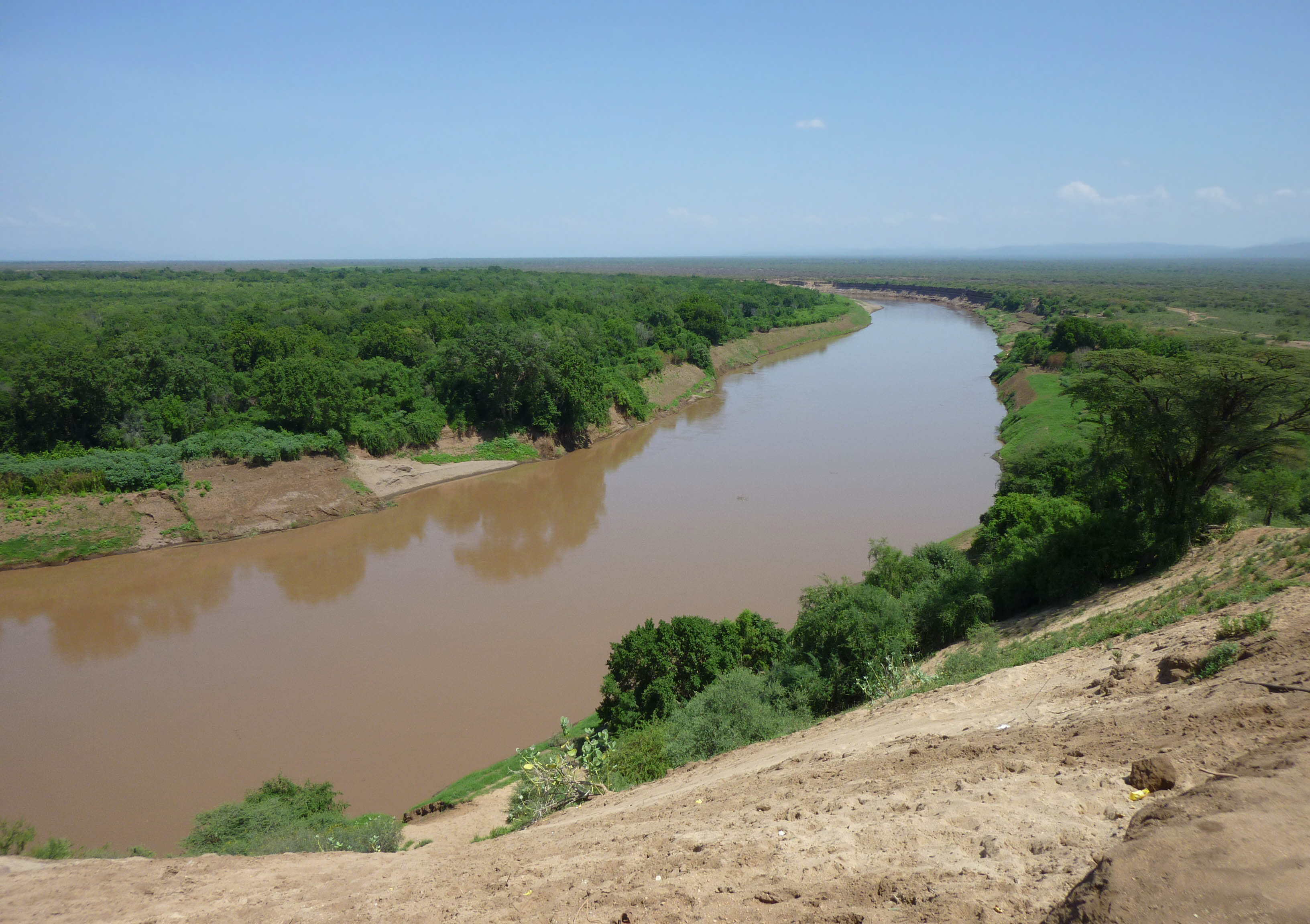
Omo National Park
The Lonely Planet guide to Ethiopia calls it simply "the country's most remote park." That description understates how thoroughly Omo National Park resists visitors. There is an airstrip near the headquarters on the Mui River, but reaching it by road means an 870-kilometer journey southwest from Addis Ababa, through terrain that treats vehicles as suggestions. Founded in 1980 on the west bank of the Omo River, the park covers 4,068 square kilometers of open savannah, riverine woodland, and mountain terrain in the Southern Nations, Nationalities, and Peoples' Region. Across the river lies Mago National Park and the Tama Wildlife Reserve, forming a vast corridor of protected land in a corner of Africa where Ethiopia, South Sudan, and Kenya converge.
A Landscape Carved by Water
The Omo River defines the park's eastern boundary, but its tributaries shape everything within. The Mui River cuts through the center before joining the Omo, and several smaller rivers drain the highlands to the west, all flowing toward the same destination. Most of the park sits at around 800 meters elevation, but the terrain is not uniform. To the north and west rise the Maji Mountains, whose highest peak within the park reaches 1,541 meters above sea level. The Sharum and Sai plains stretch below them. In the south, where the Neruze River carves its path, the land drops to 450 meters -- a descent that shifts the vegetation from highland thickets to lowland savannah. Three hot springs punctuate the landscape, their mineral-rich waters a reminder of the geological forces still at work beneath the surface.
The Animals That Remain
Seventy-three mammal species and 312 bird species have been recorded here, though seeing them requires patience and luck in equal measure. The open plains support large herds of buffalo, zebra, eland, and Grant's gazelle, along with less common species like the beisa oryx, tiang, and Lelwel hartebeest. Dik-diks and bushbucks move through the thickets, while reedbucks favor the riverine margins. The park's more elusive residents -- elephants, lions, leopards, cheetahs, African wild dogs, giraffes, and black rhinoceros -- are present but increasingly difficult to find. Hippopotamuses and warthogs inhabit the wetter lowlands. In the forested areas along the rivers, primates hold their own: mantled guerezas with their striking black-and-white coats, olive baboons in noisy troops, and the reclusive De Brazza's monkey, its blue-grey face framed by an orange crown.
People and Parkland in Collision
The tension at the heart of Omo National Park is not between predator and prey but between conservation mandates and the indigenous communities who have lived on this land for generations. In 2008, African Parks -- an international conservation organization that had taken over management of the park -- withdrew from Ethiopia entirely. Their stated reason was blunt: they described the situation as incompatible with what they called "the irresponsible way of living of some of the ethnic groups." The phrasing revealed the depth of the conflict. Indigenous communities were attempting to continue traditional practices -- cattle grazing, seasonal movement, subsistence farming -- within boundaries drawn by a government in Addis Ababa. For the conservation managers, these activities threatened the ecosystem they were charged with protecting. For the people who lived there, the park's boundaries threatened a way of life that predated the concept of national parks by centuries.
The View from Above
From the air, the Omo River writes its story in broad, looping meanders across a green-brown landscape. The contrast between the riverine woodland -- dense and dark along the water's edge -- and the open savannah beyond is sharp enough to read from cruising altitude. During the dry season, animal tracks converge on the remaining water sources in patterns visible from thousands of feet up. The Maji Mountains break the western horizon, their slopes catching the afternoon light in shades that shift from green to purple depending on the season. This is not a park built for tourism infrastructure or guided walking tours. It is a landscape that exists largely as it has for millennia, shaped by water and fire and the movement of animals, observed best from a distance that respects its indifference to visitors.
From the Air
Located at 6.00N, 35.83E in southwestern Ethiopia, roughly 870 km southwest of Addis Ababa. The park covers 4,068 sq km of savannah and mountains along the west bank of the Omo River. An airstrip exists near park headquarters on the Mui River. Most of the park sits at 800 m elevation, with the Maji Mountains reaching 1,541 m. Nearest major airport: Addis Ababa Bole International (HAAB), approximately 870 km northeast. Jimma Airport (HAJM) is closer at roughly 350 km north-northeast. Best viewed from 5,000-8,000 feet AGL, where the Omo River meanders and the transition from savannah to mountain terrain are clearly visible.