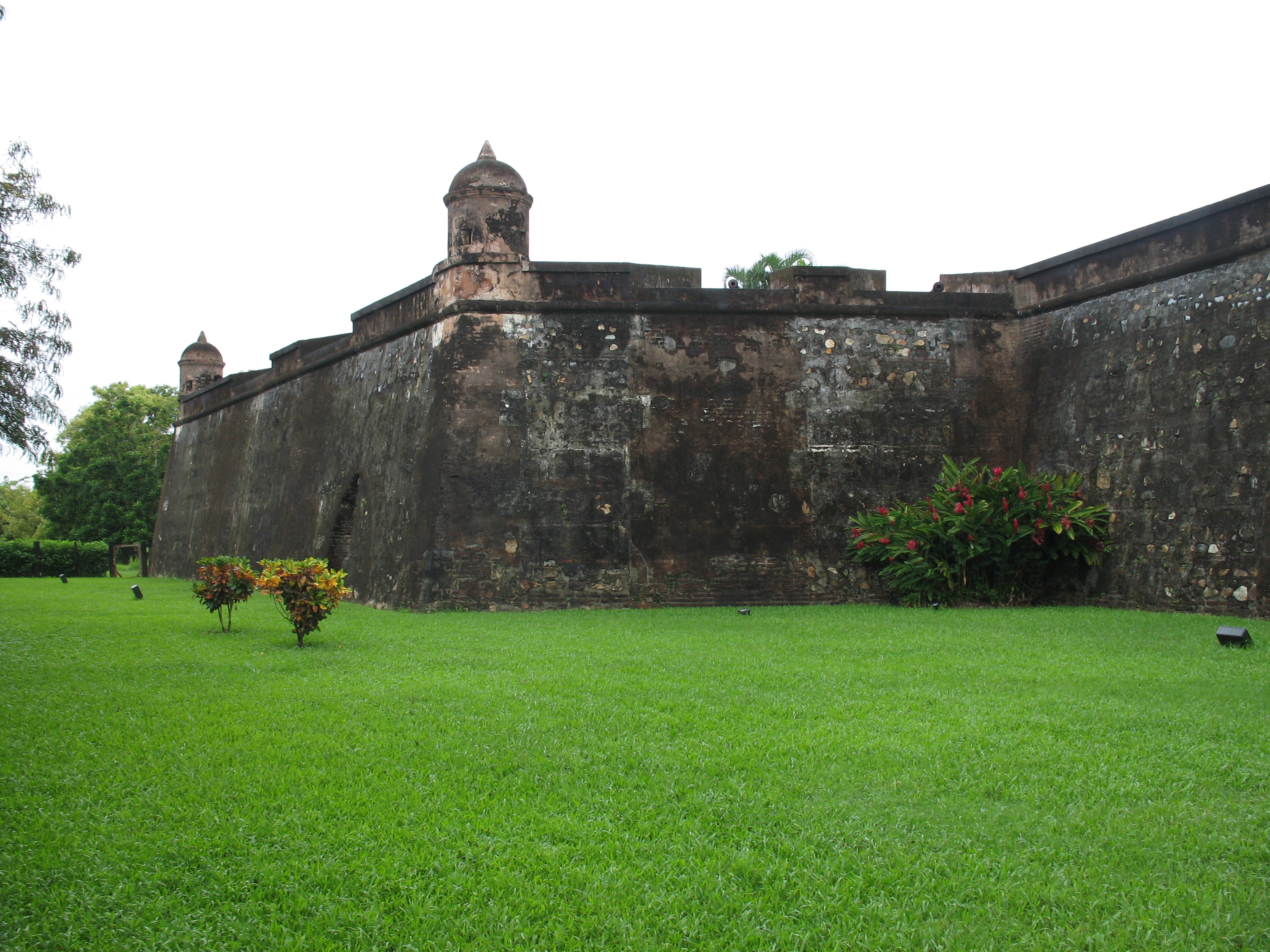
Omoa
The craters from a British bombardment in 1779 are still visible in the walls of the Fortaleza de San Fernando de Omoa. Built of brick and coral over nearly two decades, the fortress was designed to guard Spanish silver shipments from pirates -- and it was finished, ironically, only after piracy had significantly declined. Omoa sits on a small bay on Honduras's Caribbean coast, 18 kilometers west of Puerto Cortes, a fishing village of roughly 10,000 people overshadowed by one of the largest colonial fortresses in the Americas. The fort has outlasted the empire that built it, the pirates it was meant to repel, the British who briefly captured it, and the hurricane that destroyed the town around it.
A Port Worth Fighting Over
Omoa's strategic value was recognized long before its fortress was built. In 1536, the settlement was a small pueblo de indios allocated by Pedro de Alvarado; by 1582, it had ceased to exist as a viable community. But repeated pirate raids along the Caribbean coast of Central America forced the Spanish Crown, as early as 1590, to search for a defensible port from which the Captaincy General of Guatemala could ship goods to Spain. Survey after survey pointed to the bay at Omoa. In 1752, the governor of Honduras laid plans for a proper town: hospital, church, royal treasury, warehouses, barracks, and officers' quarters. Two forts would guard the bay. The smaller Fort El Real was completed around 1756. The much larger San Fernando de Omoa, constructed from 1756 through 1775, was built specifically to protect the silver cargoes originating from mines near Tegucigalpa.
The Night the Baymen Dropped the Ladders
On October 15, 1779, a British naval squadron arrived off the Honduras coast hoping to intercept Spanish treasure ships. Two Spanish vessels had taken shelter under San Fernando's guns, and an attack from the sea failed. The next day, a landing party of Royal Navy seamen, marines, soldiers from the Royal Irish Regiment, and 250 Baymen from Belize came ashore nine miles away at Puerto Caballo for an overland assault. They had underestimated the terrain -- swamps first, then wild mountainous country -- and covered only three miles during the night. When they reached Omoa the following afternoon, the town fell quickly, but the fort held: the Baymen had dropped the scaling ladders they were carrying. It took three more days of bombardment from sea and shore batteries before storming parties of seamen, marines, and soldiers infiltrated the fort under cover of darkness. The surprise was total, with only six British casualties. The treasure seized from the fort and two captured ships was worth some three million dollars, and 14 metric tons of mercury were found inside. The British abandoned the fort by November, before a Spanish counterattack arrived.
Enslaved Builders and a Diverse Port
The people who actually built and maintained the fortress were largely enslaved Africans, brought in under four royal slave contracts. By the late eighteenth century, Omoa had a remarkably diverse population: Spanish colonists, indigenous people relocated from central Honduras, enslaved Africans, mulattos, and free Black residents -- many of them enslaved people who had escaped from British-controlled Belize. This mix of peoples reflected the port's role as a crossroads of colonial trade and forced labor. After Honduras declared independence in 1821, Omoa's fortress served a grimmer domestic purpose: it was used as a prison by Honduran authorities through the 1950s. The fort was the last Spanish stronghold in Central America to fall, eventually captured by Central American Republicans under Colonel Juan Galindo.
Decline, Destruction, and What Remains
Omoa's importance as a port faded in the 1820s. Fires destroyed much of the town on more than one occasion. The bay began to silt up. Nearby Puerto Cortes grew as a competitor, and when the first railroad connecting Puerto Cortes to San Pedro Sula was completed in the 1880s, Omoa was reduced to a fishing village. Then, in 1974, Hurricane Fifi struck. The storm destroyed the town, but the fortress -- having survived pirates, the British Navy, fires, independence wars, and decades as a prison -- stood firm. It became a point of rescue operations in the hurricane's aftermath. Today, the Fortaleza de San Fernando de Omoa is one of the few surviving colonial fortresses in the Americas. It was declared a national monument in 1959 and is on Honduras's tentative list for UNESCO World Heritage status. The bombardment craters from 1779 remain embedded in its coral and brick walls, as legible as the day they were made.
From the Air
Located at 15.78N, 88.04W on the Caribbean coast of Honduras, on a small bay 18 km west of Puerto Cortes. The fortress is visible from low altitude as a large rectangular structure near the waterfront. Nearest airport is San Pedro Sula Ramon Villeda Morales International (MHLM), approximately 60 km to the southeast. The bay is best seen from a northern approach over the Caribbean, where the fortress and harbor are clearly distinguishable against the town and surrounding green hills.