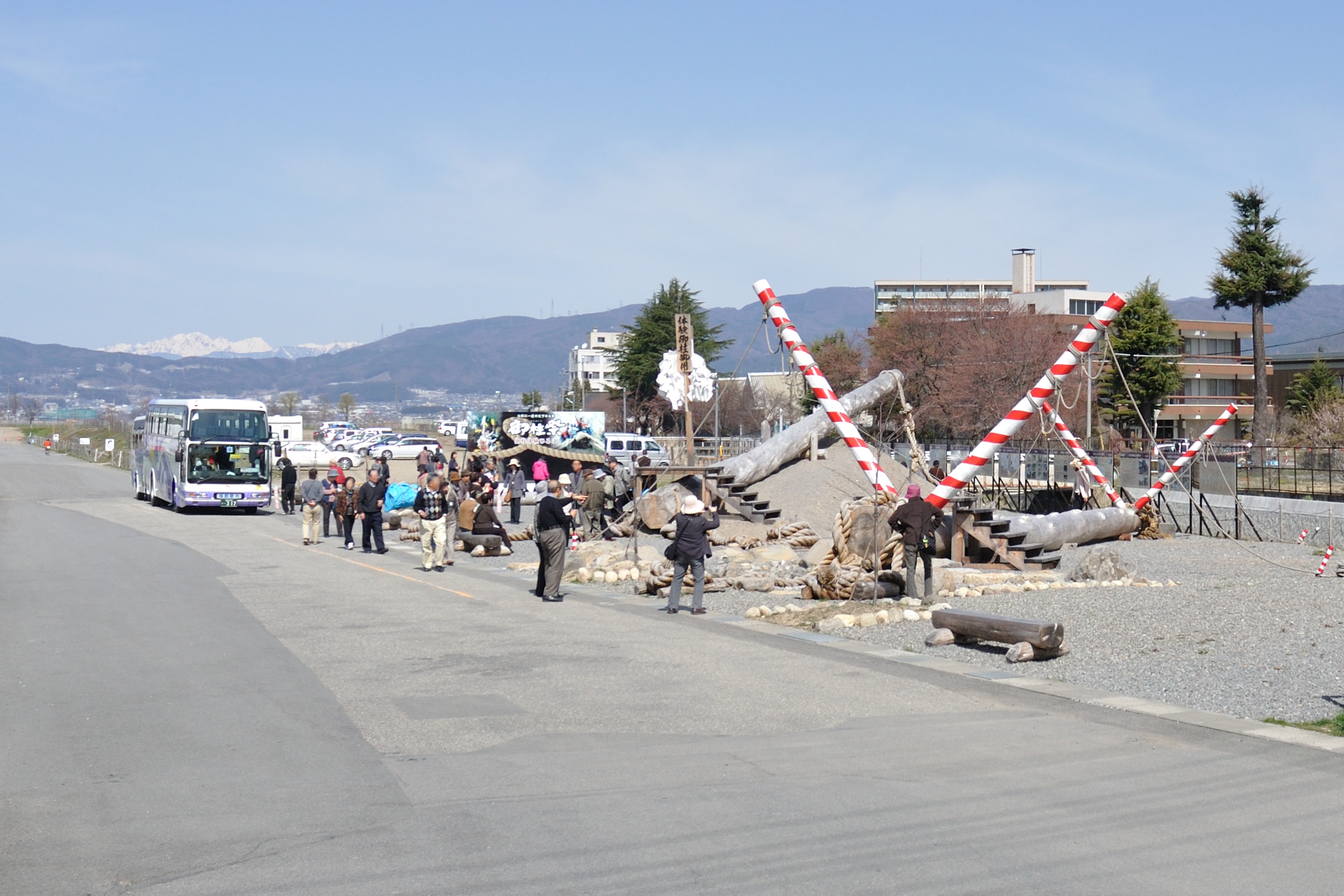
Onbashira
In 1914, a 21-year-old named Tomoya Nakamura straddled a freshly cut fir trunk and rode it down a steep hillside while hundreds of spectators watched in disbelief. He was the first person known to have done so, and he would repeat the feat at five consecutive festivals over the next thirty years, becoming a local legend in the process. The act he pioneered, riding enormous logs weighing up to 12 tons as they plunge down mountainsides, has since become the defining spectacle of the Onbashira Festival, Japan's most dangerous matsuri. Held every six years at the shores of Lake Suwa in Nagano Prefecture, this ritual renewal of the Suwa Grand Shrine has claimed lives across the centuries and continues to draw tens of thousands of participants and spectators who gather to witness the raw collision of devotion, danger, and gravity.
Sixteen Trees for Four Shrines
The word onbashira means "honored pillars," and the festival's purpose is deceptively simple: replace the four massive wooden posts standing at each corner of the shrine complex's four buildings. That means sixteen fir trees must be felled, transported down the mountains, and raised into position. The largest pillar, the ichino-hashira or "first pillar," stands approximately 16.6 meters tall. The logs for the Upper Shrine come from momi fir trees on Mount Okoya in the Southern Yatsugatake Mountains, while those of the Lower Shrine are sourced from the Higashimata forest in the town of Shimosuwa. Each log is dressed in red and white regalia, the traditional colors of Shinto ceremony, and fitted with ropes for the teams of hundreds who will haul them to the shrine. The festival unfolds in two major phases: Yamadashi in April, when the logs are brought down from the mountains, and Satobiki in May, when they are paraded to their final positions and raised at the shrine's corners.
The Kiotoshi: Where Gravity Takes Command
The festival's most heart-stopping moment is the kiotoshi, or "tree falling," when the massive logs are slid and dropped down steep hillsides. Young men clamber onto the trunks, gripping ropes and each other, as the wood lurches forward and accelerates downhill. The Lower Shrine's kiotoshi is the iconic version, originating in the Meiji period after 1895, when the Higashimata forest became the designated source and the current route through its infamous hillside was established. The danger is not theater. In 1992, two men drowned when a log was dragged across a river. In 2010, two men, Noritoshi Masuzawa, 45, and Kazuya Hirata, 33, died when a guide wire snapped as a pillar was being raised at the Suwa Grand Shrine. In 2016, another man fell to his death during the raising ceremony. The festival's reputation as the most dangerous in Japan is earned with each iteration.
Warlords and Wind Gods
The Onbashira Festival is popularly reckoned to stretch back over 1,200 years, rooted in the veneration of Suwa Daimyojin, the deity of wind and water worshipped at Suwa Grand Shrine since antiquity. Samurai clans revered him as a patron of hunting and warfare. Unlike most Shinto shrines, the Upper Shrine complex has no honden, the building that normally houses the deity. Instead, its objects of worship were the sacred mountain behind the shrine and, remarkably, the shrine's high priest himself, the Ohori, considered to be the physical incarnation of the god. During the upheavals of the Sengoku period, the warlord Takeda Shingen saved the shrine's ceremonies from oblivion. After conquering all of Shinano Province by 1565, he ordered the reinstitution of the Onbashira rites. In 1582, the eldest son of Oda Nobunaga burned the Upper Shrine to the ground, yet it was rebuilt on schedule just two years later, in the Year of the Yang Wood Monkey, as tradition demanded.
Women, War, and Renewal
The Onbashira Festival of 1944 was unlike any before it. With Japan's wartime conscription draining the countryside of able-bodied men, the enormous logs were hauled and raised primarily by women and elderly men. During that festival, the mayor of Shimosuwa, Tokichi Takagi, was killed in an accident during the proceedings. A monument to his memory now stands at the site, and it has become customary to pray for safety before it. The festival of 1950, the first held after the war, marked a turning point: women were officially allowed to participate for the first time. The ritual's roots run deeper than any one generation. The timing itself carries cosmological significance, falling in the years of the Tiger and Monkey in the Chinese zodiac, corresponding to the theory of the five elements, where wood begets fire, fire begets earth, and the cycle of creation turns. Every six years, the pillars come down, the trees come down the mountain, and the shrine is made new again.
Sacred Geometry at the Lakeshore
From the air, Lake Suwa sits in its valley like a dark mirror surrounded by the peaks of central Nagano. The four shrines of the Suwa Grand Shrine complex bracket the lake: the Upper Shrine's Honmiya and Maemiya on the southeastern shore near the cities of Suwa and Chino, and the Lower Shrine's Harumiya and Akimiya in the town of Shimosuwa on the northern side. The origins of the onbashira pillars themselves remain debated. Some scholars see them as relics of larger structures, others as boundary markers akin to Korean jangseung. A compelling theory traces the practice to prehistoric tree worship from the Jomon period, thousands of years before recorded history. Whatever their origin, the sixteen pillars standing at the shrine's corners are a statement repeated every six years: that the most sacred things must be continually remade, and that remaking them demands everything a community has to give.
From the Air
Coordinates: 36.075°N, 138.091°E. The Suwa Grand Shrine complex surrounds Lake Suwa in central Nagano Prefecture. At 3,000-5,000 feet AGL, Lake Suwa is clearly visible as a roughly circular body of water. The Upper Shrine buildings are on the southeastern shore near the city of Suwa, while the Lower Shrine sits in Shimosuwa to the north. Nearest airport: Matsumoto Airport (RJAF), approximately 40 nm northwest. The surrounding Yatsugatake Mountains provide dramatic terrain. Best approached from the east following the Chuo Expressway corridor.